A money grab at death drives outmigration |
Death and taxes may be certain, as the old saying goes, but death taxes are not.
Most states have repealed their estate and inheritance taxes that drive high-net-worth individuals out of state, incentivize costly and inefficient tax planning strategies, break up private businesses, and sacrifice ongoing tax collections from wealthy households for a volatile and unpredictable revenue stream.
Some lawmakers in Madison, however, led by members of the Assembly’s Socialist Caucus, want to implement an estate tax with a top rate of 20 percent. Currently in draft form before being introduced, their legislation would propel Wisconsin to a tie with Hawaii for the second-highest state rate in the nation.
|
Wedding barn law already bites into Wisconsin businesses |
Wedding receptions aren’t last-minute affairs, so the last time the grass was green, brides already were picking 2026 weekends, which the new law made much more scarce. “Now I’m turning away so many people, it’s sad,” said Bahn. “This isn’t sitting well with people.”
Which cuts to the heart of it: Wisconsin’s foolish new restriction on wedding venues not only hurts barn owners, it disappoints couples with rustic tastes, and for no good reason.
The law, passed in 2023, decrees that venues rented for private events at which the people holding the party bring their own alcohol can host only six such events a year, and only one a month — unless they prohibit bring-your-own drinks and instead get a liquor license like a tavern. Those are subject to strict quotas. Town boards can simply refuse.
|
|
|
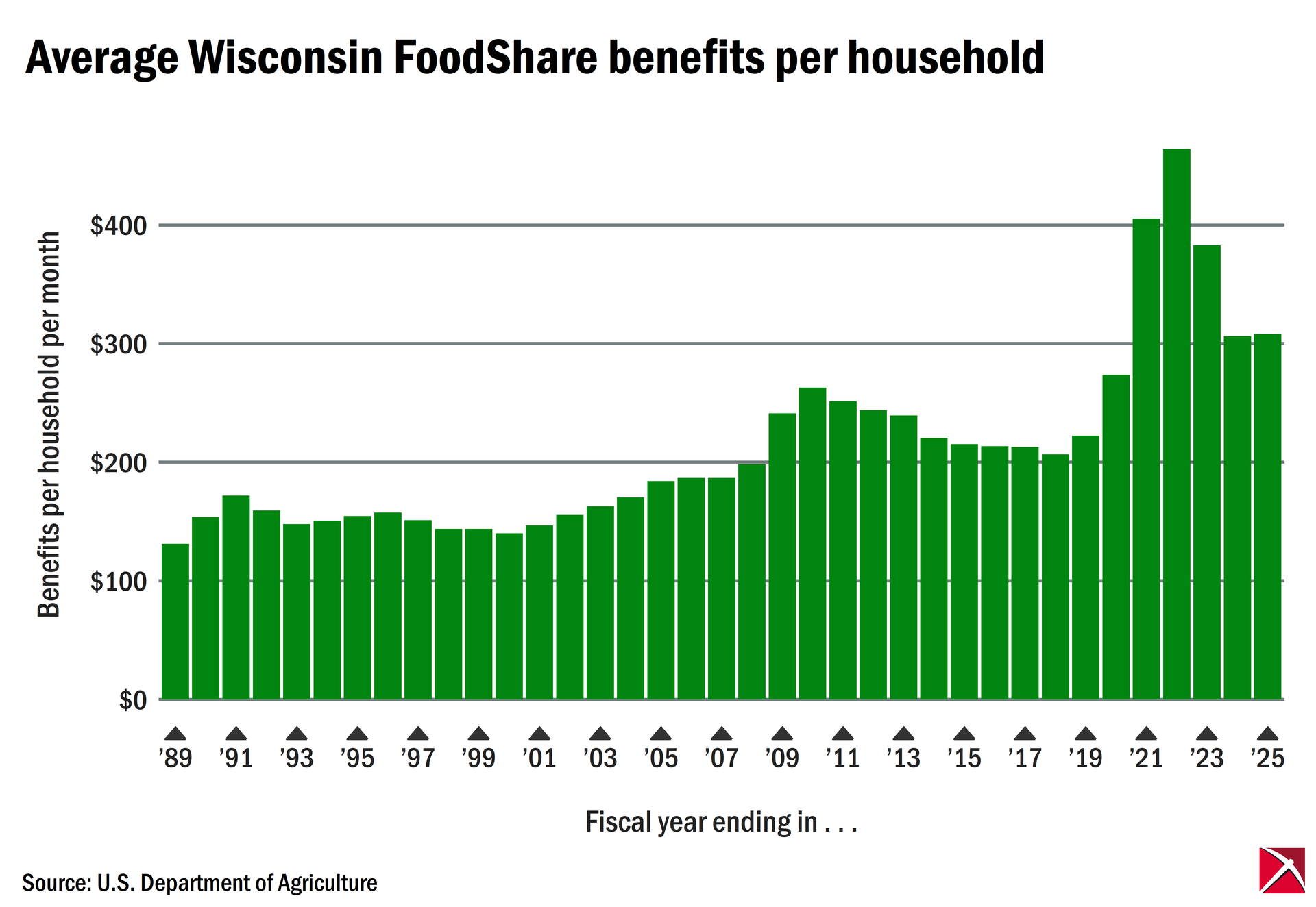
While down from pandemic era highs set in 2022, the average FoodShare benefits per Wisconsin household remain well above the pre-pandemic high water mark, according to data from the U.S. Department of Agriculture. The average monthly benefits per household reached a peak of $263 in 2019, more than double the 1989 level. The post-pandemic peak was $464 in 2022.
|
The Wisconsin Senate heard Senate Bill 732 this week, a measure aimed at reducing unnecessary barriers for aspiring accountants and lowering the high costs associated with CPA licensure. In testimony supporting the bill, Badger Institute President Mike Nichols highlighted a steep decline in accounting graduates within the University of Wisconsin System, from 828 students in the 2014-15 school year to 621 in 2024-25, a 25 percent drop. He noted that Wisconsin’s requirement of 150 credit hours for CPA licensure, effectively an extra year of schooling beyond a standard bachelor’s degree, can cost students roughly $100,000 in additional tuition and lost earnings and has discouraged many from entering the profession.
SB732 would reduce the requirements to a bachelor’s degree and two years of work experience, aligning Wisconsin with many neighboring states that have already made similar changes. Nichols warned that without action, Wisconsin risks losing aspiring CPAs to states like Minnesota, where graduates can enter the workforce sooner and earn competitive salaries. Passing SB 732, he argued, is essential to keeping high earning, in demand accounting talent in Wisconsin and maintaining the state’s economic competitiveness.
|
|
|
Seldom if ever conceded by many critics of the planned $15 billion 672-acre data center under way in Port Washington is the fact that something was inevitably going to be built there and almost invariably would have resulted in what developers and planners sometimes call “more intensive uses.” |
| |
|
Take a guess: about what percentage of all U.S. cranberries come from Wisconsin?
|
|
|
Previous survey question: |
Invest in the Badger Institute |
|
|
|
The Badger Institute has long been at the forefront of the fight for school choice, right to work, welfare reform, tax restructuring, limited government, civil society and so much more. If you appreciate the Institute’s legacy and want to support free markets, opportunity and prosperity, please consider donating today. Your support will help the Institute continue to advocate for conservative principles now and in generations to come.
|
|
|
The Institute never has, and never will, accept government funding. We gratefully welcome your online donation or email Mike Nichols, President. The Badger Institute is a 501(c)(3) tax-exempt nonprofit organization funded solely by the generosity of foundations, companies and individuals. |
|
|
Badger Institute
700 W. Virginia St., Suite 301
Milwaukee, WI 53204 |
|
|
|