|
 |
NC Vape Shop Scandal: Terror-Linked Drug Sold Near Schools
Johnston County bust reveals illegal posesions of khat — a drug tied to Islamic terrorism
|
| |||||||||||||||


 |
Law enforcement agencies are uncovering a troubling trend in North Carolina: vape shops and tobacco retailers are increasingly serving as distribution hubs for illegal dangerous drugs. These shops are selling khat - a hard-hitting stimulant banned under the same law as heroin and meth, packs serious health dangers and jail time.
On Monday, North Carolina Alcohol Law Enforcement (ALE) officers executed warrants tied to an investigation in Johnston County, revealing illegal drug sales targeted at children. According to WRAL, six minors became seriously ill after consuming illegal THC gummies purchased at Prime Vape Shop on Highway 42.
 |
The investigation expanded to multiple locations, resulting in dozens of charges against the shop owner, Ahmed Almotaser, 42, and his business partner, Mohammed Ahmed, 45, including drug distribution offenses.
During the raids, investigators also seized cash, guns, and khat. The busts show how these storefronts have become hotbeds for wider illegal drug activity.
Last Summer, a coordinated operation by Wilkesboro Police and ALE resulted in two arrests at local vape shops and the confiscation of multiple controlled substances. Among the seized products were bags of khat, alongside other illicit drugs such as tianeptine, a Schedule II drug labeled “gas station heroin.”
The appearance of khat in vape shops signals a shift toward distributing drugs linked to international terror financing.
What Is Khat and Why Is It Dangerous?
Khat is a flowering shrub native to East Africa and the Arabian Peninsula, traditionally used by chewing its leaves for their stimulant effects.
In the US the chemical cathinone found in fresh khat leaves is classified as a Schedule I stimulant under the federal Controlled Substances Act, meaning it has no accepted medical use, a high potential for abuse, and no accepted safety for use under medical supervision.
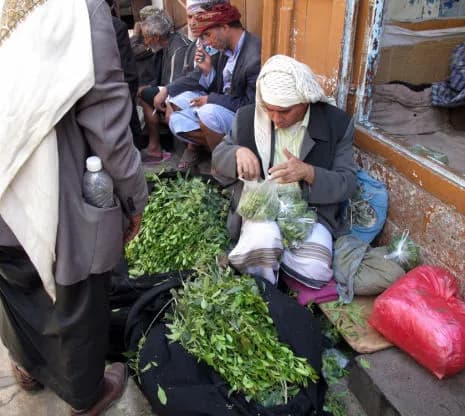 |
Use of khat has been associated with paranoia, manic behavior, hallucinations, and even suicidal depression, as well as violent behavior. In Afghanistan, Somalia, and Yemen, Islamic terrorists routinely get high on khat leaves before committing violent acts and mass murder.
Distribution Pathways and Broader Concerns
Federal and local drug intelligence reports show that khat typically enters the U.S. via air shipments and package delivery, often shipped in bundles to preserve freshness.
Once distributed, it is covertly sold in vape and tobacco stores that profit from the lack of scrutiny or community awareness.
Beyond public health risks, the illegal drug trade — including khat trafficking — has wider social implications.
The FBI recognizes that criminal proceeds from khat is sometimes funneled into organized crime and terrorist financing mechanisms, as part of broader patterns of money laundering.
A Dangerous Trend
The series of raids and arrests across North Carolina, from Johnston County to Wilkesboro, underscores a scary evolution: vape shops are serving as distribution points for substances far more dangerous than generic vaping products.
The inclusion of khat in these seizures, and the fact that operators are being charged with felonies for possession with intent to distribute it, suggests a broader pattern of criminal enterprises exploiting these shops.
What may seem like a neighborhood vape shop can hide illegal drug distribution with serious health consequences and the potential for terror financing here and abroad.
Invite your friends and earn rewards
| ||||||||||

