
Email
Data Privacy 🤝 Repro Rights
| From | Caitlin Van Orden <[email protected]> |
| Subject | Data Privacy 🤝 Repro Rights |
| Date | January 29, 2026 6:30 PM |
Links have been removed from this email. Learn more in the FAQ.
Links have been removed from this email. Learn more in the FAQ.
Hi,
Today is Data Privacy Day, a day that emphasizes taking control of our personal data. The Trump administration and allies are using technology and our personal data to surveil and criminalize pregnant people, doctors and helpers, making data privacy a reproductive rights issue.
When someone searches for abortion care, tracks a period, or texts a trusted friend, that digital information can be collected, sold, or used against them by law enforcement. Without data privacy, bodily autonomy isn’t possible.
At NIRH, we work directly with reproductive health, rights, and justice organizations and data privacy experts to address the growing threat of reproductive health data misuse. With our Repro and Data Privacy Lab, we are co-developing and advancing local legislation to protect health data and curb surveillance, while building long-term capacity to anticipate and counter emerging threats.
Alongside our partners Amplify Georgia, New America’s Open Technology Institute (OTI), Sex Worker Abortion Navigation Services (SWOP LA), and Surveillance Technology Oversight Project (S.T.O.P.) we’re fighting to protect people from surveillance, criminalization, and fear — online and offline.
Your support helps us advocate for strong privacy protections, educate communities about digital safety, and defend the right to make personal health care decisions without being tracked. This moment is urgent.
If you believe reproductive freedom includes the right to privacy, please donate today!
DONATE TODAY: [link removed]
Every dollar helps us advance proactive policy at the state and local level that will protect bodily autonomy in the digital age.
Thank you for standing with us,
Caitlin Van Orden
VP of Development
PARTNERSHIP SPOTLIGHT
Organizations and individuals who handle sensitive information or work with vulnerable communities should establish clear digital security and privacy practices — both internally and externally. These practices should be tailored to the sensitivity of the data involved, the level of risk or threat faced, available resources, and how they interact with others online.
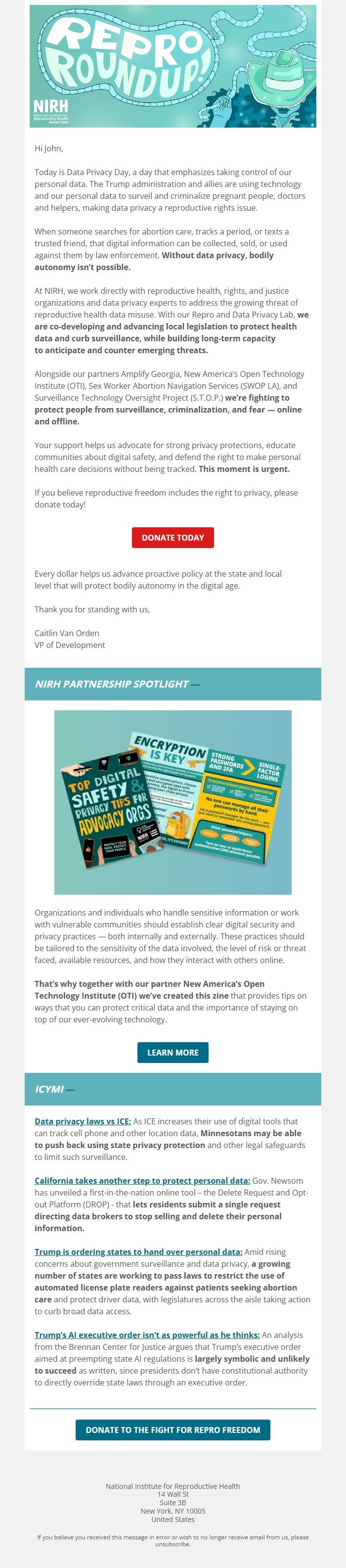
That’s why together with our partner New America’s Open Technology Institute (OTI) we’ve created this zine that provides tips on ways that you can protect critical data and the importance of staying on top of our ever-evolving technology.
CHECK IT OUT HERE: [link removed]
ICYMI
Data privacy laws vs ICE: As ICE increases their use of digital tools that can track cell phone and other location data, Minnesotans may be able to push back using state privacy protection and other legal safeguards to limit such surveillance.
California takes another step to protect personal data: Gov. Newsom has unveiled a first-in-the-nation online tool – the Delete Request and Opt-out Platform (DROP) - that lets residents submit a single request directing data brokers to stop selling and delete their personal information.
Trump is ordering states to hand over personal data: Amid rising concerns about government surveillance and data privacy, a growing number of states are working to pass laws to restrict the use of automated license plate readers against patients seeking abortion care and protect driver data, with legislatures across the aisle taking action to curb broad data access.
Trump’s AI executive order isn’t as powerful as he thinks: An analysis from the Brennan Center for Justice argues that Trump’s executive order aimed at preempting state AI regulations is largely symbolic and unlikely to succeed as written, since presidents don’t have constitutional authority to directly override state laws through an executive order.
PARTNERSHIP SPOTLIGHT
Did you know that January is Data Privacy Awareness Month? As technology — especially AI — continues to expand, raising awareness and passing legislation to protect consumer health data has never been more critical. That’s why we’ve partnered with the Surveillance Technology Oversight Project (S.T.O.P.) to advance a comprehensive approach to digital privacy in New York State and New York City.
This year, we’re working together to pass legislation that prohibits surveillance of abortion seekers and to educate the public about the disproportionate surveillance threats facing marginalized communities.
LEARN MORE: [link removed]
STAY CONNECTED
Our goal with this newsletter is to keep you informed — without overwhelming your inbox. But the work doesn’t stop here. Follow us on social media to stay up to date on reproductive rights and justice as it happens.
Instagram: [link removed]
BlueSky: [link removed]
Facebook: [link removed]
National Institute for Reproductive Health
14 Wall St
Suite 3B
New York, NY 10005
United States
If you believe you received this message in error or wish to no longer receive email from us, please unsubscribe: [link removed] .
Today is Data Privacy Day, a day that emphasizes taking control of our personal data. The Trump administration and allies are using technology and our personal data to surveil and criminalize pregnant people, doctors and helpers, making data privacy a reproductive rights issue.
When someone searches for abortion care, tracks a period, or texts a trusted friend, that digital information can be collected, sold, or used against them by law enforcement. Without data privacy, bodily autonomy isn’t possible.
At NIRH, we work directly with reproductive health, rights, and justice organizations and data privacy experts to address the growing threat of reproductive health data misuse. With our Repro and Data Privacy Lab, we are co-developing and advancing local legislation to protect health data and curb surveillance, while building long-term capacity to anticipate and counter emerging threats.
Alongside our partners Amplify Georgia, New America’s Open Technology Institute (OTI), Sex Worker Abortion Navigation Services (SWOP LA), and Surveillance Technology Oversight Project (S.T.O.P.) we’re fighting to protect people from surveillance, criminalization, and fear — online and offline.
Your support helps us advocate for strong privacy protections, educate communities about digital safety, and defend the right to make personal health care decisions without being tracked. This moment is urgent.
If you believe reproductive freedom includes the right to privacy, please donate today!
DONATE TODAY: [link removed]
Every dollar helps us advance proactive policy at the state and local level that will protect bodily autonomy in the digital age.
Thank you for standing with us,
Caitlin Van Orden
VP of Development
PARTNERSHIP SPOTLIGHT
Organizations and individuals who handle sensitive information or work with vulnerable communities should establish clear digital security and privacy practices — both internally and externally. These practices should be tailored to the sensitivity of the data involved, the level of risk or threat faced, available resources, and how they interact with others online.
That’s why together with our partner New America’s Open Technology Institute (OTI) we’ve created this zine that provides tips on ways that you can protect critical data and the importance of staying on top of our ever-evolving technology.
CHECK IT OUT HERE: [link removed]
ICYMI
Data privacy laws vs ICE: As ICE increases their use of digital tools that can track cell phone and other location data, Minnesotans may be able to push back using state privacy protection and other legal safeguards to limit such surveillance.
California takes another step to protect personal data: Gov. Newsom has unveiled a first-in-the-nation online tool – the Delete Request and Opt-out Platform (DROP) - that lets residents submit a single request directing data brokers to stop selling and delete their personal information.
Trump is ordering states to hand over personal data: Amid rising concerns about government surveillance and data privacy, a growing number of states are working to pass laws to restrict the use of automated license plate readers against patients seeking abortion care and protect driver data, with legislatures across the aisle taking action to curb broad data access.
Trump’s AI executive order isn’t as powerful as he thinks: An analysis from the Brennan Center for Justice argues that Trump’s executive order aimed at preempting state AI regulations is largely symbolic and unlikely to succeed as written, since presidents don’t have constitutional authority to directly override state laws through an executive order.
PARTNERSHIP SPOTLIGHT
Did you know that January is Data Privacy Awareness Month? As technology — especially AI — continues to expand, raising awareness and passing legislation to protect consumer health data has never been more critical. That’s why we’ve partnered with the Surveillance Technology Oversight Project (S.T.O.P.) to advance a comprehensive approach to digital privacy in New York State and New York City.
This year, we’re working together to pass legislation that prohibits surveillance of abortion seekers and to educate the public about the disproportionate surveillance threats facing marginalized communities.
LEARN MORE: [link removed]
STAY CONNECTED
Our goal with this newsletter is to keep you informed — without overwhelming your inbox. But the work doesn’t stop here. Follow us on social media to stay up to date on reproductive rights and justice as it happens.
Instagram: [link removed]
BlueSky: [link removed]
Facebook: [link removed]
National Institute for Reproductive Health
14 Wall St
Suite 3B
New York, NY 10005
United States
If you believe you received this message in error or wish to no longer receive email from us, please unsubscribe: [link removed] .
Message Analysis
- Sender: n/a
- Political Party: n/a
- Country: n/a
- State/Locality: n/a
- Office: n/a
-
Email Providers:
- EveryAction