
Email
NEWS RELEASE: DNR Asks Public To Report Black Bear Den Locations As Winter Den Surveys Begin
| From | Wisconsin Department of Natural Resources <[email protected]> |
| Subject | NEWS RELEASE: DNR Asks Public To Report Black Bear Den Locations As Winter Den Surveys Begin |
| Date | January 29, 2026 3:04 PM |
Links have been removed from this email. Learn more in the FAQ.
Links have been removed from this email. Learn more in the FAQ.
DNR News Release Header Image [ [link removed] ]
*FOR IMMEDIATE RELEASE: *Jan. 29, 2026
*Contact: *Erin Morrison, DNR Research Scientist
[email protected] or 715-499-3545
DNR Asks Public To Report Black Bear Den Locations As Winter Den Surveys Begin
"Reporting Dens Helps With Ongoing Research Project"
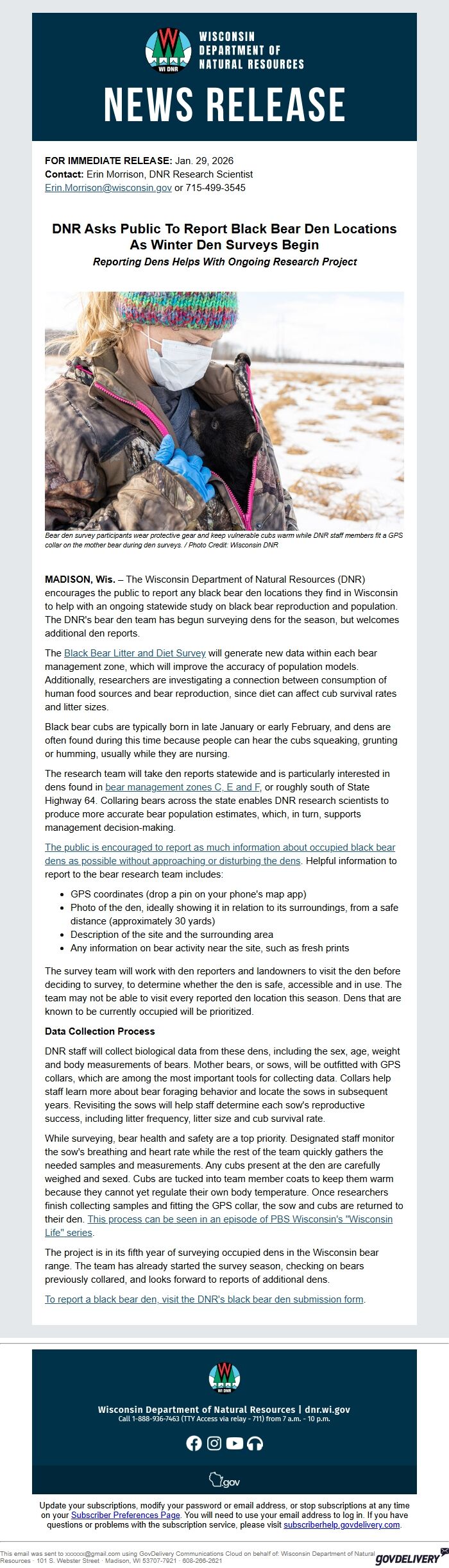
Person wearing surgical mask, blue gloves and winter clothing holds a black bear cub in a snow-covered clearing.
Bear den survey participants wear protective gear and keep vulnerable cubs warm while DNR staff members fit a GPS collar on the mother bear during den surveys. / Photo Credit: Wisconsin DNR
*
MADISON, Wis.* – The Wisconsin Department of Natural Resources (DNR) encourages the public to report any black bear den locations they find in Wisconsin to help with an ongoing statewide study on black bear reproduction and population. The DNR's bear den team has begun surveying dens for the season, but welcomes additional den reports.
The Black Bear Litter and Diet Survey [ [link removed] ] will generate new data within each bear management zone, which will improve the accuracy of population models. Additionally, researchers are investigating a connection between consumption of human food sources and bear reproduction, since diet can affect cub survival rates and litter sizes.
Black bear cubs are typically born in late January or early February, and dens are often found during this time because people can hear the cubs squeaking, grunting or humming, usually while they are nursing.
The research team will take den reports statewide and is particularly interested in dens found in bear management zones C, E and F [ [link removed] ], or roughly south of State Highway 64. Collaring bears across the state enables DNR research scientists to produce more accurate bear population estimates, which, in turn, supports management decision-making.
The public is encouraged to report as much information about occupied black bear dens as possible without approaching or disturbing the dens [ [link removed] ]. Helpful information to report to the bear research team includes:
* GPS coordinates (drop a pin on your phone's map app)
* Photo of the den, ideally showing it in relation to its surroundings, from a safe distance (approximately 30 yards)
* Description of the site and the surrounding area
* Any information on bear activity near the site, such as fresh prints
The survey team will work with den reporters and landowners to visit the den before deciding to survey, to determine whether the den is safe, accessible and in use. The team may not be able to visit every reported den location this season. Dens that are known to be currently occupied will be prioritized.
*Data Collection Process*
DNR staff will collect biological data from these dens, including the sex, age, weight and body measurements of bears. Mother bears, or sows, will be outfitted with GPS collars, which are among the most important tools for collecting data. Collars help staff learn more about bear foraging behavior and locate the sows in subsequent years. Revisiting the sows will help staff determine each sow's reproductive success, including litter frequency, litter size and cub survival rate.
While surveying, bear health and safety are a top priority. Designated staff monitor the sow's breathing and heart rate while the rest of the team quickly gathers the needed samples and measurements. Any cubs present at the den are carefully weighed and sexed. Cubs are tucked into team member coats to keep them warm because they cannot yet regulate their own body temperature. Once researchers finish collecting samples and fitting the GPS collar, the sow and cubs are returned to their den. This process can be seen in an episode of PBS Wisconsin's "Wisconsin Life" series [ [link removed] ].
The project is in its fifth year of surveying occupied dens in the Wisconsin bear range. The team has already started the survey season, checking on bears previously collared, and looks forward to reports of additional dens.
To report a black bear den, visit the DNR's black bear den submission form [ [link removed] ].
________________________________________________________________________
[ [link removed] ]
[ [link removed] ]
[ [link removed] ] [ [link removed] ] [ [link removed] ] [ [link removed] ]
[ [link removed] ] Update your subscriptions, modify your password or email address, or stop subscriptions at any time on your Subscriber Preferences Page [ [link removed] ]. You will need to use your email address to log in. If you have questions or problems with the subscription service, please visit subscriberhelp.govdelivery.com [ [link removed] ].
________________________________________________________________________
This email was sent to [email protected] using GovDelivery Communications Cloud on behalf of: Wisconsin Department of Natural Resources · 101 S. Webster Street · Madison, WI 53707-7921 · 608-266-2621 GovDelivery logo [ [link removed] ]
body .abe-column-block { min-height: 5px; } table.gd_combo_table img {margin-left:10px; margin-right:10px;} table.gd_combo_table div.govd_image_display img, table.gd_combo_table td.gd_combo_image_cell img {margin-left:0px; margin-right:0px;} table.govd_hr {min-width: 100%;} p, li, h1, h2, h3 { overflow-wrap: normal; word-wrap: normal; word-break: keep-all; -moz-hyphens: none; -ms-hyphens: none; -webkit-hyphens: none; hyphens: none; mso-hyphenate: none; }
*FOR IMMEDIATE RELEASE: *Jan. 29, 2026
*Contact: *Erin Morrison, DNR Research Scientist
[email protected] or 715-499-3545
DNR Asks Public To Report Black Bear Den Locations As Winter Den Surveys Begin
"Reporting Dens Helps With Ongoing Research Project"
Person wearing surgical mask, blue gloves and winter clothing holds a black bear cub in a snow-covered clearing.
Bear den survey participants wear protective gear and keep vulnerable cubs warm while DNR staff members fit a GPS collar on the mother bear during den surveys. / Photo Credit: Wisconsin DNR
*
MADISON, Wis.* – The Wisconsin Department of Natural Resources (DNR) encourages the public to report any black bear den locations they find in Wisconsin to help with an ongoing statewide study on black bear reproduction and population. The DNR's bear den team has begun surveying dens for the season, but welcomes additional den reports.
The Black Bear Litter and Diet Survey [ [link removed] ] will generate new data within each bear management zone, which will improve the accuracy of population models. Additionally, researchers are investigating a connection between consumption of human food sources and bear reproduction, since diet can affect cub survival rates and litter sizes.
Black bear cubs are typically born in late January or early February, and dens are often found during this time because people can hear the cubs squeaking, grunting or humming, usually while they are nursing.
The research team will take den reports statewide and is particularly interested in dens found in bear management zones C, E and F [ [link removed] ], or roughly south of State Highway 64. Collaring bears across the state enables DNR research scientists to produce more accurate bear population estimates, which, in turn, supports management decision-making.
The public is encouraged to report as much information about occupied black bear dens as possible without approaching or disturbing the dens [ [link removed] ]. Helpful information to report to the bear research team includes:
* GPS coordinates (drop a pin on your phone's map app)
* Photo of the den, ideally showing it in relation to its surroundings, from a safe distance (approximately 30 yards)
* Description of the site and the surrounding area
* Any information on bear activity near the site, such as fresh prints
The survey team will work with den reporters and landowners to visit the den before deciding to survey, to determine whether the den is safe, accessible and in use. The team may not be able to visit every reported den location this season. Dens that are known to be currently occupied will be prioritized.
*Data Collection Process*
DNR staff will collect biological data from these dens, including the sex, age, weight and body measurements of bears. Mother bears, or sows, will be outfitted with GPS collars, which are among the most important tools for collecting data. Collars help staff learn more about bear foraging behavior and locate the sows in subsequent years. Revisiting the sows will help staff determine each sow's reproductive success, including litter frequency, litter size and cub survival rate.
While surveying, bear health and safety are a top priority. Designated staff monitor the sow's breathing and heart rate while the rest of the team quickly gathers the needed samples and measurements. Any cubs present at the den are carefully weighed and sexed. Cubs are tucked into team member coats to keep them warm because they cannot yet regulate their own body temperature. Once researchers finish collecting samples and fitting the GPS collar, the sow and cubs are returned to their den. This process can be seen in an episode of PBS Wisconsin's "Wisconsin Life" series [ [link removed] ].
The project is in its fifth year of surveying occupied dens in the Wisconsin bear range. The team has already started the survey season, checking on bears previously collared, and looks forward to reports of additional dens.
To report a black bear den, visit the DNR's black bear den submission form [ [link removed] ].
________________________________________________________________________
[ [link removed] ]
[ [link removed] ]
[ [link removed] ] [ [link removed] ] [ [link removed] ] [ [link removed] ]
[ [link removed] ] Update your subscriptions, modify your password or email address, or stop subscriptions at any time on your Subscriber Preferences Page [ [link removed] ]. You will need to use your email address to log in. If you have questions or problems with the subscription service, please visit subscriberhelp.govdelivery.com [ [link removed] ].
________________________________________________________________________
This email was sent to [email protected] using GovDelivery Communications Cloud on behalf of: Wisconsin Department of Natural Resources · 101 S. Webster Street · Madison, WI 53707-7921 · 608-266-2621 GovDelivery logo [ [link removed] ]
body .abe-column-block { min-height: 5px; } table.gd_combo_table img {margin-left:10px; margin-right:10px;} table.gd_combo_table div.govd_image_display img, table.gd_combo_table td.gd_combo_image_cell img {margin-left:0px; margin-right:0px;} table.govd_hr {min-width: 100%;} p, li, h1, h2, h3 { overflow-wrap: normal; word-wrap: normal; word-break: keep-all; -moz-hyphens: none; -ms-hyphens: none; -webkit-hyphens: none; hyphens: none; mso-hyphenate: none; }
Message Analysis
- Sender: Wisconsin Department of Natural Resources
- Political Party: n/a
- Country: United States
- State/Locality: Wisconsin
- Office: n/a
-
Email Providers:
- govDelivery