|
 |
Unaffiliateds Are Up. Democrats Are Down. Republicans Can Still Blow It In NC
What new polling reveals about dealignment, distrust, and the battle for North Carolina’s largest voting bloc
|
| |||||||||||||||


 |
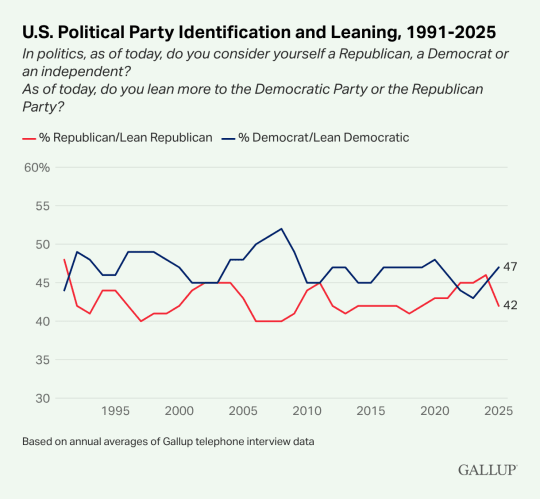
A new wave of national polling is out, and the direction is clear. Gallup reports that 45 percent of Americans now identify as independents, the highest level ever recorded, while Democrats and Republicans are tied at roughly 27 percent each.
At the same time, presidential approval ratings remain underwater, particularly on the economy. A recent New York Times / Sienna survey shows fewer than four in ten voters approve of President Trump’s handling of economic issues, even as nearly nine in ten express concern about high prices and the cost of living.
For perspective, Trump is now polling below where Obama stood heading into the disastrous 2010 midterms that fueled the Tea Party backlash. That election wiped out Democrats at every level, costing them 680 state legislative seats, 63 House seats, control of the chamber, and six Senate seats.
North Carolina reflects this national mood, but with sharper consequences.
Party loyalty is weakening here as well, yet voting behavior tells a more disciplined story. Unaffiliated voters, now the state’s largest registration bloc, have leaned Republican in recent elections, even as many hold mixed or moderate views on individual issues.
That gap between identity and behavior is now the defining feature of North Carolina politics. This is key to understanding what lies ahead in 2026.
Alike — and different: the U.S. versus North Carolina
At first blush, the national and North Carolina trends look similar. Voters are walking away from party labels. Registration rolls and self-identification surveys show fewer people willing to call themselves Democrats or Republicans, and more opting for independence instead. The erosion of party loyalty is real, broad-based, and accelerating.
But the similarities end when elections begin.
Nationally, independents tend to lean left when pressed on vote choice.
In North Carolina, unaffiliated voters have leaned right, particularly in midterm elections. Republicans have consistently won this bloc statewide, while Democrats have struggled to convert issue agreement into votes.
To understand why, you have to distinguish between how people register and what they actually believe. This is something national commentary often overlooks.
 |
Exit the label, not the ideology
The dominant pattern in today’s electorate is not ideological conversion. It is dealignment. Voters are exiting party labels faster than they are changing their underlying beliefs.
For Democrats, this erosion has been especially pronounced. Two forces help explain why.
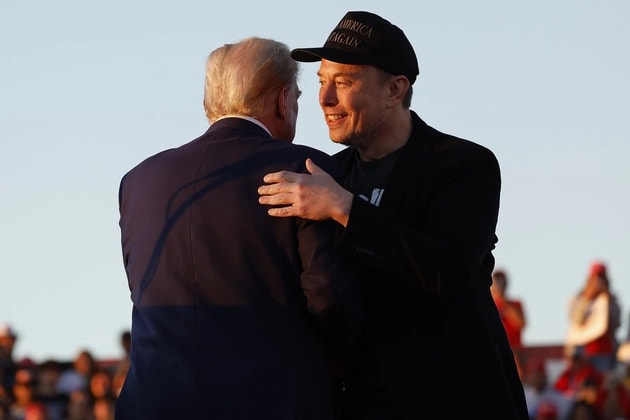
First, Donald Trump and the Republican-aligned political ecosystem succeeded in systematically degrading the Democratic brand.
Over multiple cycles, Democrats were framed as elite, performative, and disconnected from biological realities (woke). That message did not need to persuade voters to Republican positions to be effective; it merely needed to make the Democratic label feel untrustworthy or outdated.
 |
Second, Democrats have failed to build a compelling national brand after the loss of unifying leadership figures.
There is no Clinton-style triangulator or Obama-style “community organizer” capable of restoring confidence in the party’s identity. After Kamala Harris’s defeat, the party has lacked a figure who can reconnect policy priorities to cultural credibility.
What remains is a collection of positions that poll well, attached to a label that does not.
The result is a growing pool of voters, especially younger and middle-aged, who may support Democratic policies, but no longer want to call themselves Democrats.
Why unaffiliated voters lean right in North Carolina
If independents are rising everywhere, why do unaffiliated voters behave differently in North Carolina?
The answer lies in who is entering the unaffiliated pool.
A significant portion of unaffiliated growth in North Carolina comes from right-leaning voters who have left party registration without abandoning Republican voting habits. These voters may dislike national GOP complacency, political institutions, or party labels altogether, but they remain culturally conservative and vote accordingly.
There is also a regional component. In North Carolina, “unaffiliated” often signals anti-elite and anti-institutional sentiment, not ideological moderation. That posture maps more comfortably onto conservative cultural instincts than progressive branding, even when voters hold mixed views on specific policies.
Finally, Democrats have simply underperformed with unaffiliated voters for years. Republicans routinely win them by default. Democrats break through only under specific conditions: strong incumbency, unusually high turnout, or a Republican position viewed as clearly out of bounds.
Absent those factors, unaffiliated voters lean right, and they turn out inconsistently.
What this means for Republicans heading into 2026
For Republicans, the current environment presents both opportunity and risk.
They now hold a narrow registration edge in North Carolina, a milestone that reflects long-term Democratic brand erosion rather than a surge of GOP enthusiasm. That advantage is real, but fragile. It depends heavily on continued success with unaffiliated voters who are supportive but not loyal.
Republicans also benefit from asymmetry. While both parties face critique, Democrats are paying the higher price. Still, this is not immunity.
Economic dissatisfaction remains the central vulnerability. Voters concerned about inflation, healthcare costs, and household finances will not tolerate extended dysfunction, regardless of party.
Trump remains a mobilizing force for the base and a polarizing figure for unaffiliated voters. His presence can define the race, but it can also narrow the coalition. In a state as competitive as North Carolina, turnout execution and local credibility matter more than national mood.
What this means for Democrats
For Democrats, the implications are starker.
First, issue popularity is not translating into electoral strength. Winning policy arguments does not compensate for a weakened brand. Voters may agree with Democratic positions while declining to vote for Democratic candidates.
Second, unaffiliated voters cannot be treated as latent Democrats waiting to return. Many are culturally skeptical of Democratic messaging, even when aligned on substance.
Third, Trump’s unpopularity does not guarantee Democratic gains in a state where party brands are weak. In North Carolina, nationalizing races around him risks reinforcing voter skepticism instead of triggering the backlash Democrats expect.
What candidates must do to win today’s North Carolina voters
Winning in North Carolina now requires candidates to accept a simple reality: voters are not looking for ideological affirmation so much as functional competence.
Cost of living, healthcare affordability, taxes, and basic government performance dominate concern. Candidates who lead with abstractions or national talking points risk sounding disconnected from daily pressures. Those who anchor campaigns in tangible outcomes i.e how decisions affect bills, services, and accountability, will earn voter attention and trust.
Tone matters as much as content.
North Carolina’s unaffiliated voters are highly sensitive to performative politics and moral certainty. They respond better to candidates who sound local, restrained, and pragmatic. In state-wide races, they are practically allergic to cultural bomb-throwers.
For Republicans, it’s not about abandoning principles; it is about communicating them in a language of responsibility and results.
Finally, skepticism is now the electorate’s default posture.
Trust is not assumed. It must be earned incrementally through seriousness, transparency, and a willingness to challenge institutional failure, including within one’s own party.
In a state where unaffiliated voters form the largest bloc and often decide elections, successful candidates will be those who treat these voters not as a secondary audience, but as the center of gravity.
The bottom line
North Carolina is not drifting left or right so much as drifting away from party identity altogether. But elections are still decided by behavior, not labels. Right now, unaffiliated voters behave more conservatively than national narratives suggest.
The party and the candidates who understand that distinction will win in 2026.
You're currently a free subscriber to NC Political Tea. For the full experience, upgrade your subscription.
| ||||||||||

