|
What polarization actually looks like
I've been comparing Fox News, New York Times, and Wall Street Journal headlines every morning. It's jarring.
|

| |||||||||||||||


While researching this article, I started collecting screenshots of every morning’s top stories from Fox News, The New York Times, The Wall Street Journal, and The Washington Post.
I’ve been putting that online with What They’re Reporting, an Instagram page that compares how they’re covering the news. It’s fascinating to look at this stuff side-by-side—follow the account if you’re interested.
The last two weeks of news have been defined by two stories: Trump’s proposed acquisition of Greenland and the protests against ICE in Minneapolis, specifically how ICE agents have now killed two civilians.¹
I often get asked some version of this question: “Republicans can see what’s going on with Greenland/ICE/whatever insane and chaotic thing is happening right now. Why aren’t they turning on Trump?”
The answer: Republicans aren’t seeing what’s going on.
Intellectually, everyone understands that there’s a divide between how Republican outlets versus mainstream ones cover the news. But when you look side-by-side, you get a sense for just how wide that divide really is.

Article summary:
The headlines you see every morning vary wildly depending on where you’re getting your news. The screenshots below are vivid examples of that.
Fox News hardly covered Trump’s threats against Greenland; their coverage of the protests and killings in Minnesota has, to date, blamed chaos on the “far left.”
It’s hard to spin local news—you’ll know if the potholes aren’t getting fixed. But it’s much easier to spin national news, because it’s not something we immediately see.
Republicans and Democrats have different top stories
Everyone knows this: Democrats and Republicans consume and trust different media sources.
Over the last two weeks, I’ve been capturing what that concretely means. Here are screenshots of the top stories from The New York Times, The Wall Street Journal, and Fox News² taken around 8:30 a.m. on Monday, January 19.³
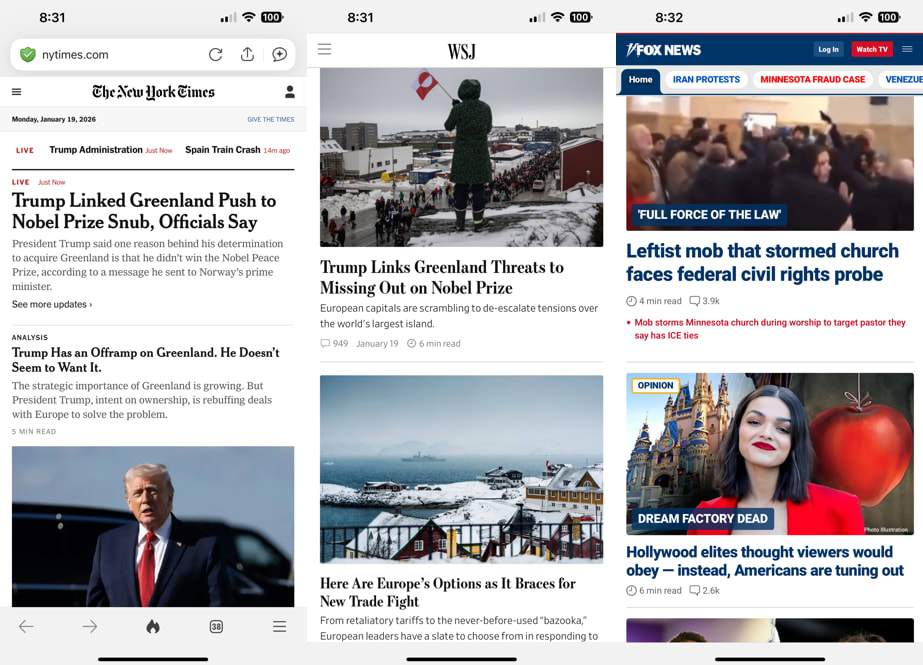 |
If you’re reading the NYT or the WSJ, the top story was about a president threatening to invade an ally over a petty personal slight.
Fox News wasn’t covering it at all. Their top story was about a “leftist mob,” and I don’t recall any Greenland news even being on their homepage that morning.
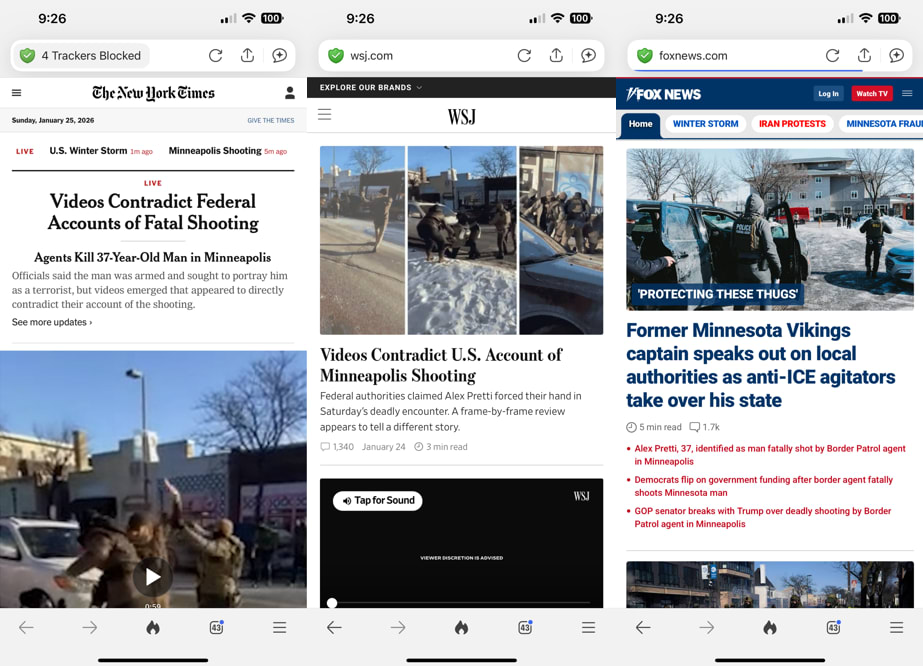
Now let’s take a look at how these three media outlets have been covering the ICE protests in Minneapolis and the killings of Alex Pretti and Renée Good. Below is their coverage around 9:30 a.m. on Sunday, January 25.
 |
And here were the top stories on the NYT, the WSJ, and Fox News taken around 6:50 a.m. on Monday, January 26.
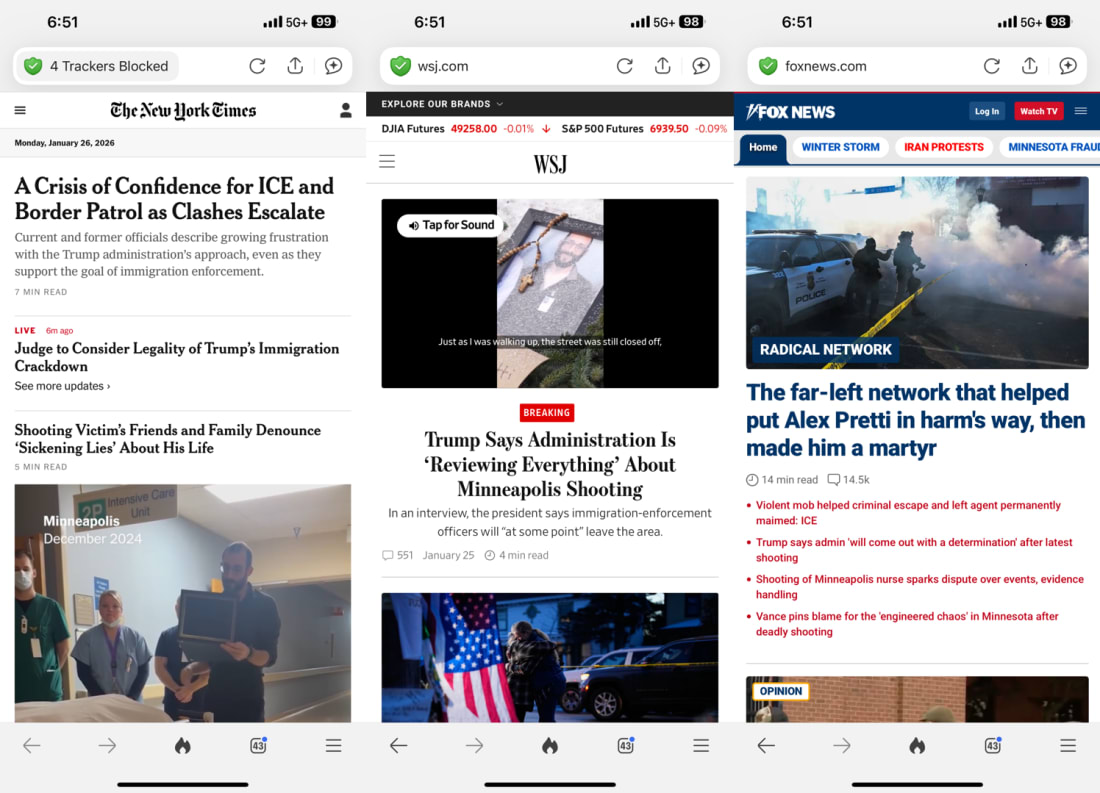 |
Unlike the story with Greenland, where Fox News coverage was largely absent, they are covering what’s happening in Minneapolis. But they’re taking a completely different angle. Where the NYT and the WSJ are covering the killing of a U.S. citizen, Fox News is focused entirely on “anti-ICE agitators” and “the far-left network that helped put Alex Pretti in harm’s way.”⁴
I’m not a newspaper editor. But from where I sit, Fox News is willfully missing the big picture. A U.S. President threatening to invade an ally is a much bigger story than protests at a church; the primary story in Minneapolis is the killing of a U.S. citizen, not what a former Vikings captain has to say on the topic.
This problem is even more acute on social media, by the way. But there’s no good way to capture that in three screenshots—the problem there is much more immense and much more diffuse.
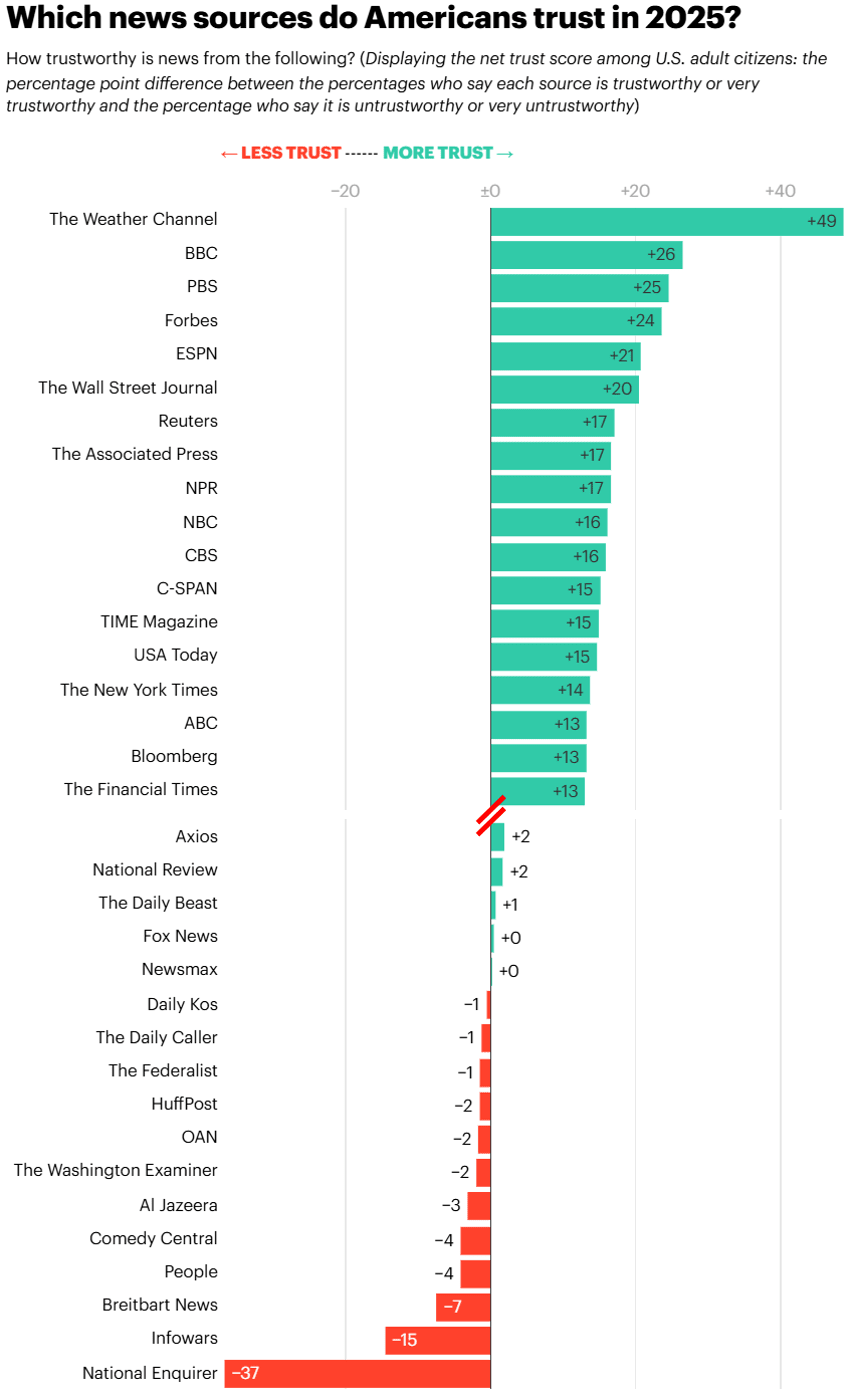
Americans trust the news that they’re consuming—and don’t trust news coming from the other side
It’s worth taking a closer look at precisely what this means.
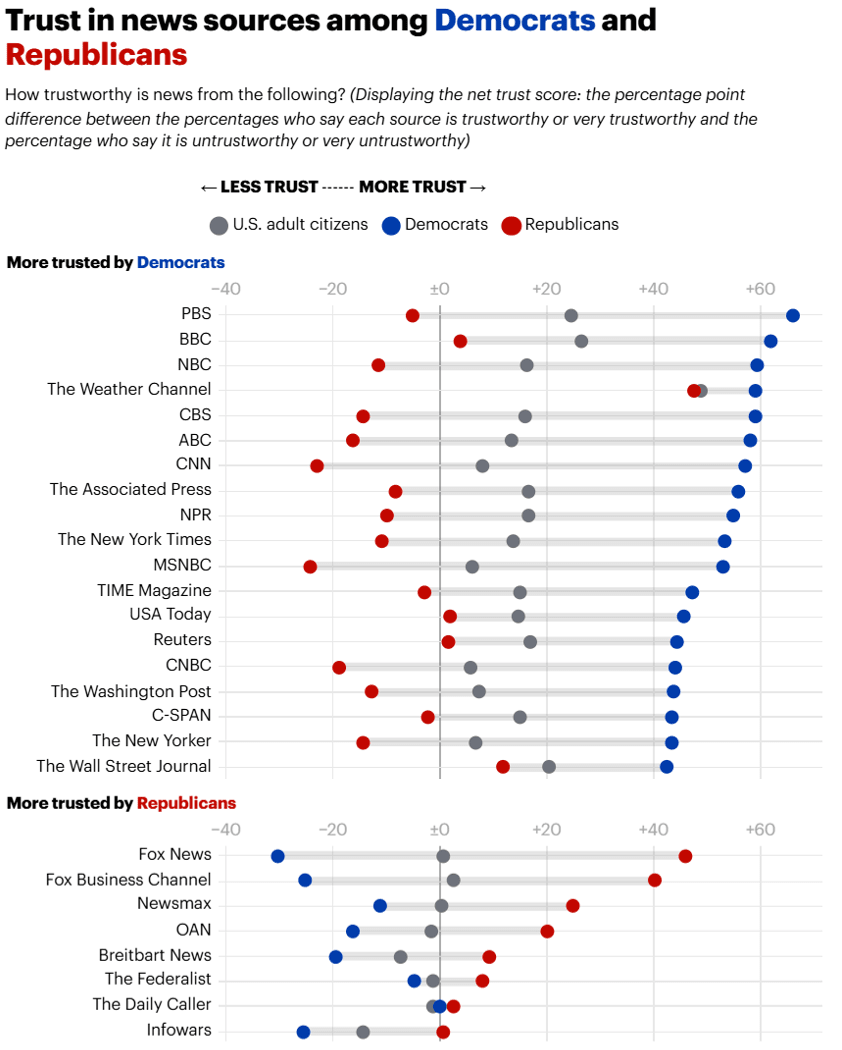
Democrats are inclined to trust traditional news sources like newspapers and broadcast news. Republicans have very little trust in any of those institutions,⁵ and instead trust outlets like Fox News and Newsmax.⁶
 |
We can quibble about the biases in the NYT or CNN newsrooms, which definitely exist, but they all aspire to, and work towards, nonpartisanship. Compare that to Fox News, which explicitly calls itself an “alternative to the left-of-center offerings of the news marketplace.” Or to Breitbart: “original reporting curated and written specifically for the new generation of independent and conservative thinkers.”⁷
So if you’re wondering why people seem so immovable in their political views, this is a huge part of the reason. You and I might be outraged by what’s happening with Greenland or what’s happening in Minneapolis, but if Fox News is your primary source of information, you may not be getting this information at all.
And even if you are exposed to the coverage from the WSJ, you’re not even inclined to believe or trust it.⁸
It’s easier to spin national news than local news
Like a lot of the country, St. Louis was covered in snow last weekend. And at least where I live in St. Louis County, they did a pretty good job plowing the snow such that I could drive without too much issue on Monday.
During last year’s big snowstorm, that wasn’t the case in the city of St. Louis. (A reminder: St. Louis City and St. Louis County are distinct from one another.) The city was so bad about dealing with that storm that then-incumbent mayor Tishaura Jones had to apologize, and it may very well have cost her the election.⁹
In 1979, something similar happened in Chicago: mayor Michael Bilandic famously did such a bad job managing a blizzard in 1979 that he lost that year’s mayoral Democratic primary.
Why am I bringing this up? Because in local politics, it’s a lot harder to hide what’s going wrong. If the snow isn’t getting plowed, if the trash isn’t getting picked up, if there are potholes on the streets, if kids aren’t getting to school on time, messaging can only do so much. People on the ground know what’s happening.
But that’s not the case with national politics. When it comes to what’s happening with Greenland, at Davos, or in Minneapolis, if it weren’t on TV, in the media, or on social media, most of us wouldn’t know what’s going on. It may impact us long-term, but it doesn’t affect our day-to-day like a pothole does.
And so media coverage—or media spin, in the case of what we’re seeing from Fox News—matters a great deal more. And it’s hard to change people’s minds if everything that they know is coming from media and social media, rather than what they’re actually seeing and experiencing themselves.
No, not all hope is lost
In spite of all of this: people do get information outside of their bubble. People watch videos online with their own eyes. They talk to friends and colleagues, some of whom don’t agree with them and force them to reckon with their own opinions.¹⁰
And it means that some people, if slowly, do change their minds. Just look at how much polling has shifted towards Democrats ahead of the ’26 midterm elections.
But this process is slow; all of us, myself included, aren’t keen to admit that we’ve been wrong about something in the past. It takes a lot to get us to change our minds.
Hopefully, the stories of the past two weeks are enough to start breaking through.
Feel free to share this post with someone who will find this interesting. If you’re reading this email because someone sent it to you, please consider subscribing.
On both fronts, what’s happening is abhorrent. I’m an ardent believer in the post-war world order, and blowing up 80 years of alliances for something so cosmically stupid—and for such a cosmically stupid reason—is unthinkable to me. And what’s happening in Minnesota is un-American at best and authoritarian at worst.
ChatGPT has the full rundown here, but The New York Times and The Wall Street Journal are italicized because they’re publications, but Fox News isn’t because it’s a TV channel. Probably an outdated rule at this point, but that is what the style guide would say.
All Central Standard Time, just to be precise in what I’m sharing.
The “far-left agitators,” according to Fox News, were group chats to help coordinate protests. At best, calling them “far-left agitators” is a stretch.
The one I can’t wrap my head around here is The Weather Channel. Yes, the vast majority of Republicans trust The Weather Channel, but still less than Democrats do. Is there so much distrust among media that there’s a sense that even The Weather Channel is feeding us fake news?
Traditional media outlets are, on the whole, more trusted than Republican-leaning outlets, in part because they’re more likely to have the trust of independents and in part because even Republicans don’t always trust Republican outlets. But the story is the chasm between Republican and Democratic trust in these news sources.
 |
I’m not talking about MSNBC/MS NOW in this article, but I think their coverage has tons of its own issues too.
It’s also worth noting: in terms of exposure, Fox News and the NYT are on similar footing. Different sources say different things (the story of this whole article!): Fox News says it draws more views than The New York Times, whereas Similarweb says that nytimes.com is slightly higher than FoxNews.com. In any event, they’re in the same league.
Then again: Tishaura Jones lost so badly to Cara Spencer that it couldn’t have just been about the snow.
Don’t pretend that posting on social media is having any impact, by the way. Not only does it do nothing to change anyone’s mind, it’s actually counterproductive—Republicans and Democrats both dig in when presented with talking points from the other side.
| ||||||||||

