
| From | Wayne Hsiung from The Simple Heart <[email protected]> |
| Subject | The New Yorker on the Moral Revolution Led by Animal Rights |
| Date | January 27, 2026 9:14 PM |
Links have been removed from this email. Learn more in the FAQ.
Links have been removed from this email. Learn more in the FAQ.
View this post on the web at [link removed]
I had the chance recently to sit down with Jay Kang at The New Yorker, which led to this piece [ [link removed] ] published by the magazine today. We talked about the failings of progressive movements over the last 10 years (infighting, sustained community, “moral worthiness”)—and the potential of religion to correct those problems. But the most important part of the piece discusses the potential for animal rights to be at the center of a “resurgent moral community.” Here’s an excerpt:
O.K., but how does animal rights, in particular, fit into the vision of the resurgent moral community?
The most powerful part of every religious tradition I’ve studied is its defense of the vulnerable. That’s why people become committed to religious communities—they understand that when they are vulnerable they will be protected, and when they are strong they will protect the vulnerable. That’s the trade.
I’ve made a bet with my life and my resources, and in some cases a bit of my freedom, that one of the most powerful iterations of that core human narrative is our treatment of animals.
When so much of what’s wrong in the world is the narrowing and shrinking of our moral circles, a movement that effectively challenges that has to do the opposite. It can’t just say, “Let’s not throw immigrants out of the country.” We have to have an affirmative vision: “We love immigrants. Immigrants are amazing because we’re all human beings, and God commanded us to love even the Samaritans, to see the beauty even in the Canaanites and the tax collectors and the lepers.”
I think the most powerful and most obvious next iteration for this expansion of our moral boundaries is other sentient beings. We’ve seen rights gradually expand for all different classes of humans throughout the past two hundred years, since the Enlightenment, and animals are, as Martha Nussbaum [ [link removed] ] has written, the next frontier.
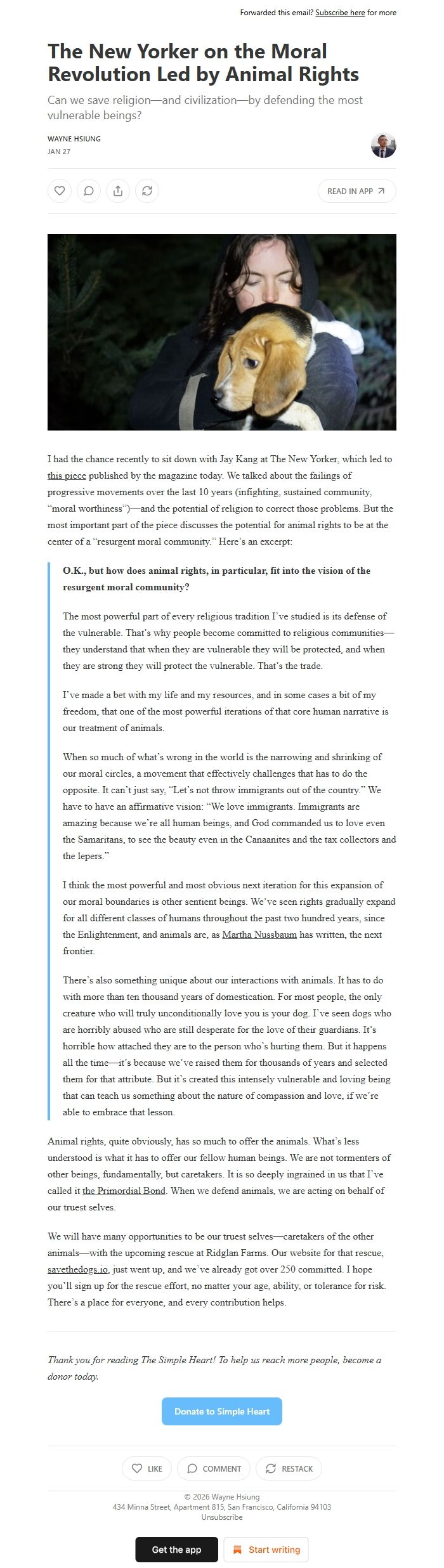
There’s also something unique about our interactions with animals. It has to do with more than ten thousand years of domestication. For most people, the only creature who will truly unconditionally love you is your dog. I’ve seen dogs who are horribly abused who are still desperate for the love of their guardians. It’s horrible how attached they are to the person who’s hurting them. But it happens all the time—it’s because we’ve raised them for thousands of years and selected them for that attribute. But it’s created this intensely vulnerable and loving being that can teach us something about the nature of compassion and love, if we’re able to embrace that lesson.
Animal rights, quite obviously, has so much to offer the animals. What’s less understood is what it has to offer our fellow human beings. We are not tormenters of other beings, fundamentally, but caretakers. It is so deeply ingrained in us that I’ve called it the Primordial Bond [ [link removed] ]. When we defend animals, we are acting on behalf of our truest selves.
We will have many opportunities to be our truest selves—caretakers of the other animals—with the upcoming rescue at Ridglan Farms. Our website for that rescue, savethedogs.io [ [link removed] ], just went up, and we’ve already got over 250 committed. I hope you’ll sign up for the rescue effort, no matter your age, ability, or tolerance for risk. There’s a place for everyone, and every contribution helps.
Unsubscribe [link removed]?
I had the chance recently to sit down with Jay Kang at The New Yorker, which led to this piece [ [link removed] ] published by the magazine today. We talked about the failings of progressive movements over the last 10 years (infighting, sustained community, “moral worthiness”)—and the potential of religion to correct those problems. But the most important part of the piece discusses the potential for animal rights to be at the center of a “resurgent moral community.” Here’s an excerpt:
O.K., but how does animal rights, in particular, fit into the vision of the resurgent moral community?
The most powerful part of every religious tradition I’ve studied is its defense of the vulnerable. That’s why people become committed to religious communities—they understand that when they are vulnerable they will be protected, and when they are strong they will protect the vulnerable. That’s the trade.
I’ve made a bet with my life and my resources, and in some cases a bit of my freedom, that one of the most powerful iterations of that core human narrative is our treatment of animals.
When so much of what’s wrong in the world is the narrowing and shrinking of our moral circles, a movement that effectively challenges that has to do the opposite. It can’t just say, “Let’s not throw immigrants out of the country.” We have to have an affirmative vision: “We love immigrants. Immigrants are amazing because we’re all human beings, and God commanded us to love even the Samaritans, to see the beauty even in the Canaanites and the tax collectors and the lepers.”
I think the most powerful and most obvious next iteration for this expansion of our moral boundaries is other sentient beings. We’ve seen rights gradually expand for all different classes of humans throughout the past two hundred years, since the Enlightenment, and animals are, as Martha Nussbaum [ [link removed] ] has written, the next frontier.
There’s also something unique about our interactions with animals. It has to do with more than ten thousand years of domestication. For most people, the only creature who will truly unconditionally love you is your dog. I’ve seen dogs who are horribly abused who are still desperate for the love of their guardians. It’s horrible how attached they are to the person who’s hurting them. But it happens all the time—it’s because we’ve raised them for thousands of years and selected them for that attribute. But it’s created this intensely vulnerable and loving being that can teach us something about the nature of compassion and love, if we’re able to embrace that lesson.
Animal rights, quite obviously, has so much to offer the animals. What’s less understood is what it has to offer our fellow human beings. We are not tormenters of other beings, fundamentally, but caretakers. It is so deeply ingrained in us that I’ve called it the Primordial Bond [ [link removed] ]. When we defend animals, we are acting on behalf of our truest selves.
We will have many opportunities to be our truest selves—caretakers of the other animals—with the upcoming rescue at Ridglan Farms. Our website for that rescue, savethedogs.io [ [link removed] ], just went up, and we’ve already got over 250 committed. I hope you’ll sign up for the rescue effort, no matter your age, ability, or tolerance for risk. There’s a place for everyone, and every contribution helps.
Unsubscribe [link removed]?
Message Analysis
- Sender: The Simple Heart
- Political Party: n/a
- Country: n/a
- State/Locality: n/a
- Office: n/a