

John,
Strategic planning, creative imaginations and deep emotional lives. If you think I'm talking about people, think again.
As it turns out, bees are in the upper echelon of intelligence -- right up there with people and a few other vertebrates. They may be small, but their cognitive depth is massive.1
Here are a few things bees can do that might just impress you:
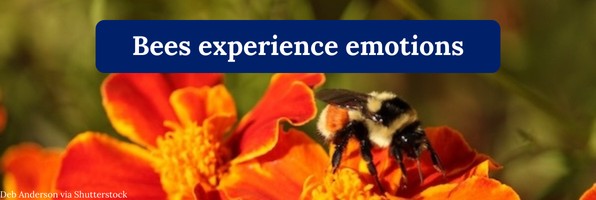
People might not be the only living creatures that feel sophisticated emotions such as joy, fear and optimism. Bees might, too.
Researchers found that bees' brains released dopamine and serotonin when they were given sugar. Bees may even experience fear and stress after traumatic events, and feel more optimistic about foraging after they've found a good food source.2
And these aren't just basic 'happy' and 'sad' emotions. Inside their tiny bodies, bees can experience complex emotions.
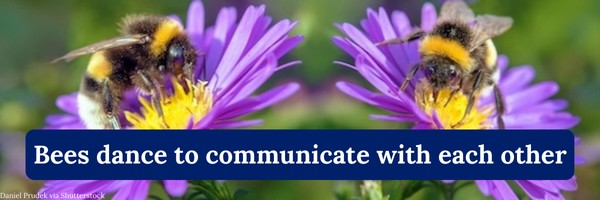
Bees just might just be speaking to each other in a secret code we don't understand.
Some bees 'talk' with each other through movements called waggle dances. They use these moves to express needs, divide up work to be more productive, share information and help each other find food sources.
When researchers studied these dances, they found that colonies have distinct "dialects," with different moves. In each colony, young bees watched more experienced bees' movements and learned how to dance.3

Whether by daydreaming or reminiscing about the past, most of us have active imaginations. It turns out bees use their imaginations, too.
Researchers have found that bees can conjure up mental images of objects they've seen before. A bee can pollinate a flower, for example, and think of the plant later that day. And, researchers think bees can even have vivid dreams while they sleep.4,5
Bees' tiny brains certainly don't work in the same ways ours do, but we can't overlook them just because they're small. Bees are far more advanced than we give them credit for.
We're awestruck by how clever bees can be. But these amazing bees need our help.
Right now, about 1 in 4 bumblebees are at risk of extinction because of threats like dangerous pesticide use and habitat loss. That's why we're working to restrict the worst uses of neonic pesticides and get them off store shelves.6
And, with your help, we're protecting pollinator habitat, so bees have safe spaces to call home.
Thank you,
Ellen Montgomery
P.S. We're working to protect bees from threats such as pesticides and habitat loss, but we need your support. Donate today.
1. Jack Guy, "Scientists now know that bees can process time, a first in insects," CNN, November 12, 2025.
2. Annette McGivney, "'Bees are sentient': inside the stunning brains of nature's hardest workers," The Guardian, April 2, 2023.
3. Mario Aguilera, "Bees don't just wiggle wiggle, they learn -- the newly discovered complex social behavior behind the 'waggle dance'," University of California, March 16, 2023.
4. Cwyn Solvi, Selene Gutierrez Al-Khudhairy, and Lars Chittka, "Bumble bees display cross-modal object recognition between visual and tactile senses," National Institute of Health, February 21, 2020.
5. Krishna Melnattur, Stephane Dissel, and Paul J. Shaw, "Learning and Memory: Do Bees Dream?," Science Direct, November 2, 2015.
6. Jan Peterson, "Bumble Bee Atlas: A Nationwide Buzz," U.S. Fish & Wildlife Service, May 2, 2023.
Your donation will be used to support all of our campaigns to protect the environment, from saving the bees and protecting public lands, to standing up for clean water and fighting climate change. None of our work would be possible without supporters like you. Environment Colorado may transfer up to $50 per dues-paying member per year into the Environment Colorado Small Donor Committee.
Environment Colorado, Inc.
1543 Wazee St., Suite 400, Denver, CO 80202, (303) 573-3871
Member questions or requests call 1-800-401-6511.
Facebook | Twitter

If you want us to stop sending you email then follow this link -- Unsubscribe.