
| From | Urban Institute External Affairs <[email protected]> |
| Subject | Solutions to challenges in tax filing and CTC benefit claims |
| Date | January 27, 2026 6:36 PM |
Links have been removed from this email. Learn more in the FAQ.
Links have been removed from this email. Learn more in the FAQ.
[link removed]
Greetings—
The earned income tax credit (EITC) and child tax credit (CTC) lifted 6.8 million people out of poverty in 2024, providing cash assistance for many families with children and low incomes. However, complex and limiting eligibility rules often exclude many families from these tax benefits.
A
[link removed]
new feature from the Urban-Brookings Tax Policy Center illustrates how current tax policies may intentionally and unintentionally exclude families, especially for
[link removed]
cohabitating caregivers and children who
[link removed]
split time across households .
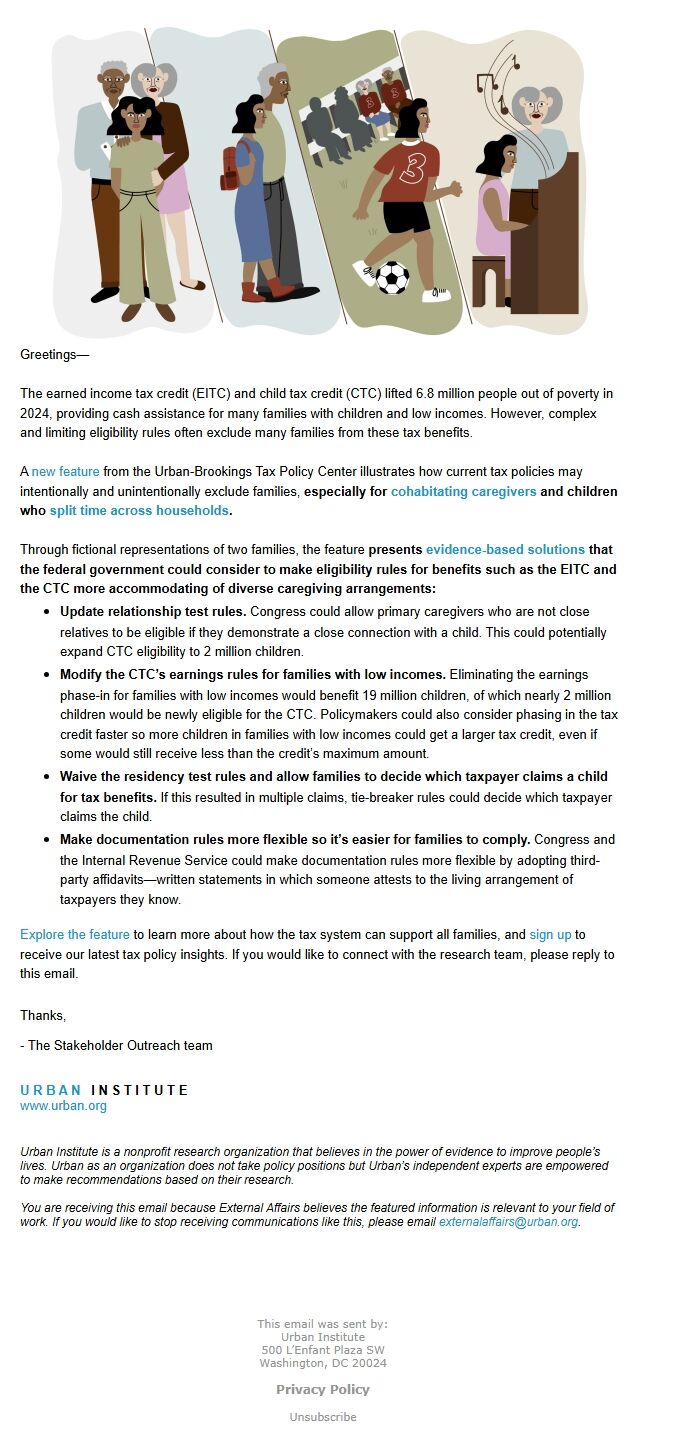
Through fictional representations of two families, the feature presents
[link removed]
evidence-based solutions that the federal government could consider to make eligibility rules for benefits such as the EITC and the CTC more accommodating of diverse caregiving arrangements:
- Update relationship test rules. Congress could allow primary caregivers who are not close relatives to be eligible if they demonstrate a close connection with a child. This could potentially expand CTC eligibility to 2 million children.
- Modify the CTC’s earnings rules for families with low incomes. Eliminating the earnings phase-in for families with low incomes would benefit 19 million children, of which nearly 2 million children would be newly eligible for the CTC. Policymakers could also consider phasing in the tax credit faster so more children in families with low incomes could get a larger tax credit, even if some would still receive less than the credit’s maximum amount.
- Waive the residency test rules and allow families to decide which taxpayer claims a child for tax benefits. If this resulted in multiple claims, tie-breaker rules could decide which taxpayer claims the child.
- Make documentation rules more flexible so it’s easier for families to comply. Congress and the Internal Revenue Service could make documentation rules more flexible by adopting third-party affidavits—written statements in which someone attests to the living arrangement of taxpayers they know.
[link removed]
Explore the feature to learn more about how the tax system can support all families, and
[link removed]
sign up to receive our latest tax policy insights. If you would like to connect with the research team, please reply to this email.
Thanks,
- The Stakeholder Outreach team
U R B A N I N S T I T U T E
[link removed]
www.urban.org
Urban Institute is a nonprofit research organization that believes in the power of evidence to improve people’s lives. Urban as an organization does not take policy positions but Urban’s independent experts are empowered to make recommendations based on their research.
You are receiving this email because External Affairs believes the featured information is relevant to your field of work. If you would like to stop receiving communications like this, please email
mailto:[email protected]?subject=Please remove me from External Affairs communications
[email protected] .
----------------------------------------
This email was sent by: Urban Institute
500 L’Enfant Plaza SW,
Washington, DC, 20024
Privacy Policy: [link removed]
Update Profile: [link removed]
Manage Subscriptions: [link removed]
Unsubscribe: [link removed]
Greetings—
The earned income tax credit (EITC) and child tax credit (CTC) lifted 6.8 million people out of poverty in 2024, providing cash assistance for many families with children and low incomes. However, complex and limiting eligibility rules often exclude many families from these tax benefits.
A
[link removed]
new feature from the Urban-Brookings Tax Policy Center illustrates how current tax policies may intentionally and unintentionally exclude families, especially for
[link removed]
cohabitating caregivers and children who
[link removed]
split time across households .
Through fictional representations of two families, the feature presents
[link removed]
evidence-based solutions that the federal government could consider to make eligibility rules for benefits such as the EITC and the CTC more accommodating of diverse caregiving arrangements:
- Update relationship test rules. Congress could allow primary caregivers who are not close relatives to be eligible if they demonstrate a close connection with a child. This could potentially expand CTC eligibility to 2 million children.
- Modify the CTC’s earnings rules for families with low incomes. Eliminating the earnings phase-in for families with low incomes would benefit 19 million children, of which nearly 2 million children would be newly eligible for the CTC. Policymakers could also consider phasing in the tax credit faster so more children in families with low incomes could get a larger tax credit, even if some would still receive less than the credit’s maximum amount.
- Waive the residency test rules and allow families to decide which taxpayer claims a child for tax benefits. If this resulted in multiple claims, tie-breaker rules could decide which taxpayer claims the child.
- Make documentation rules more flexible so it’s easier for families to comply. Congress and the Internal Revenue Service could make documentation rules more flexible by adopting third-party affidavits—written statements in which someone attests to the living arrangement of taxpayers they know.
[link removed]
Explore the feature to learn more about how the tax system can support all families, and
[link removed]
sign up to receive our latest tax policy insights. If you would like to connect with the research team, please reply to this email.
Thanks,
- The Stakeholder Outreach team
U R B A N I N S T I T U T E
[link removed]
www.urban.org
Urban Institute is a nonprofit research organization that believes in the power of evidence to improve people’s lives. Urban as an organization does not take policy positions but Urban’s independent experts are empowered to make recommendations based on their research.
You are receiving this email because External Affairs believes the featured information is relevant to your field of work. If you would like to stop receiving communications like this, please email
mailto:[email protected]?subject=Please remove me from External Affairs communications
[email protected] .
----------------------------------------
This email was sent by: Urban Institute
500 L’Enfant Plaza SW,
Washington, DC, 20024
Privacy Policy: [link removed]
Update Profile: [link removed]
Manage Subscriptions: [link removed]
Unsubscribe: [link removed]
Message Analysis
- Sender: Urban Institute
- Political Party: n/a
- Country: United States
- State/Locality: n/a
- Office: n/a
-
Email Providers:
- Salesforce Email Studio (ExactTarget)