|
 |
Minnesota Exposed Federal Power, and It Panicked
Greg Bovino is leaving, but the system that enabled him isn’t.
|

| |||||||||||||||


 |
I know how overwhelming this moment feels. The volume is constant. The stakes are heavy. And it can feel like nothing changes, no matter how much evidence, outrage, or grief piles up.
But Minnesota tells a different story.
What happened there didn’t just expose a policy failure. It exposed a pressure point and showed, unmistakably, that public pressure still matters. When people showed up, documented what they saw, and refused to accept the first official story, the machinery stalled. The narrative cracked, and power adjusted.
Renee Good was a 37-year-old U.S. citizen and mother. She was shot and killed on January 7 during an ICE operation in south Minneapolis, an encounter that had nothing to do with her immigration status. Federal officials immediately described the shooting as “defensive,” alleging she struck an agent with her vehicle. Independent video analysis and witness testimony contradicted that claim. An autopsy later found she was shot three times, including a fatal wound to the head.
Two weeks later, Alex Pretti, a 37-year-old ICU nurse who worked at the Minneapolis VA Medical Center, was shot and killed during another federal operation in the city. Once again, the official narrative moved fast, and once again, it collapsed under video evidence. Footage from multiple angles showed Pretti holding a phone, complying with commands, being pepper-sprayed, pinned to the ground, and shot from behind.
Two U.S. citizens.
Two killings.
One pattern.
Label First, Justify Force, Delay Accountability
In both cases, senior officials rushed to define the victims rather than examine the force used. That is not accidental. It is a strategy.
When Stephen Miller, the architect of Trump’s immigration crackdown, publicly labeled Alex Pretti an "assassin," he wasn’t just expressing an opinion. He was attempting to lock in permission. Permission for the violence, permission to deflect scrutiny, permission for the next operation to proceed unchanged. I know this tactic well. I’ve seen Miller deploy it before, including during cabinet-level meetings, where narrative framing is used early and aggressively to foreclose accountability before facts are known. Define the target as a threat, and everything that follows becomes easier to justify.
That kind of language isn’t incidental. It shapes how lethal force is perceived, how investigations narrow, and whether evidence is preserved at all. Once the label hardens, accountability becomes harder to reach because the conclusion has already been sold. Normalize that pattern, and the risk isn’t one tragedy, it’s repetition. The White House eventually retreated from its claims as public backlash and evidence made them impossible to sustain.
Minnesota Is Not Just A Protest Story—It’s a Constitutional Test
A federal judge has not yet halted Operation Metro Surge. But she has ordered the Department of Homeland Security to directly answer a central allegation: whether the federal government is using armed raids and street policing to punish Minnesota for its sanctuary laws and coerce state and local authorities into compliance.
The issue isn’t whether the federal government can enforce immigration law. It’s whether flooding one state with thousands of armed agents, more than the combined sworn officers of Minneapolis and St. Paul, crosses the line from enforcement into unlawful coercion. Whether forcing cities to divert police, fire, and emergency resources, cancel school days, and absorb fear and disruption is lawful, or an abuse designed to compel obedience.
If this model stands, it will not stay in Minnesota. It will be exported.
Greg Bovino Is Leaving, But That’s Not Accountability
After the killing of Alex Pretti, the administration reshuffled leadership. Gregory Bovino, the Border Patrol official who became the public face of the crackdown, is leaving Minneapolis and returning to California. His specially created title, "commander at large," was stripped. The Department of Homeland Security (DHS) also suspended his access to social media.
This is being framed as responsiveness. It isn’t.
Bovino didn’t leave because the system self-corrected. He left because Minnesotans made the operation politically and publicly unsustainable. And, credibility matters. Bovino has aggressively promoted these operations through highly produced media appearances, repeatedly defending agent conduct even when video evidence contradicted his claims. He has also been reprimanded by a federal judge in a prior case for lying to the court, a fact that matters when assessing trust, not optics.
Removing a spokesperson is not accountability. It is a pressure-release valve, meant to protect the architecture that produced the abuse.
The Phone Problem is the Democracy Problem
One of the most chilling through-lines in this story is how central citizen documentation has been, and how quickly officials tried to discredit it. In both killings, the government’s narrative unraveled because ordinary people filmed what they saw.
That is why the quiet criminalization of recording matters so much. When filming the government is treated as provocation, when a cell phone is framed as a threat, accountability is strangled before it can breathe. A democracy cannot survive if witnessing state power becomes too dangerous to attempt.
All of this should outrage conservatives because these are not conservative ideals.
If you value limited government, you should be deeply alarmed when federal agents force their way into homes with only civil paperwork—unsigned by any judge—a practice a federal judge has already found blatantly unconstitutional in Minnesota.
If you believe in free speech, you should be alarmed when recording the government is treated as an escalation.
If you believe in the Second Amendment, as I do as a gun owner, you should be alarmed by how quickly officials labeled Alex Pretti an “assassin” and “domestic terrorist” before facts were established, even though he was a lawful gun owner. That is how lawful possession is retroactively transformed into justification for lethal force, with accountability postponed or avoided altogether.
These are not conservative values. They are not moderate values. They are not American values. The distortion is the point, and it’s coming from the top.
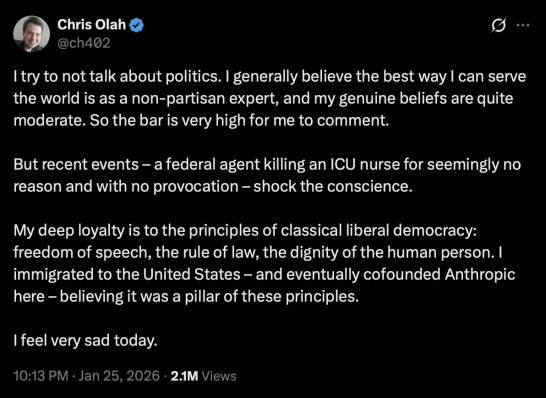
One of the most revealing moments this week didn’t come from a court filing or a press briefing. It came from social media, and it perfectly captured how distorted the worldview inside Trump’s inner circle has become. After the killing of Alex Pretti, Stephen Miller’s wife, Katie Miller, responded to a defense of classical liberal democracy by suggesting it was "woke, deeply leftist ideology." I had the unfortunate experience of working with her during Trump 1.0. The confusion on display here is, regrettably, on brand.
 |
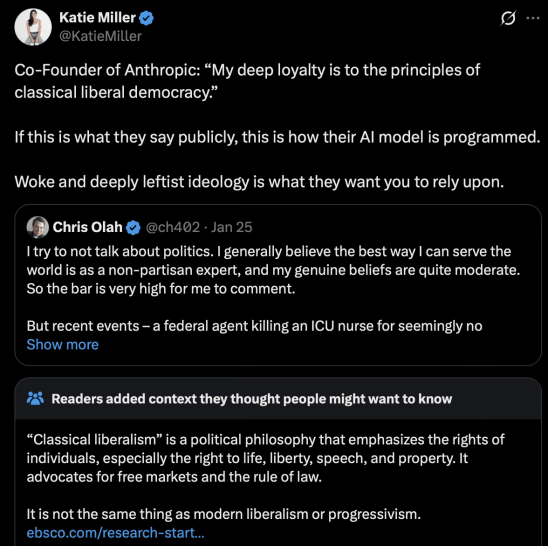 |
Classical liberalism is not progressivism. It is not leftism. It is the belief in individual rights, limited government, free expression, property rights, and the rule of law—the very principles this administration claims to defend while violating them. When people in the inner circle of power deliberately misrepresent the meaning of constitutional language, bad governance isn’t an accident. It’s inevitable.
This is how you end up calling a phone a weapon. This is how you end up calling an ICU nurse an "assassin." This is how you convince yourself that crushing civil liberties is somehow "conservative."
It isn’t.
This week, a top Republican candidate for Minnesota governor, Chris Madel, dropped out of the race, sharply criticizing what he called "federal retribution on the citizens of our state."
Madel is a Republican. He supported immigration enforcement aimed at serious criminal activity. He even previously provided legal counsel to the ICE agent involved in Renee Good’s killing. And still, he said Operation Metro Surge had expanded far beyond public safety. He described U.S. citizens carrying proof of citizenship out of fear. Home raids based on civil warrants signed by border patrol agents alone, something he called unconstitutional.
"At the end of the day…I have to look my daughters in the eye and tell them I did what was right." - Chris Madel
That matters. Because it confirms that this is no longer a left-versus-right issue. It is law versus a government that is drunk on power. Minnesota didn’t just protest. Minnesota forced constraints.
Courts are now scrutinizing the legality of the operation. The White House changed its tone. Leadership was reshuffled. Some federal agents are leaving the state. None of that happened because of a press release.
It happened because people refused to let fear become policy. And here’s the warning I want to leave you with:
If the architect stays in place, if Stephen Miller remains empowered to label Americans as enemies, then the next "incident" is already being built. Tom Homan, DHS Secretary Kristi Noem and her sidekick Corey Lewandowski are not outliers here. They are the visible executors of a strategy designed elsewhere, advancing it publicly while shielding its author from direct accountability.
This is why I tell people to keep showing up. Show up to document. Show up to demand independent investigations, not internal reviews. Show up so the next family doesn’t have to fight alone for the truth about Renee Good or Alex Pretti.
The goal isn’t to win a news cycle. The goal is to make it harder for the government to do this again.
Minnesota showed that even the most entrenched federal power can be pressured, but only when people watch, document, and refuse to accept manufactured certainty as truth.
The real question now is not whether power can blink. It’s whether the rest of the country will make it do so again.
More soon,
-Olivia
This Substack is reader-supported. Paid subscriptions allow me to continue to pour significant time and energy into breaking down the headlines and keeping my content available to others. Thank you for your support!
Have an idea or feedback? Reply directly to this email.
| ||||||||||

