|
 |


Welcome to The Corner. In this issue, we look at Amazon’s recent lawsuit that aims to keep Perplexity’s AI agents from “intruding” on Amazon’s website, in a case that could help determine the future of the emerging AI agent market.
 |
Amazon Seeks to Assert Control over Which AI Agents Can Shop Online, and How
Jack FitzGerald
In a case with deep implications for the nascent market for AI-powered online “agents,” Amazon recently sued AI search engine Perplexity over a new AI-supported browser that appears to threaten the retail giant’s grip on online shopping. Perplexity’s Comet browser allows users to buy products from Amazon.com without ever visiting the site.
The action dates to last November, when Amazon filed a complaint in the Northern District of California seeking to block Comet, labelling it an “intruder.” Perplexity responded by accusing Amazon of “bullying” and restricting user choice. The outcome of the lawsuit will help determine whether today’s dominant tech platforms are allowed to police entry to the AI agent market.
AI agents are digital assistants that can carry out multi-step tasks on behalf of users, such as managing calendars, handling email, or shopping online. For shopping, agents compare options across sites to find the best deal, and can handle checkout on the user’s behalf using stored payment details. Morgan Stanley expects nearly half of American shoppers to use AI agents by 2030.
Perplexity’s threat to Amazon comes from the fact that Comet reduces Amazon.com to simply one of many sites that it scours. This means that even when Comet makes a purchase on Amazon, the end customer never actually visits the site. Amazon loses any opportunity to serve sponsored product placements, upsell Prime memberships, or gather commercial data on the user.
According to Amazon, Perplexity is an “intruder” because it disguises Comet as a human user browsing via Chrome, rather than identifying it as an AI agent. When Amazon implemented technical measures to detect and block the agent, Perplexity bypassed these restrictions within 24 hours.
Perplexity has been criticized by other corporations as well. In August 2025, internet infrastructure provider Cloudflare accused the company of disguising its crawlers to bypass website restrictions. Web crawlers can violate user privacy and have been shown to degrade site performance.
But even if Perplexity’s actions are found to be illegal, the underlying question remains: Should Big Tech platforms get to determine how customers use AI agents, and by implication which corporations get to compete in the market for AI agent services?
There is little disputing that today’s incumbents already control most layers in the AI tech stack. Microsoft owns 27% of OpenAI, and holds IP rights to ChatGPT until 2032. Google owns 14% of Anthropic, all of Deepmind, and has developed one of the leading models, Gemini. Underlying it all, Amazon, Microsoft, and Google control roughly two-thirds of the global capacity for cloud computing, on which all AI depends.
Indeed, despite its pushback against Perplexity, Amazon has AI agent ambitions of its own. In April, it launched a ‘Buy For Me’ button, an AI agent that visits external brand websites to complete purchases for customers. Amazon is also courting partnerships with outside AI companies that offer third-party agent services.
Amazon clearly intends to set the terms for any such agent partnerships. The corporation requires agents to identify themselves and reserves “sole discretion” to refuse access. This means that even if Perplexity plays by Amazon’s rules, Amazon could still say no.
When it comes to picking partners, Amazon has already built deep ties with a few leading AI providers. The corporation inked a $38 billion cloud deal with OpenAI last November. Meanwhile, Amazon invested $8 billion in Anthropic, which in turn named Amazon its official cloud provider. Amazon also already uses Anthropic’s AI models to power its ‘Buy For Me’ button.
Given these ties, Amazon has every incentive to block out Perplexity and other agents in favor of its own services and partners. Success in the agent market risks becoming about having the right connections with large platforms, rather than offering the best product.
This doesn’t have to be the case. As platforms open up to agents, they could be required to do so on non-discriminatory terms. When telecom markets liberalized in the U.S. and Europe, incumbents were required to let competitors connect on equal footing. Similar principles could oblige Amazon to provide equal access to all agent providers, not just its partners.
Independent certification can also help support this vision. Amazon’s lawsuit argues that Comet creates considerable risks to user data. Here again a neutral body could set baseline standards for agent security to ensure safety can’t be used as a pretext for exclusion.
Ultimately, the same rules must be applied to the new agent providers themselves. As OpenAI’s recent announcement that it plans to insert ads into ChatGPT demonstrates, these corporations are also able to surveil user activity across platforms and then use that data for personalized pricing, targeted ads, and commercially driven recommendations. And even if agents initially offer a better experience, they may start to degrade service once they consolidate a dominant position.
📝 WHAT WE’RE UP TO
Open Markets legal director Sandeep Vaheesan presented at the kickoff of the Congressional Progressive Caucus’s task force on ending corporate greed, where he discussed the importance of tackling corporate pricing power through public regulation and investment.
Open Markets Institute food program manager Claire Kelloway published an article in the Washington Monthly favorably comparing New York City mayor Zohran Mamdani’s proposed city-run supermarkets to government-run grocery stores for the military. “The commissary system provides a real, workable example of how government can address the grocery cost crisis that is bedeviling the country,” she writes. “A ‘public option’ for grocery stores, based on the proof of concept provided by the commissary mode … could also inject more competition into the broader grocery market and bring down food prices for all Americans in the long term.”
Vaheesan participated in a debate entitled “Abundance and Social Democracy: Enemies or Allies?” at the Democracy Journal’s “Can’t We Just Get Along?” conference in Washington. In his remarks, Vaheesan described the empirical and conceptual problems with the so-called Abundance Agenda and why further deregulation won’t deliver widely shared abundance.
CityWatch LA cited a seminal Harvard Business Review article, “The Market Alone Can’t Fix the Housing Crisis,” by Open Markets legal director Sandeep Vaheesan and OMI economist Brian Callaci, highlighting their argument that solving the housing affordability crisis requires fixing broken market structures.
TechRadar named Open Markets Institute as one of the 10 digital rights organizations that received a grant from Proton, a Swiss company offering privcacy-focused technology, through its annual charity fundraiser. Coverage was syndicated in GearOpen.
🔊 ANTI-MONOPOLY WINS:
The Federal Trade Commission appealed its loss in an antitrust case against Meta over its social n networking monopoly, which claimed it had illegally purchased WhatsApp and Instagram to maintain its dominance in the space. (New York Times)
Visa, Mastercard and British fintech firm Revolut have lost their case seeking to block the UK’s proposed cross-border card fee cap to combat the high fees these firms are able to charge thanks to the market’s extremely concentrated nature. (Reuters)
Brazil has launched a probe into Microsoft’s cloud computing and software licensing practices. Noting the anticompetitive practices identified by the UK’s probe into the European cloud industry, Brazilian regulators say the “possibility of the same reality occurring in Brazil must be investigated.” (Data Center Dynamics)
📈 VITAL STAT:
7%
The market share of TV time in major markets Netflix claims it has, as part of an attempt to convince regulators that the streaming giant does not hold a dominant position in the combined television plus streaming market. Netflix’s all-cash $83 billion bid for Warner Bros. Discovery’s streaming and studio assets in under review by the Department of Justice. (The Wrap)
📚 WHAT WE’RE READING:
The Global Casino: How Wall Street Gambles with People and the Planet: In her book, British economist Ann Pettifor describes how everything in our economy from food to energy to housing is determined by unregulated global financial markets. The result of this “casino” is volatile speculation in global commodities, pension, energy, and housing.
Pre- Order Chief Economist Brian Callaci’s new book
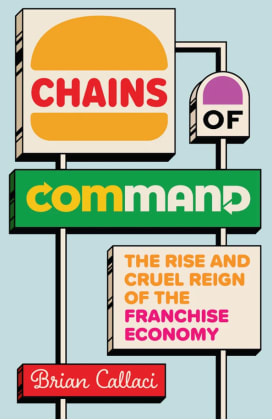 |
Open Markets Institute’s chief economist Brian Callaci will publish his first book Chains of Command: The Rise and Cruel Reign of the Franchise Economy on April 20 through University of Chicago Press. The book offers a sharp critique of the franchise model used by many fast food chains, which has shaped labor markets, corporate power, and inequality in the U.S. In Chains of Command, Callaci shows how franchisors have altered the legal treatment of corporations in their favor through a decades-long crusade of lobbying and litigation, and argues for greater cooperation between workers and small franchise owners. Pre-order the book here.
DISCOUNT CODE: CHAINS2025
Written and edited by: Karina Montoya, Barry Lynn, Ezmeralda Makhamreh, Austin Ahlman, and Anita Jain
Open Markets Institute
655 15th St NW, Suite 310
Washington, DC xxxxxx
We thought you'd like to be in the know about competition policy news. Liked what you read? Please forward to a friend or colleague and subscribe for more updates.
| ||||||||||

