
Email
Yale students document food purchases from massive grower linked to farm labor abuse; Yale Hospitality confirms purchases, yet remains opposed to joining the Fair Food Program
| From | Coalition of Immokalee Workers <[email protected]> |
| Subject | Yale students document food purchases from massive grower linked to farm labor abuse; Yale Hospitality confirms purchases, yet remains opposed to joining the Fair Food Program |
| Date | January 27, 2026 3:25 PM |
Links have been removed from this email. Learn more in the FAQ.
Links have been removed from this email. Learn more in the FAQ.
[[link removed]]
[link removed] [[link removed]]
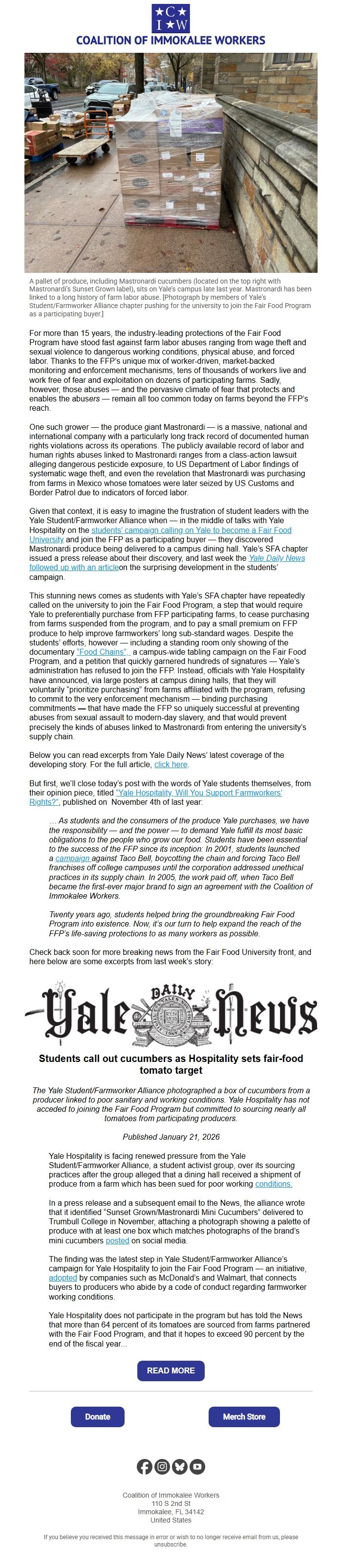
A pallet of produce, including Mastronardi cucumbers (located on the top right with Mastronardi’s Sunset Grown label), sits on Yale’s campus late last year. Mastronardi has been linked to a long history of farm labor abuse. [Photograph by members of Yale’s Student/Farmworker Alliance chapter pushing for the university to join the Fair Food Program as a participating buyer.]
For more than 15 years, the industry-leading protections of the Fair Food Program have stood fast against farm labor abuses ranging from wage theft and sexual violence to dangerous working conditions, physical abuse, and forced labor. Thanks to the FFP’s unique mix of worker-driven, market-backed monitoring and enforcement mechanisms, tens of thousands of workers live and work free of fear and exploitation on dozens of participating farms. Sadly, however, those abuses — and the pervasive climate of fear that protects and enables the abus ers — remain all too common today on farms beyond the FFP’s reach.
One such grower — the produce giant Mastronardi — is a massive, national and international company with a particularly long track record of documented human rights violations across its operations. The publicly available record of labor and human rights abuses linked to Mastronardi ranges from a class-action lawsuit alleging dangerous pesticide exposure, to US Department of Labor findings of systematic wage theft, and even the revelation that Mastronardi was purchasing from farms in Mexico whose tomatoes were later seized by US Customs and Border Patrol due to indicators of forced labor.
Given that context, it is easy to imagine the frustration of student leaders with the Yale Student/Farmworker Alliance when — in the middle of talks with Yale Hospitality on the students’ campaign calling on Yale to become a Fair Food University [[link removed]] and join the FFP as a participating buyer — they discovered Mastronardi produce being delivered to a campus dining hall. Yale’s SFA chapter issued a press release about their discovery, and last week the Yale Daily News followed up with an article [[link removed]] on the surprising development in the students’ campaign.
This stunning news comes as students with Yale’s SFA chapter have repeatedly called on the university to join the Fair Food Program, a step that would require Yale to preferentially purchase from FFP participating farms, to cease purchasing from farms suspended from the program, and to pay a small premium on FFP produce to help improve farmworkers’ long sub-standard wages. Despite the students’ efforts, however — including a standing room only showing of the documentary “Food Chains”, [[link removed]] a campus-wide tabling campaign on the Fair Food Program, and a petition that quickly garnered hundreds of signatures — Yale’s administration has refused to join the FFP. Instead, officials with Yale Hospitality have announced, via large posters at campus dining halls, that they will voluntarily “prioritize purchasing” from farms affiliated with the program, refusing to commit to the very enforcement mechanism — binding purchasing commitments — that have made the FFP so uniquely successful at preventing abuses from sexual assault to modern-day slavery, and that would prevent precisely the kinds of abuses linked to Mastronardi from entering the university’s supply chain.
Below you can read excerpts from Yale Daily News’ latest coverage of the developing story. For the full article, click here [[link removed]] .
But first, we’ll close today’s post with the words of Yale students themselves, from their opinion piece, titled “Yale Hospitality, Will You Support Farmworkers’ Rights?” [[link removed]] , published on November 4th of last year:
… As students and the consumers of the produce Yale purchases, we have the responsibility — and the power — to demand Yale fulfill its most basic obligations to the people who grow our food. Students have been essential to the success of the FFP since its inception: In 2001, students launched a campaign [[link removed]] against Taco Bell, boycotting the chain and forcing Taco Bell franchises off college campuses until the corporation addressed unethical practices in its supply chain. In 2005, the work paid off, when Taco Bell became the first-ever major brand to sign an agreement with the Coalition of Immokalee Workers.
Twenty years ago, students helped bring the groundbreaking Fair Food Program into existence. Now, it’s our turn to help expand the reach of the FFP’s life-saving protections to as many workers as possible.
Check back soon for more breaking news from the Fair Food University front, and here below are some excerpts from last week’s story:
[link removed] [[link removed]]
Students call out cucumbers as Hospitality sets fair-food tomato target
The Yale Student/Farmworker Alliance photographed a box of cucumbers from a producer linked to poor sanitary and working conditions. Yale Hospitality has not acceded to joining the Fair Food Program but committed to sourcing nearly all tomatoes from participating producers.
Published January 21, 2026
Yale Hospitality is facing renewed pressure from the Yale Student/Farmworker Alliance, a student activist group, over its sourcing practices after the group alleged that a dining hall received a shipment of produce from a farm which has been sued for poor working conditions. [[link removed]]
In a press release and a subsequent email to the News, the alliance wrote that it identified “Sunset Grown/Mastronardi Mini Cucumbers” delivered to Trumbull College in November, attaching a photograph showing a palette of produce with at least one box which matches photographs of the brand’s mini cucumbers posted [[link removed]] on social media.
The finding was the latest step in Yale Student/Farmworker Alliance’s campaign for Yale Hospitality to join the Fair Food Program — an initiative, adopted [[link removed]] by companies such as McDonald’s and Walmart, that connects buyers to producers who abide by a code of conduct regarding farmworker working conditions.
Yale Hospitality does not participate in the program but has told the News that more than 64 percent of its tomatoes are sourced from farms partnered with the Fair Food Program, and that it hopes to exceed 90 percent by the end of the fiscal year...
READ MORE [[link removed]]
Donate [[link removed]] Merch Store [[link removed]]
[link removed] [[link removed]] [link removed] [[link removed]] [link removed] [[link removed]] [link removed] [[link removed]]
Coalition of Immokalee Workers
110 S 2nd St
Immokalee, FL 34142
United States
If you believe you received this message in error or wish to no longer receive email from us, please unsubscribe: [link removed] .
[link removed] [[link removed]]
A pallet of produce, including Mastronardi cucumbers (located on the top right with Mastronardi’s Sunset Grown label), sits on Yale’s campus late last year. Mastronardi has been linked to a long history of farm labor abuse. [Photograph by members of Yale’s Student/Farmworker Alliance chapter pushing for the university to join the Fair Food Program as a participating buyer.]
For more than 15 years, the industry-leading protections of the Fair Food Program have stood fast against farm labor abuses ranging from wage theft and sexual violence to dangerous working conditions, physical abuse, and forced labor. Thanks to the FFP’s unique mix of worker-driven, market-backed monitoring and enforcement mechanisms, tens of thousands of workers live and work free of fear and exploitation on dozens of participating farms. Sadly, however, those abuses — and the pervasive climate of fear that protects and enables the abus ers — remain all too common today on farms beyond the FFP’s reach.
One such grower — the produce giant Mastronardi — is a massive, national and international company with a particularly long track record of documented human rights violations across its operations. The publicly available record of labor and human rights abuses linked to Mastronardi ranges from a class-action lawsuit alleging dangerous pesticide exposure, to US Department of Labor findings of systematic wage theft, and even the revelation that Mastronardi was purchasing from farms in Mexico whose tomatoes were later seized by US Customs and Border Patrol due to indicators of forced labor.
Given that context, it is easy to imagine the frustration of student leaders with the Yale Student/Farmworker Alliance when — in the middle of talks with Yale Hospitality on the students’ campaign calling on Yale to become a Fair Food University [[link removed]] and join the FFP as a participating buyer — they discovered Mastronardi produce being delivered to a campus dining hall. Yale’s SFA chapter issued a press release about their discovery, and last week the Yale Daily News followed up with an article [[link removed]] on the surprising development in the students’ campaign.
This stunning news comes as students with Yale’s SFA chapter have repeatedly called on the university to join the Fair Food Program, a step that would require Yale to preferentially purchase from FFP participating farms, to cease purchasing from farms suspended from the program, and to pay a small premium on FFP produce to help improve farmworkers’ long sub-standard wages. Despite the students’ efforts, however — including a standing room only showing of the documentary “Food Chains”, [[link removed]] a campus-wide tabling campaign on the Fair Food Program, and a petition that quickly garnered hundreds of signatures — Yale’s administration has refused to join the FFP. Instead, officials with Yale Hospitality have announced, via large posters at campus dining halls, that they will voluntarily “prioritize purchasing” from farms affiliated with the program, refusing to commit to the very enforcement mechanism — binding purchasing commitments — that have made the FFP so uniquely successful at preventing abuses from sexual assault to modern-day slavery, and that would prevent precisely the kinds of abuses linked to Mastronardi from entering the university’s supply chain.
Below you can read excerpts from Yale Daily News’ latest coverage of the developing story. For the full article, click here [[link removed]] .
But first, we’ll close today’s post with the words of Yale students themselves, from their opinion piece, titled “Yale Hospitality, Will You Support Farmworkers’ Rights?” [[link removed]] , published on November 4th of last year:
… As students and the consumers of the produce Yale purchases, we have the responsibility — and the power — to demand Yale fulfill its most basic obligations to the people who grow our food. Students have been essential to the success of the FFP since its inception: In 2001, students launched a campaign [[link removed]] against Taco Bell, boycotting the chain and forcing Taco Bell franchises off college campuses until the corporation addressed unethical practices in its supply chain. In 2005, the work paid off, when Taco Bell became the first-ever major brand to sign an agreement with the Coalition of Immokalee Workers.
Twenty years ago, students helped bring the groundbreaking Fair Food Program into existence. Now, it’s our turn to help expand the reach of the FFP’s life-saving protections to as many workers as possible.
Check back soon for more breaking news from the Fair Food University front, and here below are some excerpts from last week’s story:
[link removed] [[link removed]]
Students call out cucumbers as Hospitality sets fair-food tomato target
The Yale Student/Farmworker Alliance photographed a box of cucumbers from a producer linked to poor sanitary and working conditions. Yale Hospitality has not acceded to joining the Fair Food Program but committed to sourcing nearly all tomatoes from participating producers.
Published January 21, 2026
Yale Hospitality is facing renewed pressure from the Yale Student/Farmworker Alliance, a student activist group, over its sourcing practices after the group alleged that a dining hall received a shipment of produce from a farm which has been sued for poor working conditions. [[link removed]]
In a press release and a subsequent email to the News, the alliance wrote that it identified “Sunset Grown/Mastronardi Mini Cucumbers” delivered to Trumbull College in November, attaching a photograph showing a palette of produce with at least one box which matches photographs of the brand’s mini cucumbers posted [[link removed]] on social media.
The finding was the latest step in Yale Student/Farmworker Alliance’s campaign for Yale Hospitality to join the Fair Food Program — an initiative, adopted [[link removed]] by companies such as McDonald’s and Walmart, that connects buyers to producers who abide by a code of conduct regarding farmworker working conditions.
Yale Hospitality does not participate in the program but has told the News that more than 64 percent of its tomatoes are sourced from farms partnered with the Fair Food Program, and that it hopes to exceed 90 percent by the end of the fiscal year...
READ MORE [[link removed]]
Donate [[link removed]] Merch Store [[link removed]]
[link removed] [[link removed]] [link removed] [[link removed]] [link removed] [[link removed]] [link removed] [[link removed]]
Coalition of Immokalee Workers
110 S 2nd St
Immokalee, FL 34142
United States
If you believe you received this message in error or wish to no longer receive email from us, please unsubscribe: [link removed] .
Message Analysis
- Sender: Coalition of Immokalee Workers
- Political Party: n/a
- Country: United States
- State/Locality: Florida Immokalee, Florida
- Office: n/a
-
Email Providers:
- EveryAction