|
Celebrity Spotlight on Silver Surge Signals Broader Economic Warnings by Steve Abramowicz
When a country singer is live-tweeting $100 silver, you know the economy’s doing interpretive dance on a shaky stage.
|

| |||||||||||||||


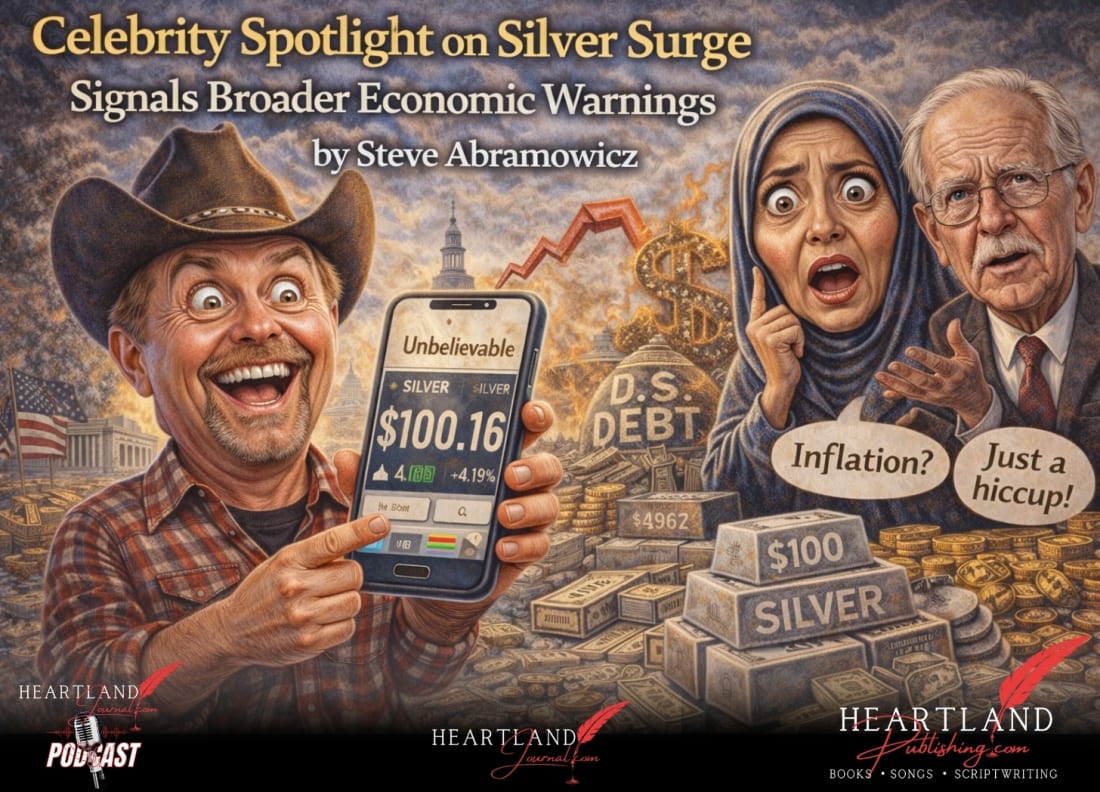 |
When country music icon John Rich, one half of the duo Big & Rich, took to X with a simple “Unbelievable.” accompanied by a screenshot of silver prices hitting triple digits, it wasn’t just a casual observation from a celebrity outside the finance world. The post, which garnered thousands of likes and replies, underscores a pivotal moment in commodity markets where precious metals are breaking records amid mounting economic pressures.
As a financial reporter, I’ve seen these spikes before, but this one feels different—driven by a cocktail of inflation concerns, unchecked government spending, persistently low interest rates, and a weakening U.S. dollar that collectively make assets like gold, silver, platinum, and palladium look undervalued despite their lofty nominal prices.
Rich’s tweet captures silver spot prices crossing $100 per ounce for the first time ever, closing at $100.16 with a 4.19% daily gain on Friday 1/123/2026. This milestone isn’t isolated; it’s part of a broader rally in precious metals that has accelerated into 2026. Gold has shattered its own records, reaching $4,967 per ounce.
Platinum trades around $2,326 per ounce, while palladium, often overshadowed but critical for industrial uses, has followed suit with gains reflecting similar dynamics. These prices might seem high at first glance, but adjusted for economic realities, they appear cheap as hedges against currency debasement and fiscal instability.
What’s fueling this surge? Start with inflation, which has stubbornly lingered above the Federal Reserve’s 2% target. The latest data shows the U.S. annual inflation rate holding steady at 2.7% in December 2025, but economists are warning of upside risks. Projections from institutions like the Peterson Institute for International Economics suggest inflation could exceed 4% by the end of 2026, amplified by tariffs, fiscal stimulus, and supply chain disruptions.
In a striking shift reshaping global reserve management, central banks worldwide are actively diversifying away from the U.S. dollar by selling portions of their dollar-denominated assets—particularly U.S. Treasuries—and channeling proceeds into gold. This trend, accelerating since 2022 amid geopolitical tensions, sanctions risks, and concerns over dollar credibility, has seen emerging market institutions lead the charge: nations like China, Poland, Turkey, and Kazakhstan have been aggressively accumulating gold, with net purchases totaling hundreds of tons annually (for instance, reported buying reached 297 tons through November 2025 alone, led by Poland’s massive additions). Surveys from the World Gold Council and others reveal that a majority of central bankers expect to increase gold’s share in reserves while reducing dollar holdings over the coming years, viewing the metal as a neutral, sanction-resistant store of value free from counterparty or political risk. This de-dollarization dynamic—fueled by events like the freezing of Russian reserves and broader multipolar realignments—has provided a powerful structural bid for gold, helping propel prices to record highs above $4,900 per ounce while underscoring eroding confidence in the dollar’s long-term dominance as the premier global reserve currency. As this quiet revolution continues into 2026, with projections for sustained buying around 60-75 tons monthly, it signals not just a hedge against uncertainty but a fundamental rebalancing of international finance.
This isn’t abstract—it’s eroding purchasing power, making hard assets like silver an attractive store of value. As one reply to Rich’s post noted, “For 15x parity it needs to hit $330!” referencing historical gold-silver ratios, hinting at even more upside potential.
Compounding this is America’s ballooning government debt, now standing at a staggering $38.43 trillion as of early January 2026.
That’s an increase of $2.25 trillion year-over-year, growing at a clip of about $8 billion per day. Such spending—fueled by expansive fiscal policies—has investors worried about long-term sustainability. Interest payments alone topped $1 trillion in fiscal 2025, crowding out other priorities and stoking fears of monetization through money printing, which historically devalues fiat currencies.
Interest rates play a key role here too. The Federal Reserve’s benchmark funds rate sits in the 3.50-3.75% range, with the effective rate at 3.64%.
While this represents a cut from higher levels in 2025, critics argue it’s still too low relative to persistent inflation and could remain accommodative for too long, especially if new policies like tax cuts or tariffs heat up the economy further. J.P. Morgan analysts expect the Fed to hold steady through much of 2026 before potentially hiking again, but in the meantime, low real yields (after inflation) make non-yielding assets like precious metals more appealing.
Finally, the falling dollar is the glue holding this narrative together. The U.S. Dollar Index (DXY) has weakened to around 98.31, down sharply from recent peaks and marking its worst weekly drop in eight months despite policy pivots.
A softer greenback boosts dollar-denominated commodities, making them cheaper for foreign buyers and amplifying demand. This dynamic is particularly potent for silver, which has dual roles as both a monetary metal and an industrial staple in solar panels, electronics, and EVs—sectors booming amid global energy transitions.
In conversations with market participants, the consensus is clear: these factors aren’t fleeting. “Silver at $100 is still undervalued,” one hedge fund manager told me, echoing sentiments in Rich’s thread where users lamented not stacking more when prices were lower. With supply deficits persisting (global silver mining output fell short by over 200 million ounces last year) and industrial demand from AI data centers and green tech surging, the case for precious metals as a portfolio diversifier strengthens.
Of course, risks remain. A stronger-than-expected economy or aggressive Fed tightening could cap gains, but the structural trends—fiscal profligacy, geopolitical tensions, low global supply and currency erosion—point to sustained upside. John Rich’s “unbelievable” moment might just be the tip of the iceberg, reminding us that when even singers notice commodity spikes, it’s time for investors to pay attention. As precious metals continue to “seem cheap” in this environment, the real question is: how high can they go?
Editorial comments expressed in this column are the sole opinion of the writer.
This is not a recommendation to buy or sell securities nor tax advice. Always consult a trusted financial professional before making a financial decision.
https://heartlandjournal.com/
You're currently a free subscriber to Heartland Journal ®. For the full experience, upgrade your subscription.
| ||||||||||

