

John,
Neither of us had been running enough lately to feel good going into the race. We pushed each other to sign up, each in our own way. Amy raising the possibility and then saying oh, I don’t know if I can do a 10k right now. And me saying of course you can. I’m the one we should be worried about. Yeah she says but you’ve been running your whole life, this wouldn’t be that hard for you. And so in that way we boosted each other into running it.
We warmed up jogging from our home in El Paso’s Sunset Heights down to San Jacinto plaza, maybe half a mile. It was cold and I was worried about my banged up toes, battered on a couple of freezing early morning mountain trail runs over the last few weeks and just starting to return to normal. The rest of the year I’m ok running the mountain, but in the winter there’s something about being cold and running these rocky trails that does something to my toes. Painful. I read that if you keep your core warm your body is more willing to extend blood to your extremities like your feet, so I wore a vest on top of my T-shirt and overshirt.
We got to the starting area of the Run Internacional U.S. - Mexico 10k. Most of the three thousand runners from El Paso and Juárez were already there, sprinting or jumping in place to warm up or talking with each other or looking for a place to pee before the race. We saw Mario and Steph who’ve been putting this run on for the last ten years with the Community Foundation and gave them a hug, took off that vest after all, and slipped into a spot 20 people deep from the start. There was maybe 5 or 6 minutes to go. I jumped around in place to keep warm, looked as far as I could see behind me and then to the right at the spectators in the park as the Mexican national anthem and then ours played out over the plaza. The other runners looking the way I felt. A little anxious, a little excited, wondering how we’d hold up over the course of the six miles in front of us.
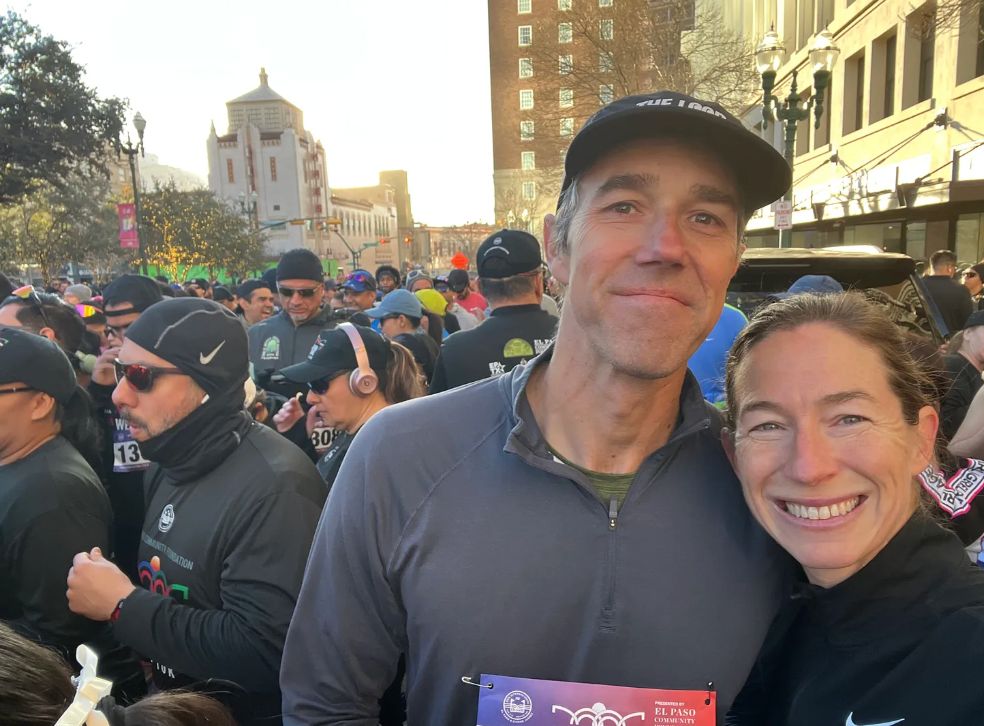
A voice on the PA counted down the final seconds and then we were off. You know what that looks like if you’ve ever run one of these. Shuffling, running, stopping because the person in front of you has stopped, walking, running again and then doing your best to both dodge those in the way and get out of the way of those dodging you. But no one went down or got hurt. A school of fish. Sometimes humans just figure it out.
Right away we were climbing. In the shadow of the triple-A Chihuahuas ballpark, the El Paso high school drum line was pounding and popping the code to get up this hill. I saw Amy in front of me and to the right but I couldn’t get close, too many people between us including some who were already walking. I moved to the other side of the street and zigzagged my way ahead.
From then on we were only barely connected. I’d look over my shoulder over the next mile and see Amy directly behind me and then a little later she’s to my right but further behind, and then finally I couldn’t see her. Usually she comes out strong and I’m the one catching up, so I figured she wasn’t feeling it today or was saving her strength.
Do I like running? I was asking myself. A little more than a mile in with five to go and my legs were heavy, my nose was running, my throat was dry. People were passing me on both sides. One person was wearing soccer cleats, another full-body flannel pajamas. They looked happy and at ease. I didn’t. The idea came into my head that maybe I wasn’t going to finish this race and should never run another one. No, I don’t like running at all I thought.
But… hearing that voice in my head that tells me to quit, and then not quitting, does something for me. I’ve passed this test of will and am now ready. For what? To finish the race. To run again, maybe. To keep going this time, and the next. Someone was holding a sign that said ¡Eres chingon! Each time my watch buzzed to tell me I’d completed another mile I felt a little stronger. I can do this. Maybe I do like running.
We ran past the Mexican consulate and then back through Segundo Barrio, the neighborhood of immigrants in a city of immigrants from which poets, revolutionaries and artists have come for as long as El Paso has existed. Segundo is where Lawrence Nixon practiced medicine and would later lead the fight to end racial segregation in voting; where Mariano Azuela—another physician turned activist—wrote Los de Abajo, the defining novel of the Mexican revolution; where Cimi Alvarado painted his murals and where Bert Williams and Nolan Richardson grew up, legends in sports and civil rights. We turned south on Stanton Street until it took us to the border, the toll collectors at the foot of the international bridge to Mexico cheering us on as we climbed the embankment to the top and then let our burning legs recover on the steep decline into Juárez.
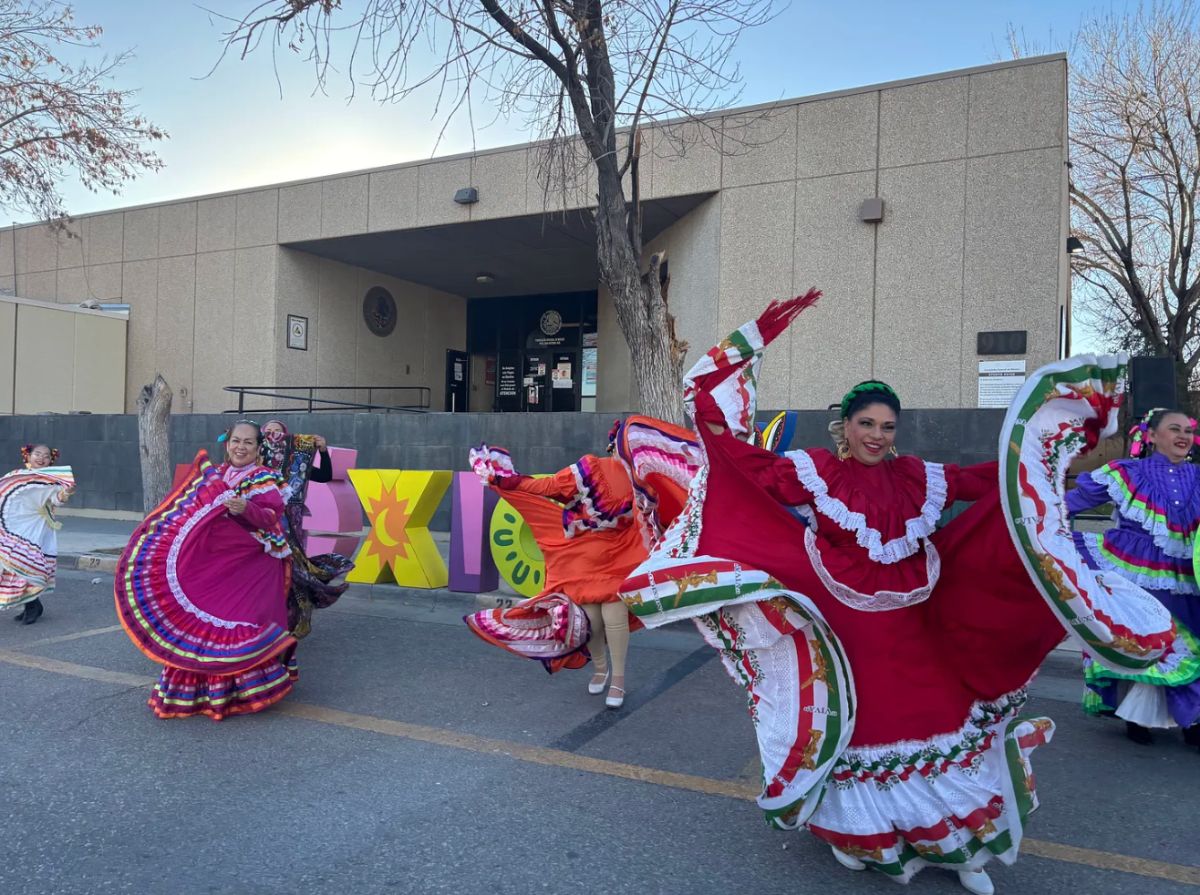
Passing the Mexican consulate in El Paso.
At the southern foot of the bridge a Juárez high school orchestra was playing Eye of the Tiger while the Mexican customs officers cheered and goaded the runners. Ya mero! one of them yelled. What’s he talking about? There’s four miles to go.
But at this point I’d found someone I could hang with, who was running my pace and seemed to be at the same level of fitness, mas o menos. I figured we’d help each other through. Was he American? Mexican? Neither of us could spare the energy to make conversation, there was no way to tell. But I was sure glad I found him, he kept me in the race.
We circled under the bridge and then headed due east for a mile or so, finally turning south and then west towards downtown Juárez. A guy just in front of me with big headphones over his head was singing a song in Spanish, in a big booming voice. How can he breathe and run this fast while singing this loud? I could barely stay with him. We passed a woman on the sidewalk holding a sign that said ¡No te conozco, pero eres mi héroe! We kept running towards the historic center of the city. Approaching the cathedral and the mission next to it that was founded in 1659, the strains of Dust in the Wind by Kansas belted out by a local artist hit my ears while my eyes were met by the first of many mimes.
They’d jump out at us from among the rest of the crowd every few minutes during that last mile and a half, black and white striped shirt, painted white face, yelling encouragement without making a sound, directing us to the big turn that would take us to Avenida Juárez, the home stretch.
Once I made that turn north, I knew I was going to be OK. Maybe I even looked happy. More mimes. Stray dogs. A couple of sharp looking high school kids dancing folklorico to a blaring boombox. People on both sides of the streets cheering, whistling, laughing, looking at their phones, taking a break from whatever a normal Saturday is to watch the race run by.
Kentucky Club on my left and then behind me. That’s where I took Amy on our first date. I remember Rodrigo was at the bar that night and we had margaritas with him before walking next door for dinner at Martinos. I turned to tell my new running partner that we were almost there but he was gone. So I focused on the next runner ahead, catching him after a few blocks. He recognized me and said Hey Beto! Let’s do this! And I said we’re almost there. He was breathing loudly, straining painful sounding breaths. I thought I probably sounded the same.
And then we came to the end of Avenida Juárez and began the final climb. Straight up the steep incline of the Paso del Norte bridge you go. The sister bridge of the one that we had crossed into Juárez. This one was bringing us back home.
As long as we could make it to the top.
But, of course, we did. That climb, which you think is going to kill you when you start it, and also when you’re in the middle of it, and just as you’re finishing it too, isn’t so bad after all. You emerge from it on top of the bridge, the finish line banner floating over the actual international boundary line. So your first footstep after the race is your first footstep back in the U.S.
I crossed the line, stopped the timer on my watch and not more than 10 seconds later Amy was next to me. She’d been gaining on me slowly ever since I thought I’d lost her. If the race had lasted another quarter mile she would have caught me.
Now on the U.S. side of the bridge, we caught our breath. Smiled, laughed about how hard that final climb was. The guy that I’d been running next to earlier in the race, the one who’d kept me in it when I needed it, came over and we shook hands, laughed and told each other we couldn’t have made it without the other. I still couldn’t tell which country he was from. Not that it matters. He was happy to be alive, to have finished the race, to have come through his doubt and pain. Just like me. We congratulated each other again, said see you out there.
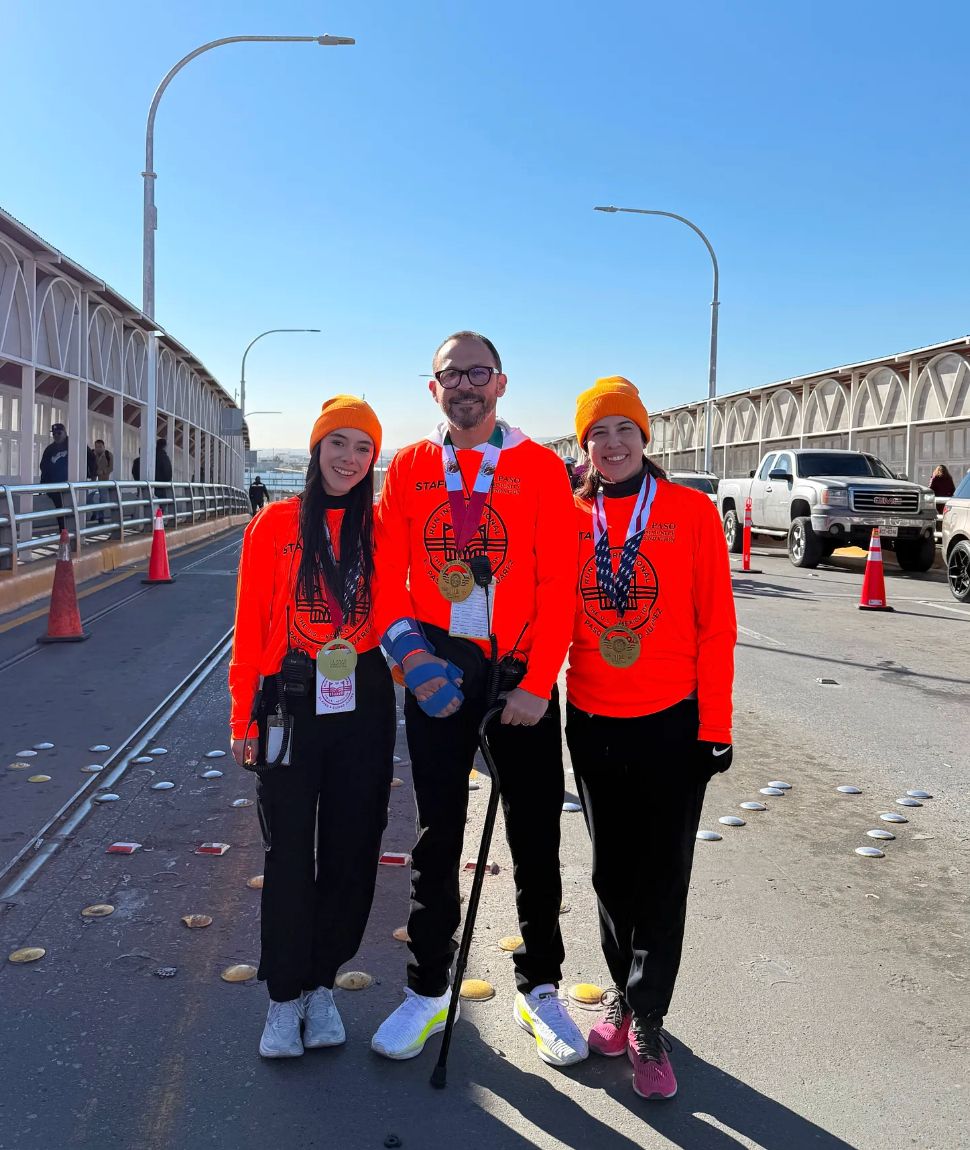
The team that put on the race: Sofia, Mario and Stephanie.
As I walked down the other side of the bridge—downtown El Paso ahead, Anapra Juárez to the left, the Franklin mountains to the right coming into full view—I ran into a Customs and Border Protection officer that I remember working with when I was in Congress. He’d help our office when we would request humanitarian assistance on behalf of a constituent, say someone in El Paso wanting to cross a family member to see their dad who lay dying at the county hospital; or a request to have a loved one come over for a funeral; or a Mexican national with a U.S. citizen child needing life-saving care. Almost always an emergency, often someone at the end of their life, a final wish. And he always tried to help, sometimes he could, sometimes it didn’t work out. But he understood the job. Vigilance against those who would harm us, those trying to break the law. Compassion towards those just doing their best at a trying time.
I wondered what he thought about all that has changed since then. Three people have died at the newly built ICE detention facility in east El Paso in just the last month and a half. And the intense militarization of our border at the same time that there is no effort to open up legal, humanitarian paths for people to flee persecution, join family, or find work—it’s killing people. Hundreds will take their last breaths here, anonymous, uncared for, uncelebrated, unloved in their final hour. (176 recorded deaths of migrants in the El Paso Border Patrol sector in 2024, the last year for which DHS has published information. In 2018, by comparison, there were six.)
The Gestapo transformation of immigration enforcement. The murder of Renee Good. The idea that at home or abroad might make right, and no longer will we care about the law, or what is decent or what is good. It’s brutality. Barbarism. Is that who we are?
Or are we this? I looked out at these beautiful people gathered atop this bridge that joins the largest binational community on the planet. Each of us having just pushed ourselves, some to extremes, and yet no one getting ahead at the expense of anyone else. In fact, the whole spirit of this thing was that we were encouraging each other, cheering each other on, celebrating this amazing place we are lucky enough to live in. Though we’re told we must be divided from one another, we’ve instead come together.
By the end of the race, with everyone on the bridge, you could no longer see the international boundary line meant to mark the separation between us.
Was he seeing what I was seeing? We shook hands and then Amy and I kept walking down the bridge towards El Paso and home.
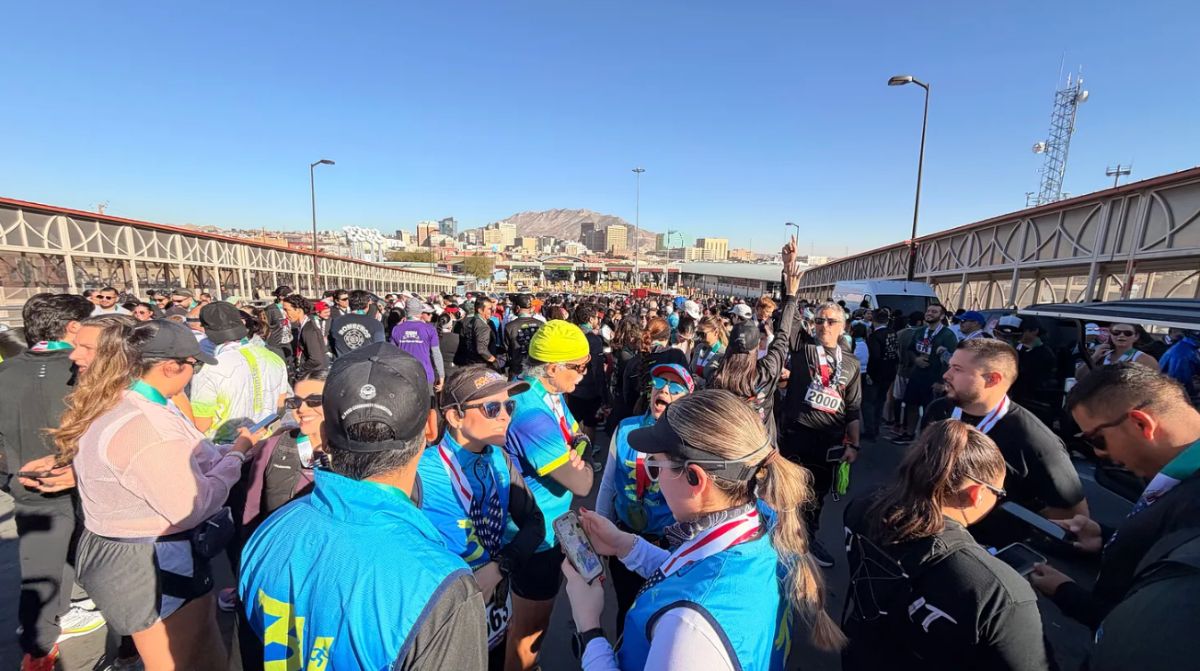
The finish line looking north to El Paso.
Thank you,
Beto
Powered by People volunteers reach, register and turn out voters by meeting them where they are and building personal relationships to significantly improve the likelihood that they vote.
