|
 |
Enjoy 25% off our annual subscription rate and get all-access to analysis and commentary from our expert strategists when you upgrade right now.
Tear down those paywalls and get all-access to Lincoln Square while making a direct investment in defending democracy.
Minneapolis Isn’t Who We Are. But It’s Who We Can Be Again.
Hope isn’t naïve. It’s the choice to believe that “this isn’t who we are” can still become “this is who we chose to be.”
|
| |||||||||||||||


Trygve Olson is a strategist, pro-democracy fighter and a founding Lincoln Project advisor. Subscribe to his Searching for Hope Substack.
 |
The cold of -14 below zero hit my face as I walked out of the plane yesterday at Minneapolis–St. Paul airport, and I immediately felt at ease. My life’s journey has taken me around the world, and no matter where the remaining years take me, my favorite sight will always be that bridge over the St. Croix River on I-94 — the one that tells me I’m home.
Too often, though, what brings me home these days are funerals — for the parents of friends who shaped my life, who remind me that I’ve now become the people they were when I was young. The circle of life is humbling that way. It gives you the gift of returning, but always with a touch of loss.
This time, though, the joy of being home felt different. It wasn’t just nostalgia. It was the tension in the air — the unease of what’s happening in the place that will always be home.
It started almost immediately. As I came down the escalator toward the rental car counter, I was stopped by a couple of Minneapolis police officers who politely told us to wait. There were protests, they said.
I’ve seen protests all over the world — from those demanding democracy in Vilnius to those crushed by dictators in Minsk — but standing there, hearing that word protests in my home state, it hit differently.
After a few minutes, we were waved through. As I hopped on the train to the rental car counter, I was joined by a few people bundled up against the cold, holding signs — and two Minneapolis police officers. Me being me, I started a conversation.
The couple had come from Forest Lake, a suburb outside the Twin Cities. They told me they “weren’t particularly political.” The husband said, “We decided to go today because this just isn’t who we are.” As we talked, I glanced toward the two cops who appeared to be listening in. Both were smiling. I swear one even nodded in agreement when the man said those words — this isn’t who we are.
That phrase stuck with me all weekend.
The funeral was for my best friend’s dad, Tom. There was nothing sad about it. He had 97 good years — taught, raised his boys with his wife of over sixty-five years, went to mass every Sunday, and lived in his home right up until the last few days of his life. In small towns like mine, funerals like that fill every pew.
I was late — which would’ve made Tom smile. He used to say, “If you’re a few minutes late, mass goes faster.” I walked in the back and was greeted by Jim, another friend’s dad and part of the American Legion honor guard. Big hug. Bigger grin. Then I found myself sitting with some of the youngest brothers’ friends — guys five years behind me, my sister’s age. There were man hugs and quick catch-ups, to the mild annoyance of the folks in front of us who turned around mid-eye-roll and broke into smiles when they realized who it was.
After the service, as tradition demands, we all headed down to Johnny’s Bar to toast Tom and “update files.” Forty, maybe fifty of us. A multi-class reunion. Everyone knew a little about everyone else from Facebook — which, strangely, made it easier. You skip the small talk and go straight to what matters.
These are the moments I treasure — being with people who’ve known you, appreciated you, and loved you your whole life. There’s comfort in that, especially when you’re one of the ones who left. One who’s always hoped the road might lead back home.

I tend to compartmentalize my online life. X and Bluesky get my professional takes. Facebook is personal. Substack bridges the two — mostly because I posted some of my Substack on Facebook.
Turns out some of you reading this were at Johnny’s or Kealy’s. You told me you’ve been following what I write here, and I can’t tell you how much that meant.
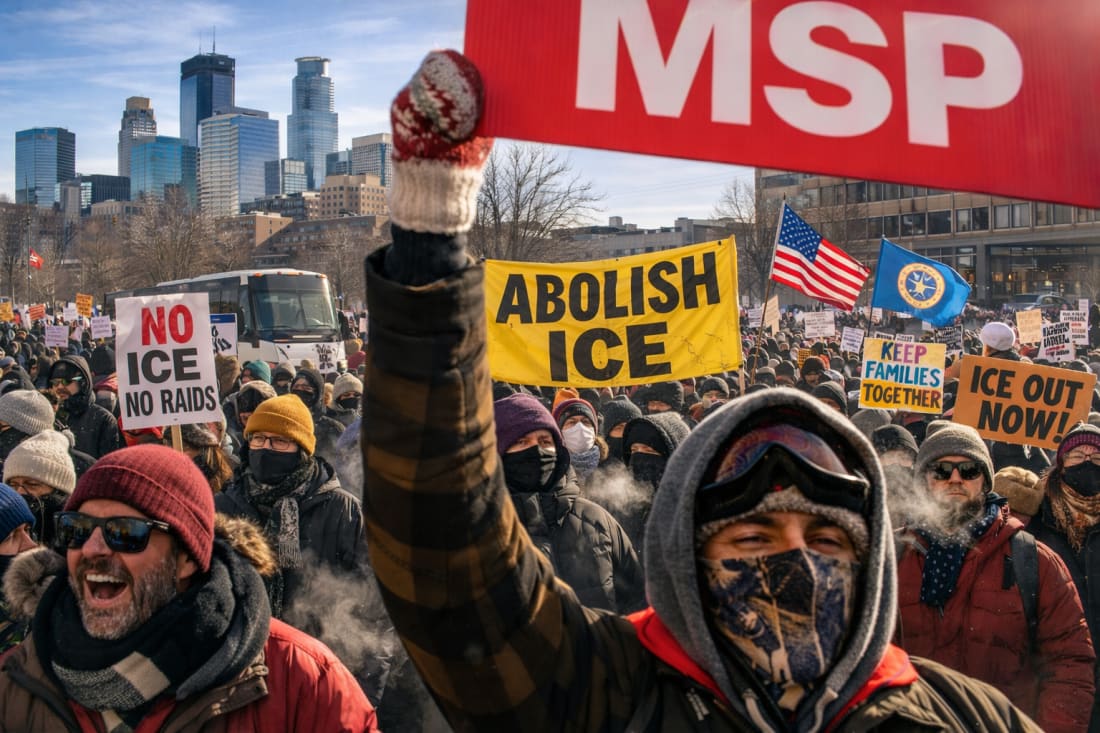
Because of the work I’ve done for decades — in politics, democracy, and strategy — when I’m back home people want to talk about what’s happening in the world. But this time was different. Friends who had backed Trump. Friends who had loathed him. Almost everyone wanted to talk about what’s happening in the Twin Cities.
And there it was again — that phrase from the airport train. “This isn’t who we are.”
There was near-universal agreement on that. What I heard wasn’t political outrage. It was concern — fear, even. People who’ve never marched for anything are suddenly showing up with signs because something inside them won’t let them stay silent.
One friend who once proudly wore a MAGA hat told me he went to the protest after the ICE shooting. “I don’t want rapists and murderers on the streets,” he said. “But I don’t want the government or the people on TV telling me I didn’t see what I saw with my own eyes. That’s what they tried to do with Biden too.”
There was no talking-point in that. Just confusion and a sense that truth itself is being taken hostage.
Later that day, a college friend messaged me. Word spreads fast in small towns. They’d been downtown at the protests and sent pictures. This was someone who had never been political. Ever. That’s when I knew something real is happening — ordinary people deciding silence is no longer an option.
Now, sitting on a plane back to DC, I find myself thinking about another flight, years ago — from Belgrade to Frankfurt. I had been in Serbia working with students risking their lives to oppose the Milosevic regime. As the plane lifted off, I remember thinking, this place will never change.
Eighteen months later, those same students led a peaceful revolution that ended his rule.
They were just regular people who finally said enough.
Of course, not every conversation back home was that hopeful. I also had beers with a few buddies still all-in on the movement fueling this moment. They, too, wanted to talk. Mostly to ask me what I thought. Instead of telling them, I asked why they felt as they did.
Many of them are the kind of people who’d give you the shirt off their back. They coach little league and youth hockey, donate to the church raffle, show up with a snowblower when your dad’s sick. There’s a dissonance between how they live and what they support politically.
The easy path would’ve been to let them off the hook — answer their questions, nod along. But that’s not how this gets fixed.
What we’re facing isn’t about what I think. It’s about helping people see the gap between who they are and what they’re being told to believe. Between the decency they live every day and the fear being pumped into their information streams. Between what they know is true — and the gaslighting that tells them it’s not.
I’ve spent my life fighting for democracy around the world. What I’m realizing now is that the battle isn’t just out there — it’s here. It’s at our kitchen tables, in small-town bars, at airport train stations. It’s in the quiet courage of people who finally say, “This isn’t who we are.”
Home isn’t just where we’re from. It’s what we choose to stand for.
And maybe — just maybe — the people who show up for funerals, hug in church basements, coach youth hockey and little league, shovel their neighbor’s driveway, and still believe in kindness over cruelty — maybe they’re the ones who will remind all of us who we really are.
 | A guest post by
|
Not ready to subscribe? Make a one-time donation of $10 or more to support our work amplifying the facts on social media, targeted to voters in red states and districts that we can help flip. Every $10 reaches 1000 Americans. The Truth needs a voice. Your donation will help us amplify it.
| ||||||||||

