
Email
Lighting the Path Forward in Nicaragua & Trinational Declaration on USMCA
| From | Quixote Center <[email protected]> |
| Subject | Lighting the Path Forward in Nicaragua & Trinational Declaration on USMCA |
| Date | January 24, 2026 3:02 PM |
Links have been removed from this email. Learn more in the FAQ.
Links have been removed from this email. Learn more in the FAQ.
If you are having trouble viewing this message, go here: [link removed]
 
Lighting the Path Forward: Inspiring Results from Our Nicaragua Pilot with CacaoNica
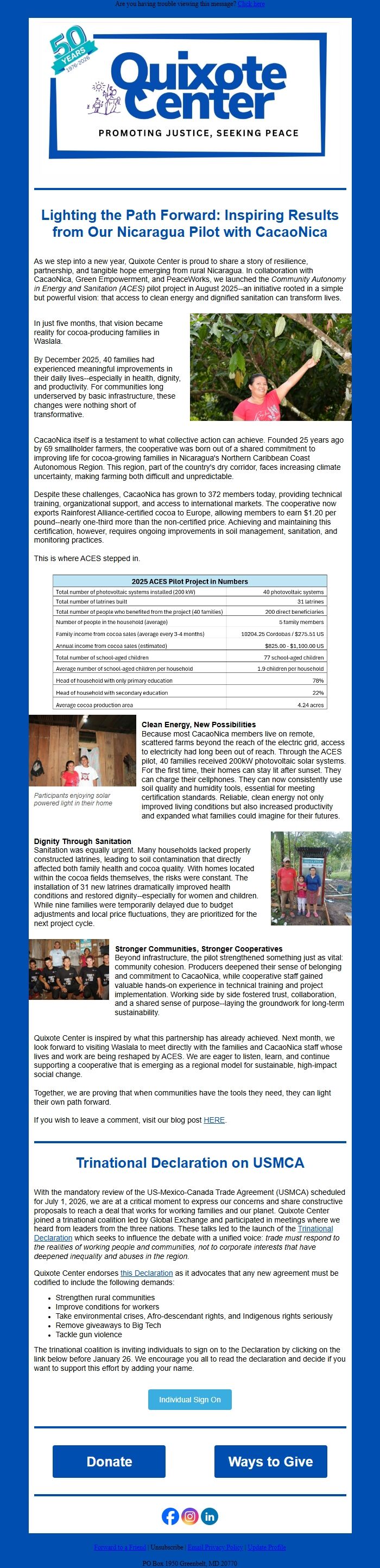
As we step into a new year, Quixote Center is proud to share a story of resilience, partnership, and tangible hope emerging from rural Nicaragua. In collaboration with CacaoNica, Green Empowerment, and PeaceWorks, we launched the Community Autonomy in Energy and Sanitation (ACES) pilot project in August 2025--an initiative rooted in a simple but powerful vision: that access to clean energy and dignified sanitation can transform lives.
In just five months, that vision became reality for cocoa-producing families in Waslala.
By December 2025, 40 families had experienced meaningful improvements in their daily lives--especially in health, dignity, and productivity. For communities long underserved by basic infrastructure, these changes were nothing short of transformative.
CacaoNica itself is a testament to what collective action can achieve. Founded 25 years ago by 69 smallholder farmers, the cooperative was born out of a shared commitment to improving life for cocoa-growing families in Nicaragua's Northern Caribbean Coast Autonomous Region. This region, part of the country's dry corridor, faces increasing climate uncertainty, making farming both difficult and unpredictable.
Despite these challenges, CacaoNica has grown to 372 members today, providing technical training, organizational support, and access to international markets. The cooperative now exports Rainforest Alliance-certified cocoa to Europe, allowing members to earn $1.20 per pound--nearly one-third more than the non-certified price. Achieving and maintaining this certification, however, requires ongoing improvements in soil management, sanitation, and monitoring practices.
This is where ACES stepped in.
Participants enjoying solar powered light in their home
Clean Energy, New Possibilities
Because most CacaoNica members live on remote, scattered farms beyond the reach of the electric grid, access to electricity had long been out of reach. Through the ACES pilot, 40 families received 200kW photovoltaic solar systems. For the first time, their homes can stay lit after sunset. They can charge their cellphones. They can now consistently use soil quality and humidity tools, essential for meeting certification standards. Reliable, clean energy not only improved living conditions but also increased productivity and expanded what families could imagine for their futures.
Dignity Through Sanitation
Sanitation was equally urgent. Many households lacked properly constructed latrines, leading to soil contamination that directly affected both family health and cocoa quality. With homes located within the cocoa fields themselves, the risks were constant. The installation of 31 new latrines dramatically improved health conditions and restored dignity--especially for women and children. While nine families were temporarily delayed due to budget adjustments and local price fluctuations, they are prioritized for the next project cycle.
Stronger Communities, Stronger Cooperatives
Beyond infrastructure, the pilot strengthened something just as vital: community cohesion. Producers deepened their sense of belonging and commitment to CacaoNica, while cooperative staff gained valuable hands-on experience in technical training and project implementation. Working side by side fostered trust, collaboration, and a shared sense of purpose--laying the groundwork for long-term sustainability.
Quixote Center is inspired by what this partnership has already achieved. Next month, we look forward to visiting Waslala to meet directly with the families and CacaoNica staff whose lives and work are being reshaped by ACES. We are eager to listen, learn, and continue supporting a cooperative that is emerging as a regional model for sustainable, high-impact social change.
Together, we are proving that when communities have the tools they need, they can light their own path forward.
If you wish to leave a comment, visit our blog post HERE ([link removed]).
 
Trinational Declaration on USMCA
With the mandatory review of the US-Mexico-Canada Trade Agreement (USMCA) scheduled for July 1, 2026, we are at a critical moment to express our concerns and share constructive proposals to reach a deal that works for working families and our planet. Quixote Center joined a trinational coalition led by Global Exchange and participated in meetings where we heard from leaders from the three nations. These talks led to the launch of the Trinational Declaration ([link removed]) which seeks to influence the debate with a unified voice: trade must respond to the realities of working people and communities, not to corporate interests that have deepened inequality and abuses in the region.
Quixote Center endorses this Declaration ([link removed]) as it advocates that any new agreement must be codified to include the following demands:
* Strengthen rural communities
* Improve conditions for workers
* Take environmental crises, Afro-descendant rights, and Indigenous rights seriously
* Remove giveaways to Big Tech
* Tackle gun violence
The trinational coalition is inviting individuals to sign on to the Declaration by clicking on the link below before January 26. We encourage you all to read the declaration and decide if you want to support this effort by adding your name.
Individual Sign On ([link removed])
 
Donate ([link removed])
Ways to Give ([link removed])
 
([link removed]) ([link removed]) ([link removed])
Forward to a Friend:
[link removed]
Unsubscribe:
[link removed]
Email Privacy Policy:
[link removed]
Update Profile:
[link removed]
PO Box 1950 Greenbelt, MD 20770
 
Lighting the Path Forward: Inspiring Results from Our Nicaragua Pilot with CacaoNica
As we step into a new year, Quixote Center is proud to share a story of resilience, partnership, and tangible hope emerging from rural Nicaragua. In collaboration with CacaoNica, Green Empowerment, and PeaceWorks, we launched the Community Autonomy in Energy and Sanitation (ACES) pilot project in August 2025--an initiative rooted in a simple but powerful vision: that access to clean energy and dignified sanitation can transform lives.
In just five months, that vision became reality for cocoa-producing families in Waslala.
By December 2025, 40 families had experienced meaningful improvements in their daily lives--especially in health, dignity, and productivity. For communities long underserved by basic infrastructure, these changes were nothing short of transformative.
CacaoNica itself is a testament to what collective action can achieve. Founded 25 years ago by 69 smallholder farmers, the cooperative was born out of a shared commitment to improving life for cocoa-growing families in Nicaragua's Northern Caribbean Coast Autonomous Region. This region, part of the country's dry corridor, faces increasing climate uncertainty, making farming both difficult and unpredictable.
Despite these challenges, CacaoNica has grown to 372 members today, providing technical training, organizational support, and access to international markets. The cooperative now exports Rainforest Alliance-certified cocoa to Europe, allowing members to earn $1.20 per pound--nearly one-third more than the non-certified price. Achieving and maintaining this certification, however, requires ongoing improvements in soil management, sanitation, and monitoring practices.
This is where ACES stepped in.
Participants enjoying solar powered light in their home
Clean Energy, New Possibilities
Because most CacaoNica members live on remote, scattered farms beyond the reach of the electric grid, access to electricity had long been out of reach. Through the ACES pilot, 40 families received 200kW photovoltaic solar systems. For the first time, their homes can stay lit after sunset. They can charge their cellphones. They can now consistently use soil quality and humidity tools, essential for meeting certification standards. Reliable, clean energy not only improved living conditions but also increased productivity and expanded what families could imagine for their futures.
Dignity Through Sanitation
Sanitation was equally urgent. Many households lacked properly constructed latrines, leading to soil contamination that directly affected both family health and cocoa quality. With homes located within the cocoa fields themselves, the risks were constant. The installation of 31 new latrines dramatically improved health conditions and restored dignity--especially for women and children. While nine families were temporarily delayed due to budget adjustments and local price fluctuations, they are prioritized for the next project cycle.
Stronger Communities, Stronger Cooperatives
Beyond infrastructure, the pilot strengthened something just as vital: community cohesion. Producers deepened their sense of belonging and commitment to CacaoNica, while cooperative staff gained valuable hands-on experience in technical training and project implementation. Working side by side fostered trust, collaboration, and a shared sense of purpose--laying the groundwork for long-term sustainability.
Quixote Center is inspired by what this partnership has already achieved. Next month, we look forward to visiting Waslala to meet directly with the families and CacaoNica staff whose lives and work are being reshaped by ACES. We are eager to listen, learn, and continue supporting a cooperative that is emerging as a regional model for sustainable, high-impact social change.
Together, we are proving that when communities have the tools they need, they can light their own path forward.
If you wish to leave a comment, visit our blog post HERE ([link removed]).
 
Trinational Declaration on USMCA
With the mandatory review of the US-Mexico-Canada Trade Agreement (USMCA) scheduled for July 1, 2026, we are at a critical moment to express our concerns and share constructive proposals to reach a deal that works for working families and our planet. Quixote Center joined a trinational coalition led by Global Exchange and participated in meetings where we heard from leaders from the three nations. These talks led to the launch of the Trinational Declaration ([link removed]) which seeks to influence the debate with a unified voice: trade must respond to the realities of working people and communities, not to corporate interests that have deepened inequality and abuses in the region.
Quixote Center endorses this Declaration ([link removed]) as it advocates that any new agreement must be codified to include the following demands:
* Strengthen rural communities
* Improve conditions for workers
* Take environmental crises, Afro-descendant rights, and Indigenous rights seriously
* Remove giveaways to Big Tech
* Tackle gun violence
The trinational coalition is inviting individuals to sign on to the Declaration by clicking on the link below before January 26. We encourage you all to read the declaration and decide if you want to support this effort by adding your name.
Individual Sign On ([link removed])
 
Donate ([link removed])
Ways to Give ([link removed])
 
([link removed]) ([link removed]) ([link removed])
Forward to a Friend:
[link removed]
Unsubscribe:
[link removed]
Email Privacy Policy:
[link removed]
Update Profile:
[link removed]
PO Box 1950 Greenbelt, MD 20770
Message Analysis
- Sender: n/a
- Political Party: n/a
- Country: n/a
- State/Locality: n/a
- Office: n/a