|
Inside the Gun Industry’s Closed-Door World
How a private trade show helps shape what becomes normal in American gun culture.
|

| |||||||||||||||


 |
For much of the twentieth century, the tobacco industry deflected scrutiny by framing harm as a matter of individual choice. Smoking was presented as a personal risk, even as companies coordinated advertising, distribution, and legal strategy on a national scale. When the industry was finally held to account, the revelation was not simply that cigarettes were dangerous. It was that danger had been systematically organized, defended, and normalized long before it appeared as a public health crisis.
Gun violence in the United States is still discussed in a markedly different register. It is treated as episodic, arriving through breaking alerts and crime scenes rather than through sustained examination of the market that supplies the weapons. What remains largely unexamined are the industry spaces where the gun business gathers to preview products, reinforce norms, and align priorities well before violence enters public view.

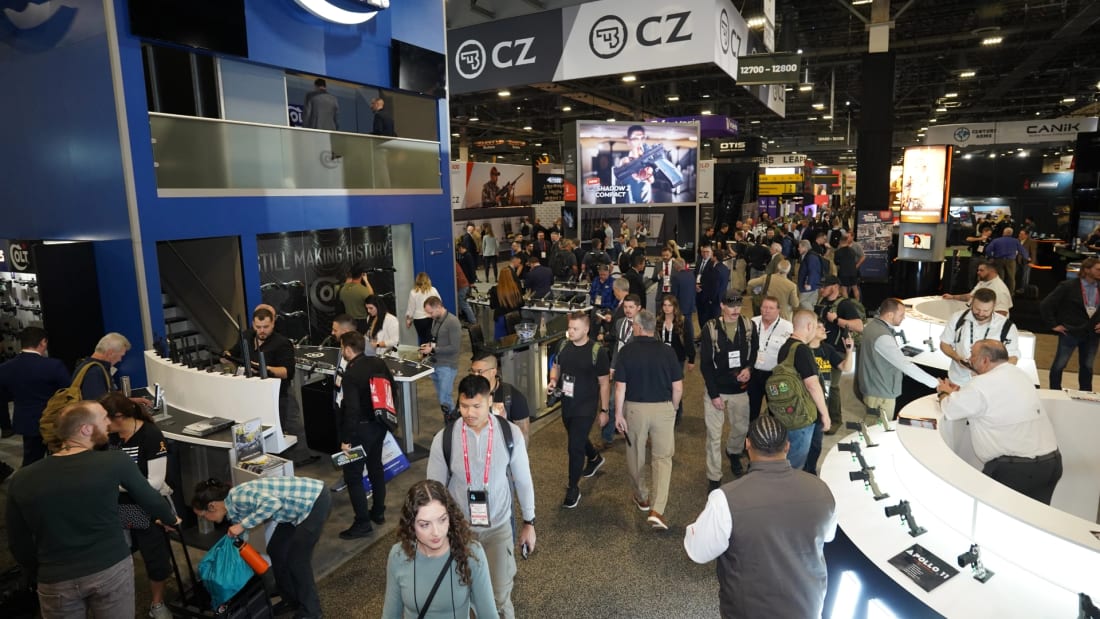
Each year, tens of thousands of people involved in the firearms trade travel to Las Vegas for the SHOT Show, the industry’s largest annual convention. The event is closed to the general public and limited to exhibitors, bulk purchasers such as wholesalers and retailers, certain law enforcement and military representatives, and firearms media. Hosted by the National Shooting Sports Foundation, the show is explicitly commercial in purpose. It is designed to facilitate sales, partnerships, and expansion, not public debate.
The scale of the convention is unmistakable. The exhibition floor spans miles, packed with firearms, ammunition, and tactical gear presented with the polish of a major consumer trade show. Manufacturers debut new models, distributors discuss bulk purchases, and marketing language is tested and refined. In the evenings, the industry gathers for private events and celebrations, even as gun violence occupies headlines elsewhere.
The SHOT Show is less a site of singular decisions than a space where assumptions are reinforced. Growth is taken as a given. Innovation is measured in performance and marketability, detached from social consequence. With little external scrutiny, questions of public safety remain marginal. Over time, this environment shapes which products receive investment and how aggressively the civilian market is pursued.
Many of the industry’s most controversial products have passed through this setting: devices that simulate automatic fire, untraceable firearms assembled from parts, even a scaled-down AR-15 marketed to children. Individually, such products are often dismissed as anomalies. Together, they reflect a market that steadily pushes toward greater lethality and wider distribution, with few internal limits.
The SHOT Show is not only an industry gathering; it is also central to the finances of the organization that runs it. The National Shooting Sports Foundation derives the majority of its revenue from the convention, funds that support lobbying and legal efforts to oppose gun safety legislation. As the NRA has weakened under scandal and litigation, the NSSF has grown more influential, operating with less public visibility while advancing many of the same policy goals.
The show’s internal rules reveal a telling contrast: personal firearms and ammunition are prohibited. Display weapons are rendered inoperable and inspected. Within the convention hall, safety is enforced as nonnegotiable. Outside its walls, the industry continues to argue against comparable safeguards for the public.
Conspicuously absent from the expo floor are the people most affected by gun violence. Families who have lost loved ones do not attend. Students shaped by lockdown drills do not attend. Communities living with chronic gunfire are not invited into the conversation. Decisions about products that will circulate nationally are made without their participation or consent, in spaces designed to exclude those who would complicate the industry’s assumptions.
That exclusion creates a familiar pattern. Like other industries that profited from harm, the gun industry benefits from distance between decision and consequence. The damage appears later, elsewhere, and disconnected from its source. When violence occurs, attention settles on the aftermath, not the machinery that made it more likely.
Gun violence is often described as inevitable. History suggests something more precise: harm becomes permanent when the systems that sustain it remain unexamined.
Thanks for reading! Subscribe to stay connected to the young leaders, stories, and ideas shaping the future of this movement.
| ||||||||||

