|
 |


By Amy Sapola, Pharm.D., Functional Medicine Practitioner, Contributor, The MAHA Report
Americans are not only suffering from a chronic disease epidemic, but many are also suffering from a deep spiritual – even existential – crisis that requires healing.
This truth sits quietly—but powerfully—at the center of A Woman in the Wild, a novel by Tad Crawford that feels unexpectedly aligned with the MAHA movement. While the book is not written as social commentary, it explores a parallel truth now reflected in federal priorities. Policy can create better conditions for health, but people must choose to make difficult changes. Only their own initiative and commitment will send them on a path toward healing.
 |
A Woman in the Wild follows Thea Firth, a psychologist whose life unravels after her daughter is sexually abused by her second husband. Thea had a chance to change this outcome, but failed to decisively intervene. What follows is neither a clinical case study nor a story of diagnosis and treatment. Instead, Crawford examines what happens when professional training, institutional frameworks, and good intentions prove insufficient—and what healing demands when certainty collapses.
Thea’s response is not a rejection of structure, but a recalibration of it. She steps away from her practice and daily life and retreats to a remote mountain setting known as the Institute for Healing and Transformation. There, healing is grounded in fundamentals often displaced by modern life: regular time outdoors, daily hiking, shared meals, periods of sustained—sometimes uncomfortable—silence, and deliberate reflection. Within that quiet, Thea begins to interrupt cycles of rumination and self-blame that have kept her psychologically stuck, creating space for awareness and healing.
Nature, Reflection, and the Conditions for Change
One of the novel’s central insights is that stepping away from constant stimulation and routine can create the conditions for healing. When I asked Crawford what “the wild” symbolizes, he described it as both physical and internal—“a place outside of our everyday awareness,” he said, reflecting “the power and being of nature” and offering “a chance to go back to essential being and seek what is healthy there.”
That framing aligns closely with established research on stress physiology, nervous system regulation, and mental health. Time in nature, reduced sensory overload, and regular physical movement are associated with improved sleep, lower cortisol levels, and greater emotional resilience—the same foundational inputs now being elevated in federal conversations about prevention and long-term wellbeing.
The Institute in the novel is oriented toward inputs modern life often neglects. Crawford describes it as a place grounded in hope—that people can heal when given time, space, and the right conditions.
As HHS works to improve the nutritional landscape and reduce chronic disease, this distinction matters. Systems can create opportunity; individuals still have to seize it.
Healing Beyond Institutional Control
Lucas Lamont—referred to by staff as “the Bear Man”—emerges as one of the novel’s most consequential figures, even though he no longer speaks. Found living in the wilderness after traveling with a bear, he arrives at the Institute, met not with curiosity, but fear and uncertainty. The institutional response is swift and familiar: confinement, sedation, and supervision.
 |
The Bear Man is placed in a locked room and given sedatives not because he has harmed anyone, but because, as Crawford put it, “nobody knows what to do with him.” Containment replaces understanding.
Thea is troubled by this response and begins to push back. She insists that The Bear Man be called by his name, allowed outside, given an apartment of his own, and trusted to live as a human being rather than treated as a problem to be controlled. Her resistance reflects Crawford’s broader insight about healing: when familiar methods fail, default responses often prioritize control over curiosity.
Crawford notes that Lucas’s story is driven by grief and the limits of conventional responses to it. “The bear is a manifestation of our inner need for healing,” he explained—something that emerges when “grief, stress, or loss overwhelms ordinary coping mechanisms.” In that context, Thea’s advocacy for Lucas becomes more than an ethical stance; it marks a shift in her own healing. By challenging how the system responds to The Bear Man, she begins to confront the internalized patterns—self-blame, paralysis, and fear—that have kept her stuck.
Writing, Listening, and Self-Trust
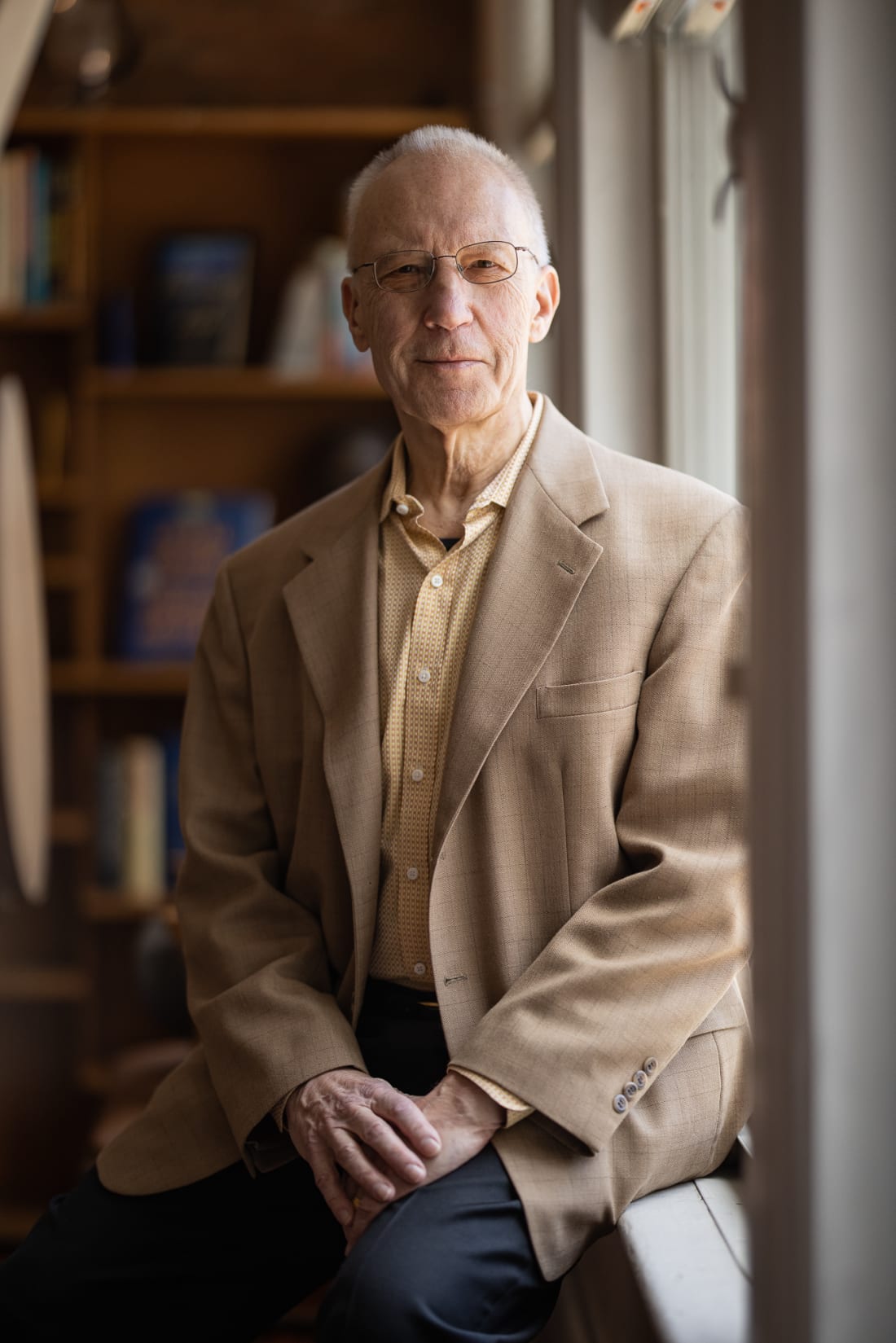
Crawford’s writing process mirrors these themes of listening and trust. Trained as an attorney at Columbia Law School and founder of Allworth Press, he returned to fiction not through rigid structure, but through attentive observation. “My writing process is a process of surprise,” he told me. He writes without fixed endings, allowing the story to unfold rather than forcing it.
Dreams play a central role. “Before I go to sleep, I say, if I dream tonight, I would be very appreciative if I could remember my dream,” he explained, often waking to write it down before returning to sleep. During the day, he keeps constant notes, aware that insight can surface briefly and disappear just as quickly. “Things flit in and out of your mind,” he said. “If you don’t note it down, it won’t make it onto the page.”
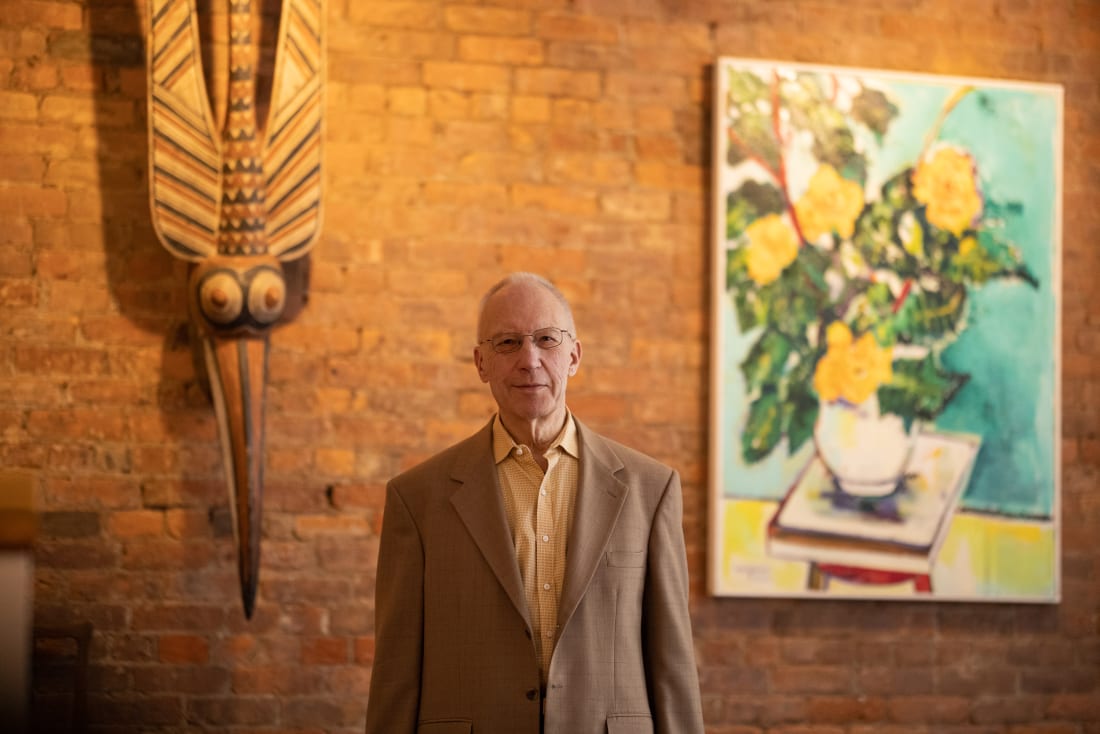 |
This receptivity developed over years of Jungian analysis, which oriented him toward the unconscious as a source of creative insight. “I believe in the power of the unconscious,” Crawford said, noting that he often does not know how a book will end while he’s writing it. A Woman in the Wild took seven years to complete and was transformed multiple times along the way.
Even then, the process remained collaborative. Crawford relied on a circle of readers to test and refine the work. “When I came to revise the book,” he said, “I found that I used almost all of their insights, and the final result was stronger for their having participated.”
His process offers a literary reminder of a principle echoed across contemplative traditions: when noise recedes, and attention deepens, insight does not need to be forced—it arises.
Grounded Optimism for the MAHA Moment
Importantly, A Woman in the Wild does not offer a tidy resolution. Thea is not “fixed.” There is no dramatic rescue, no symbolic cure, and no illusion that healing unfolds on a clean timeline. Crawford resists a familiar—and often hollow—narrative: the idea that a woman’s suffering is resolved when the right man arrives. This is not that story.
Instead, Crawford insists on psychological realism. Healing, when it is real, is ongoing, non-linear, and earned through attention rather than certainty. Thea’s progress depends not on being saved, but on her willingness to face what has broken, listen more honestly, and act with greater clarity—often in uncomfortable ways.
That restraint is precisely what gives the novel its power.
Crawford told me he hopes readers finish the book with a grounded sense of possibility. “No matter how difficult a situation appears,” he said, “there is some redeeming possibility,” if a person is willing to face what is truly difficult and continue the journey.
This is where A Woman in the Wild aligns with the MAHA movement. As federal policy moves toward prevention, nutrition quality, and the everyday conditions that shape health, the novel offers a necessary reminder. Even as systems improve and institutions change, healing still requires individual participation. The book invites readers to step out of habitual noise, make room for silence, and listen more carefully—to their bodies, their values, and the signals they have long overlooked.
For readers skeptical of easy resolutions, for MAHA moms who know healing cannot be outsourced, and for anyone committed to making America healthier—personally or collectively—A Woman in the Wild is not just worth reading. It is a novel that meets the moment.
Thank you for subscribing to The MAHA Report
You can follow us at: TheMAHA_Report on X
You can also follow us at: MAHA Action on Facebook
Make America Healthy Again™ and MAHA™ are trademarks owned by MAHA TM LLC
| ||||||||||

