
Email
A new year and a huge breakthrough!
| From | Henry from Diabetes UK <[email protected]> |
| Subject | A new year and a huge breakthrough! |
| Date | January 22, 2026 4:30 PM |
Links have been removed from this email. Learn more in the FAQ.
Links have been removed from this email. Learn more in the FAQ.
Your January e-Newsletter
View in browser [link removed]
( [link removed] )
( [link removed] )
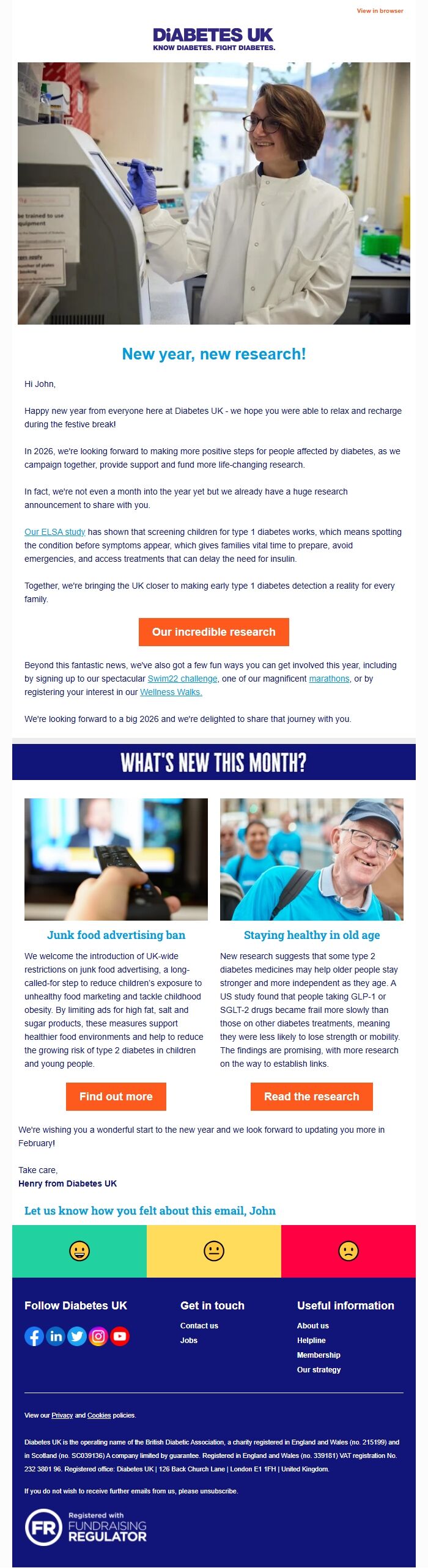
New year, new research!
Hi John,
Happy new year from everyone here at Diabetes UK - we hope you were able to relax and recharge during the festive break!
In 2026, we're looking forward to making more positive steps for people affected by diabetes, as we campaign together, provide support and fund more life-changing research.
In fact, we're not even a month into the year yet but we already have a huge research announcement to share with you.
Our ELSA study ( [link removed] ) has shown that screening children for type 1 diabetes works, which means spotting the condition before symptoms appear, which gives families vital time to prepare, avoid emergencies, and access treatments that can delay the need for insulin.
Together, we're bringing the UK closer to making early type 1 diabetes detection a reality for every family.
Our incredible research ( [link removed] )
Beyond this fantastic news, we've also got a few fun ways you can get involved this year, including by signing up to our spectacular Swim22 challenge ( [link removed] ), one of our magnificent marathons ( [link removed] ), or by registering your interest in our Wellness Walks ( [link removed] ). ( [link removed] )
( [link removed] )
We're looking forward to a big 2026 and we're delighted to share that journey with you. ( [link removed] )
( [link removed] )
Junk food advertising ban
We welcome the introduction of UK-wide restrictions on junk food advertising, a long-called-for step to reduce children’s exposure to unhealthy food marketing and tackle childhood obesity. By limiting ads for high fat, salt and sugar products, these measures support healthier food environments and help to reduce the growing risk of type 2 diabetes in children and young people.
Find out more ( [link removed] )
( [link removed] )
Staying healthy in old age
New research suggests that some type 2 diabetes medicines may help older people stay stronger and more independent as they age. A US study found that people taking GLP-1 or SGLT-2 drugs became frail more slowly than those on other diabetes treatments, meaning they were less likely to lose strength or mobility. The findings are promising, with more research on the way to establish links.
Read the research ( [link removed] )
We're wishing you a wonderful start to the new year and we look forward to updating you more in February!
( [link removed] )
Take care,
Henry from Diabetes UK
( [link removed] )
( [link removed] )
Let us know how you felt about this email, John
😀 ( [link removed] )
😐 ( [link removed] )
🙁 ( [link removed] )
Follow Diabetes UK
( [link removed] )
( [link removed] )
( [link removed] )
( [link removed] )
( [link removed] )
Get in touch
Contact us ( [link removed] )
Jobs ( [link removed] )
Useful information
About us ( [link removed] )
Helpline ( [link removed] )
Membership ( [link removed] )
Our strategy ( [link removed] )
View our Privacy ( [link removed] ) and Cookies ( [link removed] ) policies.
Diabetes UK is the operating name of the British Diabetic Association, a charity registered in England and Wales (no. 215199) and in Scotland (no. SC039136) A company limited by guarantee. Registered in England and Wales (no. 339181) VAT registration No. 232 3801 96. Registered office: Diabetes UK | 126 Back Church Lane | London E1 1FH | United Kingdom.
If you do not wish to receive further emails from us, please unsubscribe [link removed].
View in browser [link removed]
( [link removed] )
( [link removed] )
New year, new research!
Hi John,
Happy new year from everyone here at Diabetes UK - we hope you were able to relax and recharge during the festive break!
In 2026, we're looking forward to making more positive steps for people affected by diabetes, as we campaign together, provide support and fund more life-changing research.
In fact, we're not even a month into the year yet but we already have a huge research announcement to share with you.
Our ELSA study ( [link removed] ) has shown that screening children for type 1 diabetes works, which means spotting the condition before symptoms appear, which gives families vital time to prepare, avoid emergencies, and access treatments that can delay the need for insulin.
Together, we're bringing the UK closer to making early type 1 diabetes detection a reality for every family.
Our incredible research ( [link removed] )
Beyond this fantastic news, we've also got a few fun ways you can get involved this year, including by signing up to our spectacular Swim22 challenge ( [link removed] ), one of our magnificent marathons ( [link removed] ), or by registering your interest in our Wellness Walks ( [link removed] ). ( [link removed] )
( [link removed] )
We're looking forward to a big 2026 and we're delighted to share that journey with you. ( [link removed] )
( [link removed] )
Junk food advertising ban
We welcome the introduction of UK-wide restrictions on junk food advertising, a long-called-for step to reduce children’s exposure to unhealthy food marketing and tackle childhood obesity. By limiting ads for high fat, salt and sugar products, these measures support healthier food environments and help to reduce the growing risk of type 2 diabetes in children and young people.
Find out more ( [link removed] )
( [link removed] )
Staying healthy in old age
New research suggests that some type 2 diabetes medicines may help older people stay stronger and more independent as they age. A US study found that people taking GLP-1 or SGLT-2 drugs became frail more slowly than those on other diabetes treatments, meaning they were less likely to lose strength or mobility. The findings are promising, with more research on the way to establish links.
Read the research ( [link removed] )
We're wishing you a wonderful start to the new year and we look forward to updating you more in February!
( [link removed] )
Take care,
Henry from Diabetes UK
( [link removed] )
( [link removed] )
Let us know how you felt about this email, John
😀 ( [link removed] )
😐 ( [link removed] )
🙁 ( [link removed] )
Follow Diabetes UK
( [link removed] )
( [link removed] )
( [link removed] )
( [link removed] )
( [link removed] )
Get in touch
Contact us ( [link removed] )
Jobs ( [link removed] )
Useful information
About us ( [link removed] )
Helpline ( [link removed] )
Membership ( [link removed] )
Our strategy ( [link removed] )
View our Privacy ( [link removed] ) and Cookies ( [link removed] ) policies.
Diabetes UK is the operating name of the British Diabetic Association, a charity registered in England and Wales (no. 215199) and in Scotland (no. SC039136) A company limited by guarantee. Registered in England and Wales (no. 339181) VAT registration No. 232 3801 96. Registered office: Diabetes UK | 126 Back Church Lane | London E1 1FH | United Kingdom.
If you do not wish to receive further emails from us, please unsubscribe [link removed].
Message Analysis
- Sender: n/a
- Political Party: n/a
- Country: n/a
- State/Locality: n/a
- Office: n/a