
Email
New book explores how the CIW and Fair Food Program have become a global inspiration
| From | Coalition of Immokalee Workers <[email protected]> |
| Subject | New book explores how the CIW and Fair Food Program have become a global inspiration |
| Date | January 22, 2026 3:46 PM |
Links have been removed from this email. Learn more in the FAQ.
Links have been removed from this email. Learn more in the FAQ.
[[link removed]]
[link removed] [[link removed]]
Will Work for Food: “With a combination of education, monitoring, and enforcement, the Fair Food Program and the CIW have provided fertile ground for both preventing and addressing sexual violence in the workplace.”
“The CIW successfully looks up the food chain to the highest-profiting companies in retail and service and puts pressure on them to absorb the cost of higher worker wages at the farm level. Because of their successes, thousands of farmworkers like Lupe have benefited from better pay and working conditions.”
As the CIW’s Fair Food Program—and the broader Worker-driven Social Responsibility model to which it gave rise—continue to scale and be replicated in workplaces across the country and around the globe, a new book goes under the hood of the FFP to tell a remarkable story of transformation and hope.
The book traces how farmworkers from the forgotten agricultural town of Immokalee, Florida, achieved what once seemed unthinkable: bringing about a new day of dignity and respect for farmworkers across the United States, and in the process helping to forge a new paradigm for enforcing human rights in global supply chains through the Fair Food Program. What makes the achievements of the FFP so extraordinary is not just the program’s current reach, but its most unlikely origins. In an industry long defined by impunity, entrenched power imbalances, and a chilling climate of fear, farmworkers—among the most economically and politically marginalized workers in the global economy today—stood up, made common cause with consumers, and demanded they be treated as human beings.
Will Work for Food: Labor across the Food Chain places the groundbreaking success of the Fair Food Program against the stark backdrop of a global food system that all too often exploits and abuses those at the very bottom—stripping workers of their time, their dignity, and, in some cases, their freedom. For readers seeking to understand both the depth of abuse that persists in food and agriculture and the proven solutions capable of ending it, this book is essential reading.
The book is co-written by two leading scholars of food systems: Laura-Anne Minkoff-Zern and Teresa Mares. Minkoff-Zern is an Associate Professor of Geography and the Environment at Syracuse University. Mares is an Associate Professor of Anthropology at the University of Vermont and serves as Director of the university’s Graduate Program in Food Systems.
We are excited to share a few excerpts below, but you’ll want to read the whole thing, which you can find here! [[link removed]]
[link removed] [[link removed]]
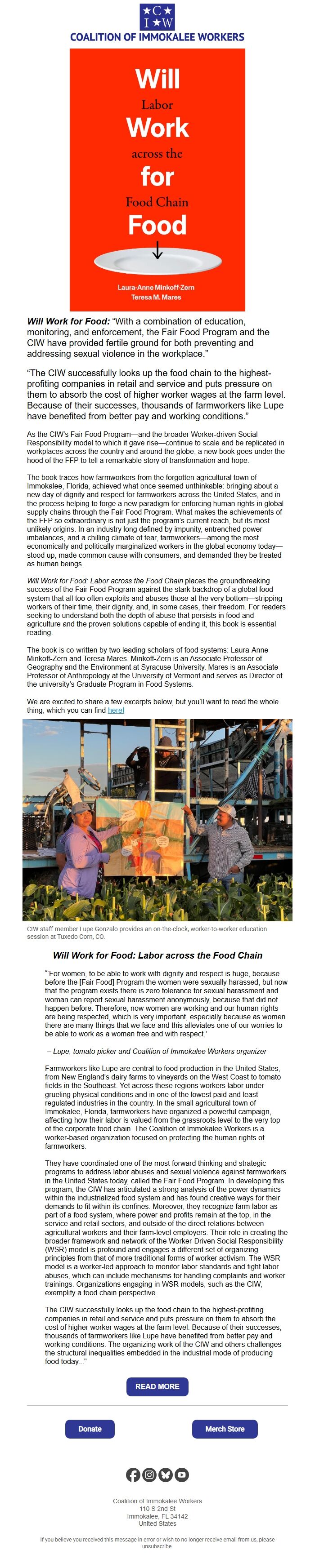
CIW staff member Lupe Gonzalo provides an on-the-clock, worker-to-worker education session at Tuxedo Corn, CO.
Will Work for Food: Labor across the Food Chain
“‘For women, to be able to work with dignity and respect is huge, because before the [Fair Food] Program the women were sexually harassed, but now that the program exists there is zero tolerance for sexual harassment and woman can report sexual harassment anonymously, because that did not happen before. Therefore, now women are working and our human rights are being respected, which is very important, especially because as women there are many things that we face and this alleviates one of our worries to be able to work as a woman free and with respect.’
– Lupe, tomato picker and Coalition of Immokalee Workers organizer
Farmworkers like Lupe are central to food production in the United States, from New England’s dairy farms to vineyards on the West Coast to tomato fields in the Southeast. Yet across these regions workers labor under grueling physical conditions and in one of the lowest paid and least regulated industries in the country. In the small agricultural town of Immokalee, Florida, farmworkers have organized a powerful campaign, affecting how their labor is valued from the grassroots level to the very top of the corporate food chain. The Coalition of Immokalee Workers is a worker-based organization focused on protecting the human rights of farmworkers.
They have coordinated one of the most forward thinking and strategic programs to address labor abuses and sexual violence against farmworkers in the United States today, called the Fair Food Program. In developing this program, the CIW has articulated a strong analysis of the power dynamics within the industrialized food system and has found creative ways for their demands to fit within its confines. Moreover, they recognize farm labor as part of a food system, where power and profits remain at the top, in the service and retail sectors, and outside of the direct relations between agricultural workers and their farm-level employers. Their role in creating the broader framework and network of the Worker-Driven Social Responsibility (WSR) model is profound and engages a different set of organizing principles from that of more traditional forms of worker activism. The WSR model is a worker-led approach to monitor labor standards and fight labor abuses, which can include mechanisms for handling complaints and worker trainings. Organizations engaging in WSR models, such as the CIW, exemplify a food chain perspective.
The CIW successfully looks up the food chain to the highest-profiting companies in retail and service and puts pressure on them to absorb the cost of higher worker wages at the farm level. Because of their successes, thousands of farmworkers like Lupe have benefited from better pay and working conditions. The organizing work of the CIW and others challenges the structural inequalities embedded in the industrial mode of producing food today..."
READ MORE [[link removed]]
Donate [[link removed]] Merch Store [[link removed]]
[link removed] [[link removed]] [link removed] [[link removed]] [link removed] [[link removed]] [link removed] [[link removed]]
Coalition of Immokalee Workers
110 S 2nd St
Immokalee, FL 34142
United States
If you believe you received this message in error or wish to no longer receive email from us, please unsubscribe: [link removed] .
[link removed] [[link removed]]
Will Work for Food: “With a combination of education, monitoring, and enforcement, the Fair Food Program and the CIW have provided fertile ground for both preventing and addressing sexual violence in the workplace.”
“The CIW successfully looks up the food chain to the highest-profiting companies in retail and service and puts pressure on them to absorb the cost of higher worker wages at the farm level. Because of their successes, thousands of farmworkers like Lupe have benefited from better pay and working conditions.”
As the CIW’s Fair Food Program—and the broader Worker-driven Social Responsibility model to which it gave rise—continue to scale and be replicated in workplaces across the country and around the globe, a new book goes under the hood of the FFP to tell a remarkable story of transformation and hope.
The book traces how farmworkers from the forgotten agricultural town of Immokalee, Florida, achieved what once seemed unthinkable: bringing about a new day of dignity and respect for farmworkers across the United States, and in the process helping to forge a new paradigm for enforcing human rights in global supply chains through the Fair Food Program. What makes the achievements of the FFP so extraordinary is not just the program’s current reach, but its most unlikely origins. In an industry long defined by impunity, entrenched power imbalances, and a chilling climate of fear, farmworkers—among the most economically and politically marginalized workers in the global economy today—stood up, made common cause with consumers, and demanded they be treated as human beings.
Will Work for Food: Labor across the Food Chain places the groundbreaking success of the Fair Food Program against the stark backdrop of a global food system that all too often exploits and abuses those at the very bottom—stripping workers of their time, their dignity, and, in some cases, their freedom. For readers seeking to understand both the depth of abuse that persists in food and agriculture and the proven solutions capable of ending it, this book is essential reading.
The book is co-written by two leading scholars of food systems: Laura-Anne Minkoff-Zern and Teresa Mares. Minkoff-Zern is an Associate Professor of Geography and the Environment at Syracuse University. Mares is an Associate Professor of Anthropology at the University of Vermont and serves as Director of the university’s Graduate Program in Food Systems.
We are excited to share a few excerpts below, but you’ll want to read the whole thing, which you can find here! [[link removed]]
[link removed] [[link removed]]
CIW staff member Lupe Gonzalo provides an on-the-clock, worker-to-worker education session at Tuxedo Corn, CO.
Will Work for Food: Labor across the Food Chain
“‘For women, to be able to work with dignity and respect is huge, because before the [Fair Food] Program the women were sexually harassed, but now that the program exists there is zero tolerance for sexual harassment and woman can report sexual harassment anonymously, because that did not happen before. Therefore, now women are working and our human rights are being respected, which is very important, especially because as women there are many things that we face and this alleviates one of our worries to be able to work as a woman free and with respect.’
– Lupe, tomato picker and Coalition of Immokalee Workers organizer
Farmworkers like Lupe are central to food production in the United States, from New England’s dairy farms to vineyards on the West Coast to tomato fields in the Southeast. Yet across these regions workers labor under grueling physical conditions and in one of the lowest paid and least regulated industries in the country. In the small agricultural town of Immokalee, Florida, farmworkers have organized a powerful campaign, affecting how their labor is valued from the grassroots level to the very top of the corporate food chain. The Coalition of Immokalee Workers is a worker-based organization focused on protecting the human rights of farmworkers.
They have coordinated one of the most forward thinking and strategic programs to address labor abuses and sexual violence against farmworkers in the United States today, called the Fair Food Program. In developing this program, the CIW has articulated a strong analysis of the power dynamics within the industrialized food system and has found creative ways for their demands to fit within its confines. Moreover, they recognize farm labor as part of a food system, where power and profits remain at the top, in the service and retail sectors, and outside of the direct relations between agricultural workers and their farm-level employers. Their role in creating the broader framework and network of the Worker-Driven Social Responsibility (WSR) model is profound and engages a different set of organizing principles from that of more traditional forms of worker activism. The WSR model is a worker-led approach to monitor labor standards and fight labor abuses, which can include mechanisms for handling complaints and worker trainings. Organizations engaging in WSR models, such as the CIW, exemplify a food chain perspective.
The CIW successfully looks up the food chain to the highest-profiting companies in retail and service and puts pressure on them to absorb the cost of higher worker wages at the farm level. Because of their successes, thousands of farmworkers like Lupe have benefited from better pay and working conditions. The organizing work of the CIW and others challenges the structural inequalities embedded in the industrial mode of producing food today..."
READ MORE [[link removed]]
Donate [[link removed]] Merch Store [[link removed]]
[link removed] [[link removed]] [link removed] [[link removed]] [link removed] [[link removed]] [link removed] [[link removed]]
Coalition of Immokalee Workers
110 S 2nd St
Immokalee, FL 34142
United States
If you believe you received this message in error or wish to no longer receive email from us, please unsubscribe: [link removed] .
Message Analysis
- Sender: Coalition of Immokalee Workers
- Political Party: n/a
- Country: United States
- State/Locality: Florida Immokalee, Florida
- Office: n/a
-
Email Providers:
- EveryAction