
| From | Dana Criswell <[email protected]> |
| Subject | Freedom to Bake, Bottle, and Build a Business |
| Date | January 22, 2026 3:30 PM |
Links have been removed from this email. Learn more in the FAQ.
Links have been removed from this email. Learn more in the FAQ.
View this post on the web at [link removed]
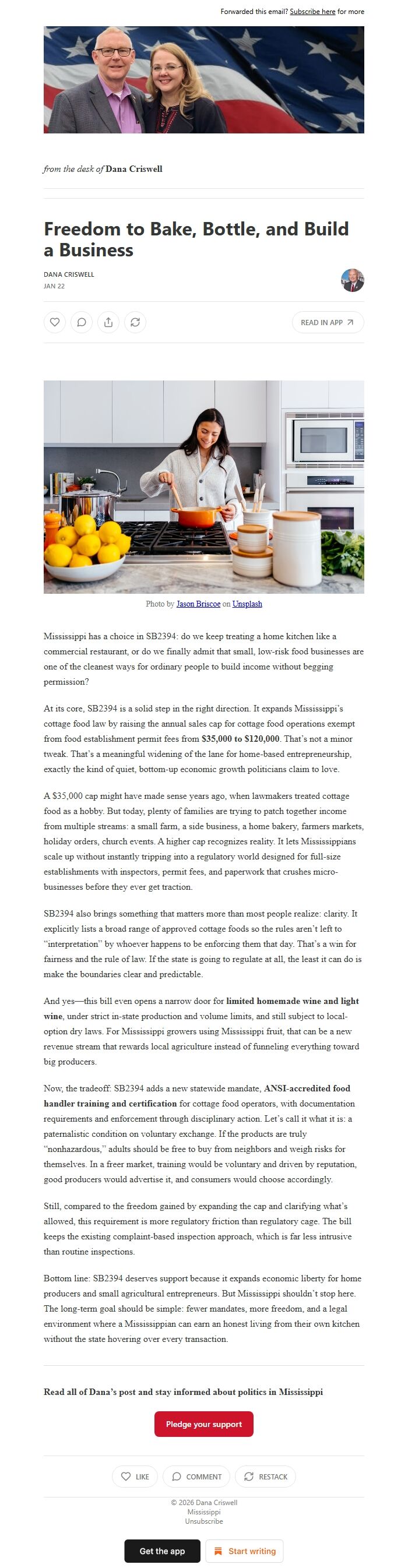
Mississippi has a choice in SB2394: do we keep treating a home kitchen like a commercial restaurant, or do we finally admit that small, low-risk food businesses are one of the cleanest ways for ordinary people to build income without begging permission?
At its core, SB2394 is a solid step in the right direction. It expands Mississippi’s cottage food law by raising the annual sales cap for cottage food operations exempt from food establishment permit fees from $35,000 to $120,000. That’s not a minor tweak. That’s a meaningful widening of the lane for home-based entrepreneurship, exactly the kind of quiet, bottom-up economic growth politicians claim to love.
A $35,000 cap might have made sense years ago, when lawmakers treated cottage food as a hobby. But today, plenty of families are trying to patch together income from multiple streams: a small farm, a side business, a home bakery, farmers markets, holiday orders, church events. A higher cap recognizes reality. It lets Mississippians scale up without instantly tripping into a regulatory world designed for full-size establishments with inspectors, permit fees, and paperwork that crushes micro-businesses before they ever get traction.
SB2394 also brings something that matters more than most people realize: clarity. It explicitly lists a broad range of approved cottage foods so the rules aren’t left to “interpretation” by whoever happens to be enforcing them that day. That’s a win for fairness and the rule of law. If the state is going to regulate at all, the least it can do is make the boundaries clear and predictable.
And yes—this bill even opens a narrow door for limited homemade wine and light wine, under strict in-state production and volume limits, and still subject to local-option dry laws. For Mississippi growers using Mississippi fruit, that can be a new revenue stream that rewards local agriculture instead of funneling everything toward big producers.
Now, the tradeoff: SB2394 adds a new statewide mandate, ANSI-accredited food handler training and certification for cottage food operators, with documentation requirements and enforcement through disciplinary action. Let’s call it what it is: a paternalistic condition on voluntary exchange. If the products are truly “nonhazardous,” adults should be free to buy from neighbors and weigh risks for themselves. In a freer market, training would be voluntary and driven by reputation, good producers would advertise it, and consumers would choose accordingly.
Still, compared to the freedom gained by expanding the cap and clarifying what’s allowed, this requirement is more regulatory friction than regulatory cage. The bill keeps the existing complaint-based inspection approach, which is far less intrusive than routine inspections.
Bottom line: SB2394 deserves support because it expands economic liberty for home producers and small agricultural entrepreneurs. But Mississippi shouldn’t stop here. The long-term goal should be simple: fewer mandates, more freedom, and a legal environment where a Mississippian can earn an honest living from their own kitchen without the state hovering over every transaction.
Unsubscribe [link removed]?
Mississippi has a choice in SB2394: do we keep treating a home kitchen like a commercial restaurant, or do we finally admit that small, low-risk food businesses are one of the cleanest ways for ordinary people to build income without begging permission?
At its core, SB2394 is a solid step in the right direction. It expands Mississippi’s cottage food law by raising the annual sales cap for cottage food operations exempt from food establishment permit fees from $35,000 to $120,000. That’s not a minor tweak. That’s a meaningful widening of the lane for home-based entrepreneurship, exactly the kind of quiet, bottom-up economic growth politicians claim to love.
A $35,000 cap might have made sense years ago, when lawmakers treated cottage food as a hobby. But today, plenty of families are trying to patch together income from multiple streams: a small farm, a side business, a home bakery, farmers markets, holiday orders, church events. A higher cap recognizes reality. It lets Mississippians scale up without instantly tripping into a regulatory world designed for full-size establishments with inspectors, permit fees, and paperwork that crushes micro-businesses before they ever get traction.
SB2394 also brings something that matters more than most people realize: clarity. It explicitly lists a broad range of approved cottage foods so the rules aren’t left to “interpretation” by whoever happens to be enforcing them that day. That’s a win for fairness and the rule of law. If the state is going to regulate at all, the least it can do is make the boundaries clear and predictable.
And yes—this bill even opens a narrow door for limited homemade wine and light wine, under strict in-state production and volume limits, and still subject to local-option dry laws. For Mississippi growers using Mississippi fruit, that can be a new revenue stream that rewards local agriculture instead of funneling everything toward big producers.
Now, the tradeoff: SB2394 adds a new statewide mandate, ANSI-accredited food handler training and certification for cottage food operators, with documentation requirements and enforcement through disciplinary action. Let’s call it what it is: a paternalistic condition on voluntary exchange. If the products are truly “nonhazardous,” adults should be free to buy from neighbors and weigh risks for themselves. In a freer market, training would be voluntary and driven by reputation, good producers would advertise it, and consumers would choose accordingly.
Still, compared to the freedom gained by expanding the cap and clarifying what’s allowed, this requirement is more regulatory friction than regulatory cage. The bill keeps the existing complaint-based inspection approach, which is far less intrusive than routine inspections.
Bottom line: SB2394 deserves support because it expands economic liberty for home producers and small agricultural entrepreneurs. But Mississippi shouldn’t stop here. The long-term goal should be simple: fewer mandates, more freedom, and a legal environment where a Mississippian can earn an honest living from their own kitchen without the state hovering over every transaction.
Unsubscribe [link removed]?
Message Analysis
- Sender profile: Dana Criswell
- Political Party: Republican
- Country: United States
- State/Locality: Mississippi
- Office: State Representative