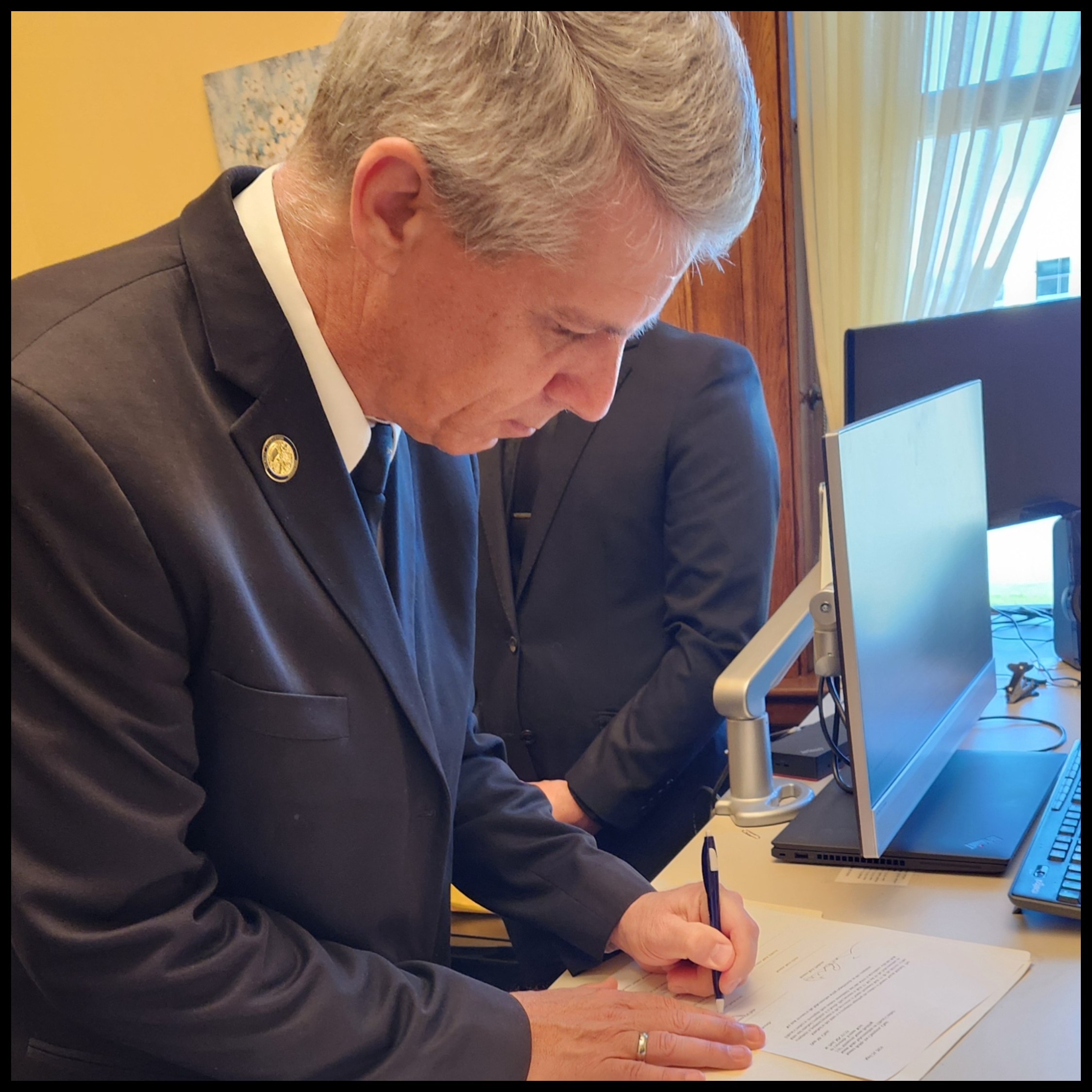
I appeared on Fox News' Sunday Briefing to discuss ICE operations and fraud in Minnesota with a constituent, Dirk Cedergren from Zumbrota.
"Operation Metro Surge," as the US Department of Homeland Security named it, aims to increase public safety by removing dangerous criminals from our communities. Immigration and Customs Enforcement (ICE) has made over 3,000 arrests since December 2025, including 240 DHS calls the "worst of the worst" with convictions for violent crimes, like murder, sex offenses, drug trafficking, fraud, and DWIs. You can view an updated list here.
Why is DHS targeting Minnesota? Why do we have so many of these criminals? Because Gov. Walz and Minneapolis Mayor Jacob Frey have shielded them by refusing to honor ICE detainers. In other states, transfers are taking place with the consistent and frequent cooperation of police and sheriffs. In Minnesota, top leaders are leading law enforcement to refuse to cooperate.
What are Ice Detainers? They are requests issued by ICE to local jails, prisons, or law enforcement agencies. These requests ask the agencies to notify ICE before releasing an individual and to detain that person beyond their scheduled release date, allowing ICE time to take custody for potential deportation proceedings.
"Sanctuary" states, cities, and counties refuse to accept ICE detainers and will release these individuals without charges or on zero bail, allowing them to continue to evade immigration enforcement. In some cases, they have gone on to commit other crimes.
The result is that Federal ICE officers have had to conduct these apprehensions, just as local police, the FBI, US Marshals, and even independent "skip tracers" and "bounty hunters" have always captured dangerous fugitives-- by going to neighborhoods and workplaces, watching them pick up their kids from school or from grocery store parking lots. This could have been avoided if Minnesota honored ICE detainers.
Supporters of the "sanctuary" state idea don't only disagree with ICE's activities, they disagree with the law that entering the United States illegally or overstaying a Visa is a crime. I am not exaggerating. Rep. Sandi Feist, my former Democrat colleague in the House, had a now-viral interaction with Customs and Border Control Field Commander Greg Bovino in our own state capital. It is a window into that alternate reality where Democrat politicians live right now.
Making the situation even more tense are the appearances of protesters at these arrests. Something Governor Walz, Attorney General Ellison, and Mayor Frey have all encouraged. We are now witnessing a deteriorating situation, from what were initially called "peaceful protests" to attempts to help criminals resist arrest and escape, often with violence. Last weekend, a group of protesters invaded a St. Paul church, disrupting a service, mocking the faith of those present and frightening young children. This action was applauded and/or supported by Democrat elected officials, such as Rep. Leigh Finke and Attorney General Keith Ellison.
On January 7, a protester who attempted to use her car to interfere in the arrest of a criminal illegal alien was shot dead by an ICE agent in South Minneapolis. Video evidence was not enough to settle the public's question of who was at fault. People who support immigration enforcement say the agent was acting in self-defense because she hit him with her car. People who are anti-ICE say that she presented no danger to him. The bottom line is that this never had to happen at all, but for the tactics chosen by the protester. Many aspects of this situation could have been different if the city police or state patrol had been part of the equation to handle the crowds, keep the protesters peaceful, and prevent them from interfering with arrests.
There was more anger by anti-ICE activists (and the Governor and Mayor Frey) when the Department of Homeland Security took over the investigation of this incident. Many of us look at this situation and wonder whether any law enforcement official could get a fair trial in this state, given the level of hostility toward them before they even arrived.
Agents are now forced to be more aggressive in stopping the assaults and threats to their lives. This escalation of violence is hard to watch on the numerous videos taking place on neighborhood streets. If it angers you, it should, not because of what the agents are doing, but because it was entirely preventable if the Democrat leadership in our state had done their jobs and worked with the federal government on apprehending the worst criminals, instead of siding with mobs and lawbreakers.
What can we do to end this terrible spiral of disorder? The longer it goes on, the more it will damage our state in multiple ways.
First, we must end the chaos in the streets. Having state and local leaders actively promoting interference with federal immigration authorities is irresponsible behavior. If agents have made a mistake and are dealing with the wrong person or bad information, the street is not the place to resolve those issues. Those should be resolved in a court of law or an immigration court. A federal court order has defined what constitutes a peaceful protest and the role of federal agents; it will take both federal agents and local law enforcement to ensure that happens.
Second, once "metro surge" is complete, Minnesota's elected officials will have to reconcile themselves to the fact that they swore an oath to the Constitution, which means upholding the laws of the United States, including immigration laws, whether they agree with them or not. The open borders policy of the Biden presidency was an unmitigated disaster for our country. That's not just my opinion; it was a key reason that President Trump was re-elected in 2024. That may be a disagreeable thought to the people blowing whistles in the street, but it's the reality that they don't want to face.
Finally, we must get back to taking a hard look at our state government institutions that have allowed so much fraud and law-breaking to occur. Minnesota has become a national example of dysfunctional government. Its government accountability systems need an overhaul. The executive branch has grown in size and power, imposing a heavier and more costly burden on its citizens. This is at the expense of a legislature that has grown weaker and less able to exercise oversight proportional to that growth in government. These trends need to be reversed.