|
It's Not A Tragedy When You've Ignored the People Who Told You It Was Going To Happen
No one wants to take responsibility for policies that are killing Americans
|

| |||||||||||||||


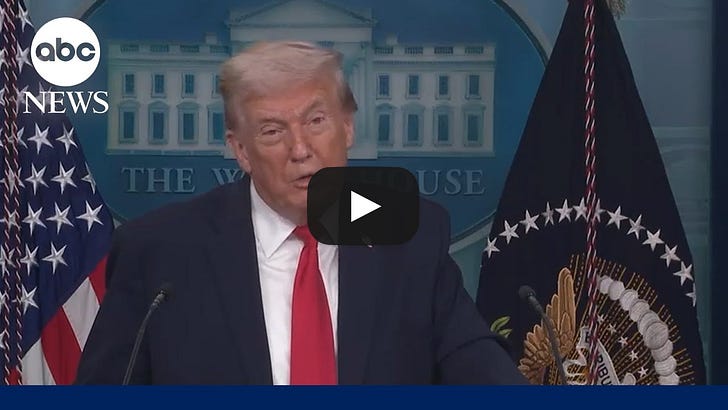
In the press briefing room at the White House yesterday, Donald Trump appeared in person to perform the social media messages that he usually posts from the privacy of his personal quarters. Confident that he is his own best spokesperson, Trump addressed members of the White House press corps as he would a rally crowd, weaving his own version of reality while he felt his way from one topic to the next.
As a sort of stand-up routine, this performance is entertainment for Trump’s base. As a glimpse into his state of mind, it is a sort of revelation.
In the hours after Renee Good was shot and killed by an ICE officer on January 7th, Trump and DHS officials attacked Good as a “domestic terrorist.” Trump’s first social media post about the incident claimed that Good “violently, willfully, and viciously ran over the ICE Officer.” Later the same day, after presumably learning more about the incident and coordinating his response with others, Trump wrote, “When a vehicle is coming at you and is being used as a weapon, deadly force is justified.”
But this is not how he remembered his response to the news of Good’s death in yesterday’s soliloquy. “I felt horribly when I was told that the young woman who was - uh - had the tragedy. It’s a tragedy. It’s a horrible thing. Everybody would say it. I would say the same thing.”
What changed in two weeks? What compelled Trump to remember his reaction so differently from the way he had proclaimed it just two weeks ago?
The answer seems to be common sense - that is, in Trump’s words from yesterday, the emerging consensus about what “everybody would say.” Despite the propaganda from the White House, 73% percent of US voters have watched a video of the encounter ourselves, according to a YouGov poll conducted over the weekend.
We did not see a violent and vicious attack against ICE officers. We did not see a vehicle being used as a weapon. We did not see a “domestic terrorist.”
In an attempt to catch up with the popular consensus that the regime’s initial narrative was a lie, Trump wants to say Good’s death was a tragedy.
But this is not a tragedy.
A tragedy is a house catching fire when its inhabitants are asleep. It is an earthquake in a dense urban area that kills hundreds of unsuspecting people. It’s a tornado that strikes without any possible warning.
As pastors we know what it means to get the late night call when tragedy strikes. We’ve been to the hospital when the young couple who carried their child to term realized the baby wasn’t going to make it. We’ve stood in the pulpit to preach the funeral for the parent who isn’t going to be there as their children grow up. When tragedy strikes, we cry out to God, hold onto one another, and bow in humble submission to a reality where there are some losses we will never understand.
But it’s not a tragedy when you spend a decade telling lies about immigrants to win political power that you then use to fund a masked paramilitary force to hunt people based on their race and the language they speak. It’s not a tragedy when one of those crusaders kills someone who objects to the assault on their community. It’s not a tragedy when you’ve ignored and attacked everyone who told you that this would be the inevitable consequence of your public policy.
The legislation that Congress passed last year at Trump’s behest tripled the size of ICE, and the agency has been purged of any leadership that objects to the extreme vision of Stephen Miller and the MAGA regime. More than 30 people died in ICE custody last year, and multiple others have been shot by ICE agents on US streets.
The violence is escalating, and the resources fueling its rise are not going away. ICE officers are filming the violence they create to make recruitment videos online, complete with Scripture verses misquoted to justify their violence as a righteous crusade.
Most of the government programs that were cut last year to pay for this ICE surge (in addition to massive tax cuts for billionaires) have not gone into effect yet. But they are coming in 2026. Americans are about to experience dramatic cuts to nutrition assistance and Medicaid that will impact millions directly and millions more indirectly as hospitals and nursing homes in their communities close.
Like the violent ICE raids on our streets right now, this policy violence will kill people people in our communities.
But none of these deaths are tragedies.
Each and every unnecessary death is the predictable result of political decisions that are being made to serve a very narrow set of interests.
What Trump didn’t say at yesterday’s press conference is that he is out front, making the case himself, because he knows his policy violence is not popular. He has seen the projections for the midterms, and he is worried. Most people don’t want what his regime is shoving down our throats. That’s why he called state legislatures that are controlled by Republicans and ordered them to gerrymander as many seats as possible.
On the ground in Eastern North Carolina, we’ve been talking with people from every walk of life about why their state representatives conspired with the Trump regime to try to steal a House seat in District 1. We’ve talked to Republicans, Independents, and Democrats, and we’ve talked to people who haven’t voted in years because they don’t think anybody in Washington, DC cares about them. But if the past year has shown them anything, it’s shown them that their political power does matter.
No one would be trying this hard to steal their Congressional seat if it didn’t matter.
And no one would be trying to pretend their pain is a “tragedy” if they weren’t trying to shirk responsibility and avoid the accountability that’s coming at the ballot box this November.
This is why we’re organizing to love forward together in Eastern North Carolina and inviting people across the country to do the same in their place.
When people learn that their pain isn’t a tragic inevitability but a policy choice, then they know they have a choice to make. People in power here in North Carolina and across this nation have shown us who they are. The only question is whether we are going to hook up in the power of love and show them that we want to be something else.
In the theater they say the difference between a tragedy and a comedy isn’t that one is sad and the other is funny, but that one is focused on a flawed individual while the other draws our attention to a cast of characters in community. We know this story we’re living in right now is not a tragedy. It is, instead, an opportunity for each of us to come together in beloved community and learn together what part we can each play to lift this nation up a little bit higher.
That’s why we were at the People’s House in Raleigh this morning to invite North Carolinians to hold vigil together and tell the stories of our pain next Monday, January 26, starting at 3pm. Please help us spread the word.
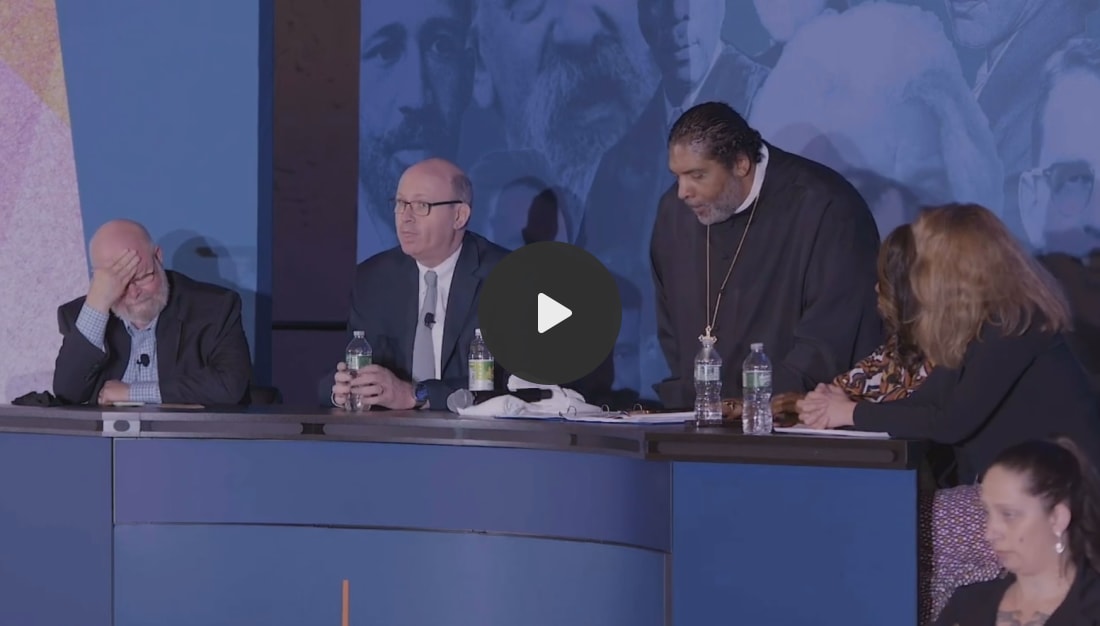
We also invite you to join us Friday, January 23 at 1pm ET for a Substack Live with Marc Elias, a leader in the fight to protect voting rights. Marc shared at our national conference in 2024 about the importance of doing the one thing each of us can do. If you can’t join live, be sure to subscribe to Our Moral Moment to make sure a recording is sent to you afterward.
You’re currently a free subscriber to Our Moral Moment, which is and always will be a free publication. Paid subscribers support this publication and the moral movement. All proceeds from Our Moral Moment are donated to organizations that are building a moral fusion movement for a Third Reconstruction of America.
| ||||||||||

