|
Critical State: The $839 Billion Defense Spending Bill
If you read just one thing this week … read about the hundreds of billions of dollars in defense spending Congress passed.
|

| |||||||||||||||


 |
US lawmakers recently unveiled a compromise $839 billion fiscal 2026 defense spending bill that significantly boosts funding for next‑generation aircraft, according to a report from Stephen Losey at Military Times. The compromise came after months of negotiation between the House and Senate, setting key Pentagon priorities and largely averting a budget stalemate in Congress.
The conferenced legislation reflects broad, bipartisan support for increased Pentagon spending. It boosts procurement for advanced weapons systems, including nearly $3 billion for the Air Force’s next-generation F-47 fighter and nearly $1 billion for the Navy’s F/A-XX aircraft, far above original Pentagon requests.
The bill preserves the Air Force’s E-7 Wedgetail airborne battle management program after Pentagon leaders had proposed its cancellation. It also funds 47 F-35 Joint Strike Fighters with spare parts and upgrades and tens of billions for Navy shipbuilding.
Additional allocations included two EA-37B Compass Call aircraft, nearly $2 billion for the B-21 Raider stealth bomber, full funding for the LGM-35A Sentinel ICBM program, showing Congress supports nuclear modernization efforts.
The package was part of must-pass legislation to keep federal funding on track before a looming deadline.
If You Read One More Thing: Right-wing City’s Benevolent Immigration Policy
Felipe De La Hoz at The New Republic has a new feature on Salt Lake City’s immigration approach, which is an unusual anomaly in a deeply conservative state. By 2025, immigrants and refugees were acknowledged as significant economic contributors, and city initiatives helped newcomers navigate daily life.
Utah has also developed its own refugee resettlement efforts and civic collaborations that stood in contrast with broader GOP support for stricter enforcement.
Salt Lake City’s stance is rooted in history. In 1998, the city council narrowly rejected joining the federal 287(g) program that would have deputized local police to check immigration status.
That resistance, rooted in a mix of Mormon-inspired sympathy for refugees and a local ethos of minding one’s own business, shaped a more welcoming stance toward immigrants even as national sentiment hardened.
Yet rising federal crackdowns and state deportation laws under the Trump administration threatened to strain this distinct “Utah Way.”
Far-right Influencer’s Ties to Trump Administration
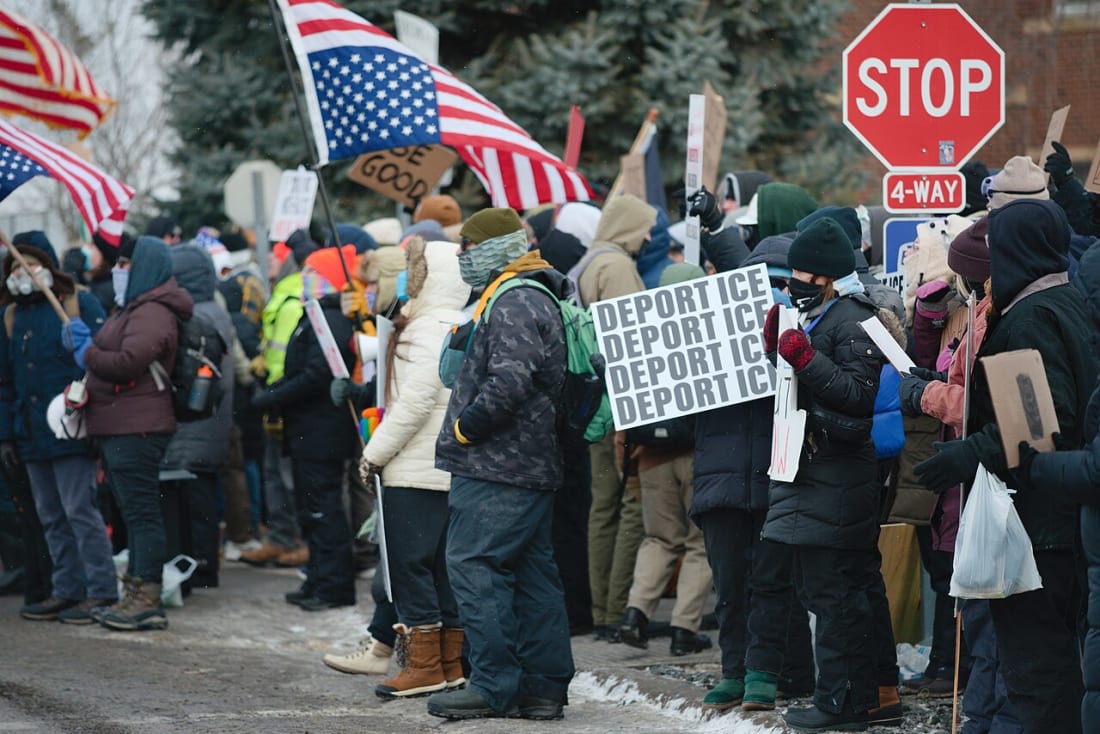 |
At The Guardian, Jason Wilson covered right-wing influencer Nick Sortor, who appeared to admit driving his truck at protesters in Minneapolis and had for years cooperated closely with the Trump administration.
Sortor, 27, a MAGA-aligned video influencer with 1.2 million followers on X, has received public backing from Trump officials after arrests and altercations in Portland and elsewhere, and attended a White House influencer roundtable, despite a history of arrests and accusations of provoking violence for online content.
Experts argue his inflammatory portrayals of protesters and immigrants feeds into aggressive federal enforcement actions, particularly in Minnesota.
In Minneapolis, Sortor has posted videos cheering on ICE agents’ use of force and amplifying disputed accounts of confrontations, while others have shared footage contradicting his claims.
Arne Holverscheid, a PhD candidate in political science at Northwestern University, described a “symbiotic” relationship between such influencers and the administration, which benefited from their content while maintaining plausible deniability.
Deep Dive: Greenland’s Store of Rare Earth Minerals
In early 2026, Greenland has emerged as one of the world’s most geologically promising yet commercially dormant sources of rare earth minerals (REEs) — strategic elements critical to modern technology, clean energy systems, and national defense, according to a new report from The World Data. The report comes amid US President Donald Trump’s push for sovereignty over the island, which is an autonomous region of Denmark, an important NATO ally.
According to up-to-date statistics, the Arctic territory’s proven REE reserves were estimated at approximately 1.5 million metric tons as of 2025, positioning Greenland eighth globally by documented reserve size. This placed it ahead of many countries but well behind major producers like China, Brazil, India, and Australia.
Crucially, the territory’s rare earth riches were concentrated in the Gardar geological province in southern Greenland, where ancient alkaline intrusions have fostered high concentrations of these elements over millions of years. The region’s geology created conditions favorable for economic REE accumulation — specifically in two world-class prospective deposits: Kvanefjeld and Tanbreez.
Kvanefjeld, located near the town of Narsaq, was already recognized as one of the largest known land-based REE accumulations worldwide, with resource estimates exceeding 11 million metric tons of rare earths. Within that total sat roughly 370,000 metric tons of heavy rare earth elements (HREEs) — the rarer, higher-value subset critical to advanced technologies, such as permanent magnets in electric vehicles and military systems. Its proven and probable ore reserve alone comprises 108 million tonnes averaging about 1.43% total rare earth oxide (TREO).
Tanbreez, a relatively newer target for development, offers even more dramatic statistics. Because of varying methodologies in drilling and surveying, estimates for Tanbreez’s REE resource ranged broadly from four million to over 28 million metric tons. What sets Tanbreez apart was its high proportion of heavy rare earths — more than 27% of total REE content compared with global averages of 5–10%. That characteristic elevates its potential value and makes it one of the most strategically advantageous undeveloped deposits in the world.
In addition to these flagship deposits, geological extrapolation suggests that sub-ice reserves — minerals concealed under Greenland’s ice sheet, which covers about 81% of the territory — could substantially increase total resource estimates. Some analysts have projected that when inferred and undiscovered reserves are considered alongside documented ones, Greenland might hold 36–42 million metric tons of rare earth oxides. That figure potentially rivals China’s supply — the world’s dominant producer — and represents up to 25% of future global demand for key elements like neodymium and dysprosium, important magnets.
Despite these promising figures, no commercial rare earth mining has taken place in Greenland by January 2026. Multiple barriers remained in the way of full-scale development. Greenland’s harsh Arctic climate — with temperatures plunging below −40 °F and a short window for outdoor industrial operations — greatly constrains construction and extraction activities. The territory’s remote location and lack of transportation infrastructure, including the absence of inter-town road networks, further amplify operational risks and costs.
One of the most consequential impediments is political. In 2021, Greenland’s parliament passed a law setting strict limits on uranium content for mining projects, a policy that effectively blocks the Kvanefjeld project because its ore also contains a significant uranium deposit. This decision triggered an ongoing international arbitration under which the Australian developer Energy Transition Minerals has sought $11.5 billion in compensation for what it views as expropriation of its investment.
Environmental concerns have played a central role in shaping policy and local sentiment. Greenland’s residents, particularly in communities near prospective mine sites and indigenous populations, raised fears about radioactive contamination, disruption of traditional fishing and hunting livelihoods, and broader ecological damage. This tension complicates efforts to balance sustainable economic development with environmental stewardship.
Regulatory complexity has also hampered progress. Greenland’s status as a self-governing territory within the Kingdom of Denmark means that mining projects must navigate overlapping jurisdictions and approval processes, adding time and uncertainty to exploration and permitting. Combined with the lack of infrastructure and the high capital requirements — often running into billions of dollars over prolonged timeframes — these factors have discouraged many potential investors.
Beyond rare earths, Greenland’s broader mineral portfolio is equally extensive. The territory hosts 25 of 34 critical minerals identified by the European Commission and 43 of 50 considered strategic for US national security, including graphite, copper, zinc, and gallium. However, like REEs, these resources have largely remained undeveloped due to similar logistical and political barriers.
The report underscores the geopolitical backdrop of its untapped mineral wealth. With global demand for rare earths rising — driven in part by defense technologies that the US produces — access to diversified supply sources has gained strategic importance. Greenland’s potential role in that landscape, and Washington’s aggressive stance towards acquiring these REEs, highlights the geopolitical importance of these resources.
Show Us the Receipts
At Inkstick, Lital Khaikin reports on how Afghanistan faces overlapping humanitarian, economic, and political crises. More than 2.8 million Afghans have returned from neighboring countries amid earthquakes, border clashes, and historic levels of food insecurity “They have left everything … They just came with their clothes. They don’t have enough,” Gul Mohammed Aryan, head of the Sustainable Goals Organization, told Inkstick. International sanctions, frozen central bank assets, and donor uncertainty have deepened economic paralysis, limiting cash access and stalling development projects. Aid as a result of the Taliban’s renewed rule has caused flows to fluctuate, while recent funding cuts threaten essential services. The Taliban has pursued regional partnerships and infrastructure projects but has struggled to deliver governance reforms. For their part, ordinary Afghans bear the consequences of this prolonged international disengagement.
Thandiwe Birchwood covered Venezuelan women in Trinidad and Tobago facing prolonged legal uncertainty, discrimination, and heightened violence as restrictive immigration policies leave many without lawful status. The article explains that the expiration of temporary registration programs and limited asylum options have forced women into informal and precarious work. This has resulted in labor exploitation, sexual abuse, and trafficking. A xenophobic public discourse and aggressive policing further marginalizes migrants, discouraging them from reporting crimes or accessing healthcare. While local NGOs have attempted to provide legal aid and protection, resources remain insufficient. Venezuela’s crisis continues to drive migration, exposing more women to these abuses.
The World has covered the situation for Venezuelans in Caracas, who have had mixed reactions to opposition leader María Corina Machado’s recent political strategy. Many credit Machado with reviving democratic participation during the 2024 election and mobilizing citizens to defend the vote. Others have questioned her close alignment with Trump and her silence after US military strikes. “I don’t like her tone toward Donald Trump,” journalist Alejandra Otero said. “We shouldn’t look for another savior for our democracy.” Critics say Machado appears distant while in exile and sidelined from transition talks. Despite unease, polls show she remains Venezuela’s most popular opposition figure and a symbol of democratic hope.
Support Inkstick
For anyone who missed our annual fundraising campaign last year but would still like to support Inkstick, there are several ways. We accept one-time donations and recurring monthly support year round. We also make a sum off any of the snazzy Inkstick swag you purchase from our merch store. As always, any support you can offer will go directly toward our reporting. And if financial support isn’t something you can swing, then we’d love it if you shared our articles anywhere you are on social media.
Critical State is written by Inkstick Media in collaboration with The World.
The World is a weekday public radio show and podcast on global issues, news, and insights from PRX and GBH.
With an online magazine and podcast featuring a diversity of expert voices, Inkstick Media is “foreign policy for the rest of us.”
Critical State is made possible in part by the Carnegie Corporation of New York.
You're currently a free subscriber to Inkstick’s Substack. For the full experience, upgrade your subscription.
| ||||||||||

