
Email
Raise Taxes on Guns - MS HB145
| From | Dana Criswell <[email protected]> |
| Subject | Raise Taxes on Guns - MS HB145 |
| Date | January 20, 2026 9:11 PM |
Links have been removed from this email. Learn more in the FAQ.
Links have been removed from this email. Learn more in the FAQ.
View this post on the web at [link removed]
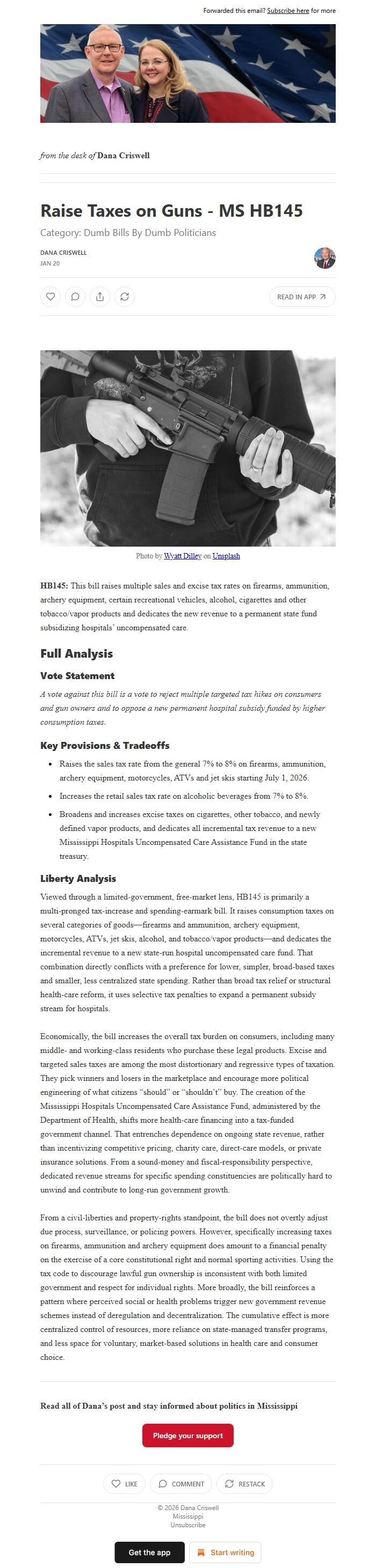
HB145: This bill raises multiple sales and excise tax rates on firearms, ammunition, archery equipment, certain recreational vehicles, alcohol, cigarettes and other tobacco/vapor products and dedicates the new revenue to a permanent state fund subsidizing hospitals’ uncompensated care.
Full Analysis
Vote Statement
A vote against this bill is a vote to reject multiple targeted tax hikes on consumers and gun owners and to oppose a new permanent hospital subsidy funded by higher consumption taxes.
Key Provisions & Tradeoffs
Raises the sales tax rate from the general 7% to 8% on firearms, ammunition, archery equipment, motorcycles, ATVs and jet skis starting July 1, 2026.
Increases the retail sales tax rate on alcoholic beverages from 7% to 8%.
Broadens and increases excise taxes on cigarettes, other tobacco, and newly defined vapor products, and dedicates all incremental tax revenue to a new Mississippi Hospitals Uncompensated Care Assistance Fund in the state treasury.
Liberty Analysis
Viewed through a limited‑government, free‑market lens, HB145 is primarily a multi‑pronged tax‑increase and spending‑earmark bill. It raises consumption taxes on several categories of goods—firearms and ammunition, archery equipment, motorcycles, ATVs, jet skis, alcohol, and tobacco/vapor products—and dedicates the incremental revenue to a new state‑run hospital uncompensated care fund. That combination directly conflicts with a preference for lower, simpler, broad‑based taxes and smaller, less centralized state spending. Rather than broad tax relief or structural health‑care reform, it uses selective tax penalties to expand a permanent subsidy stream for hospitals.
Economically, the bill increases the overall tax burden on consumers, including many middle‑ and working‑class residents who purchase these legal products. Excise and targeted sales taxes are among the most distortionary and regressive types of taxation. They pick winners and losers in the marketplace and encourage more political engineering of what citizens “should” or “shouldn’t” buy. The creation of the Mississippi Hospitals Uncompensated Care Assistance Fund, administered by the Department of Health, shifts more health‑care financing into a tax‑funded government channel. That entrenches dependence on ongoing state revenue, rather than incentivizing competitive pricing, charity care, direct‑care models, or private insurance solutions. From a sound‑money and fiscal‑responsibility perspective, dedicated revenue streams for specific spending constituencies are politically hard to unwind and contribute to long‑run government growth.
From a civil‑liberties and property‑rights standpoint, the bill does not overtly adjust due process, surveillance, or policing powers. However, specifically increasing taxes on firearms, ammunition and archery equipment does amount to a financial penalty on the exercise of a core constitutional right and normal sporting activities. Using the tax code to discourage lawful gun ownership is inconsistent with both limited government and respect for individual rights. More broadly, the bill reinforces a pattern where perceived social or health problems trigger new government revenue schemes instead of deregulation and decentralization. The cumulative effect is more centralized control of resources, more reliance on state‑managed transfer programs, and less space for voluntary, market‑based solutions in health care and consumer choice.
Unsubscribe [link removed]?
HB145: This bill raises multiple sales and excise tax rates on firearms, ammunition, archery equipment, certain recreational vehicles, alcohol, cigarettes and other tobacco/vapor products and dedicates the new revenue to a permanent state fund subsidizing hospitals’ uncompensated care.
Full Analysis
Vote Statement
A vote against this bill is a vote to reject multiple targeted tax hikes on consumers and gun owners and to oppose a new permanent hospital subsidy funded by higher consumption taxes.
Key Provisions & Tradeoffs
Raises the sales tax rate from the general 7% to 8% on firearms, ammunition, archery equipment, motorcycles, ATVs and jet skis starting July 1, 2026.
Increases the retail sales tax rate on alcoholic beverages from 7% to 8%.
Broadens and increases excise taxes on cigarettes, other tobacco, and newly defined vapor products, and dedicates all incremental tax revenue to a new Mississippi Hospitals Uncompensated Care Assistance Fund in the state treasury.
Liberty Analysis
Viewed through a limited‑government, free‑market lens, HB145 is primarily a multi‑pronged tax‑increase and spending‑earmark bill. It raises consumption taxes on several categories of goods—firearms and ammunition, archery equipment, motorcycles, ATVs, jet skis, alcohol, and tobacco/vapor products—and dedicates the incremental revenue to a new state‑run hospital uncompensated care fund. That combination directly conflicts with a preference for lower, simpler, broad‑based taxes and smaller, less centralized state spending. Rather than broad tax relief or structural health‑care reform, it uses selective tax penalties to expand a permanent subsidy stream for hospitals.
Economically, the bill increases the overall tax burden on consumers, including many middle‑ and working‑class residents who purchase these legal products. Excise and targeted sales taxes are among the most distortionary and regressive types of taxation. They pick winners and losers in the marketplace and encourage more political engineering of what citizens “should” or “shouldn’t” buy. The creation of the Mississippi Hospitals Uncompensated Care Assistance Fund, administered by the Department of Health, shifts more health‑care financing into a tax‑funded government channel. That entrenches dependence on ongoing state revenue, rather than incentivizing competitive pricing, charity care, direct‑care models, or private insurance solutions. From a sound‑money and fiscal‑responsibility perspective, dedicated revenue streams for specific spending constituencies are politically hard to unwind and contribute to long‑run government growth.
From a civil‑liberties and property‑rights standpoint, the bill does not overtly adjust due process, surveillance, or policing powers. However, specifically increasing taxes on firearms, ammunition and archery equipment does amount to a financial penalty on the exercise of a core constitutional right and normal sporting activities. Using the tax code to discourage lawful gun ownership is inconsistent with both limited government and respect for individual rights. More broadly, the bill reinforces a pattern where perceived social or health problems trigger new government revenue schemes instead of deregulation and decentralization. The cumulative effect is more centralized control of resources, more reliance on state‑managed transfer programs, and less space for voluntary, market‑based solutions in health care and consumer choice.
Unsubscribe [link removed]?
Message Analysis
- Sender: n/a
- Political Party: n/a
- Country: n/a
- State/Locality: n/a
- Office: n/a