|
Jon Lovett on One Year of Trump 2.0
“And yet with the dreaded danger upon us, I could hardly believe the evidence of my own eyes.”
|

| |||||||||||||||


“And yet with the dreaded danger upon us, I could hardly believe the evidence of my own eyes.”
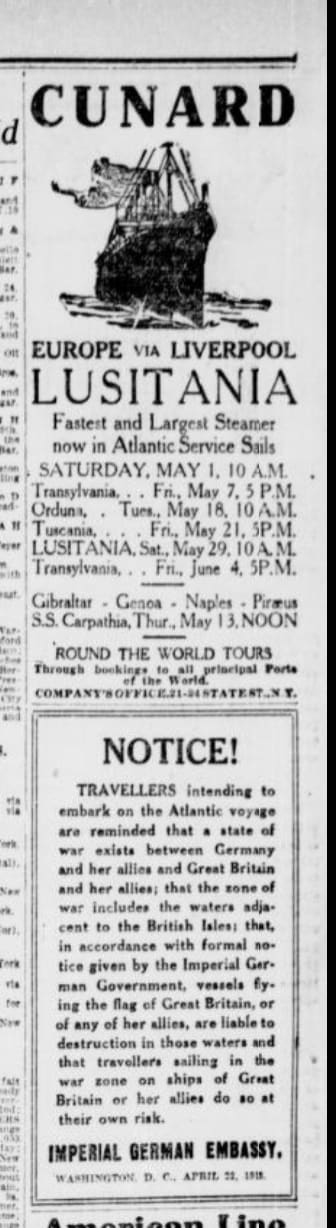 |
Before the Lusitania departed New York City, bound for Liverpool, on May 1, 1915, the German embassy posted notices in the city’s papers warning travelers not to cross the Atlantic aboard vessels flying the British flag. In The New York Tribune, in fact, the warning appeared directly below an ad by Britain’s Cunard for the Lusitania herself, the “Fastest and Largest Steamer” in service. Spooky!
And so the possibility of being torpedoed by a German U-boat was never far from passengers’ minds, while also being too horrible to contemplate. The Germans couldn’t sink a world-famous passenger ship filled with civilians, including Americans, could they? Cunard wouldn’t let us sail if we were in such danger, would they? And then… a puff of water in the distance and a streak of white cutting through the ocean like a knife.
So what does a worst case scenario feel like?
“We had all been thinking, dreaming, eating, sleeping ‘submarine’ from the hour we left New York, and yet with the dreaded danger upon us, I could hardly believe the evidence of my own eyes.
There was little fear, [set designer Oliver] Bernard said. “I did not think that anybody, even women and children, were so much terrified as they were astounded and stunned by the consciousness that the fears, cherished half in ridicule for five days previous, had at last been realized…”
OK, so I read Dead Wake by Erik Larson (from which the above is drawn) over the holidays and it has stuck with me as our own worst-case scenario unfolds. Look at the last few days:
Greg Bovino, Trump’s immigration Commander-at-Large, preening for the cameras in his bespoke Generalissimo Franco coat to match a high-and-tight haircut coded as either “Nazi” or “rich older gay guy who tells a group of twinks that he’s having some people over at his house which is right on the water.”
America jeered around the world for menacing our allies while Trump threatens tariffs and writes ominous semi-literate texts to Norway as part of his cockamamie plan to seize fucking Greenland.
Masked thugs bullying Minnesota while grabbing citizens off the street only to dump them on a street corner a few hours later.
Brazenly corrupt pardons on behalf of Trump’s donors and allies that would have been defining scandals in any other era.
A completely captured, politicized Department of Justice launching a sham investigation into the chair of the Federal Reserve.
And Republicans in Congress and prominent conservatives in the media ignoring, obtusely defending, or enthusiastically supporting it all.
Here at the one-year mark, I find myself staring at the water, vaguely awestruck at the sight of our collective fears being realized. One year ago, if you said you were worried about a version of the above, there would have been so many sophisticated, worldly people to reassure you and patronize you and pat you on the head. But a pompous Vanderbilt too soft and incurious to imagine his world falling apart will end up next to you all the same, panting and clinging to the balustrades, scrambling for a spot on a lifeboat.
Anyway, Trump’s poll numbers are very bad, so there is that. And we know by now that Trump is not the vanguard of a popular front. His policies do not have broad political support. And his program is ultimately being carried out by a small clique of true believers and opportunists. That does create practical and political limits: today we see Trump lamenting the coverage of his ICE raids, an admission of regular politics poking through the clouds. Still, those limits — as we can see on the streets of Minneapolis and St. Paul or in the inbox of the Norwegian prime minister — are nowhere near enough. How do you resolve the contradiction of a lame duck dictator, less popular and more dangerous than he has ever been?
What I take from the past year: it’s worth fighting the impulse to look for hopeful signs among the blinking red lights, and the natural assumption that the worse an outcome is, the less likely it is to happen. We ought to assume there is no bottom for Trump, Noem, Bondi, Rubio, Vance, and of course Miller. We may even be pleasantly surprised from time to time. And there is value in understanding the incentives that drive this ramshackle regime. But whatever limits exist will be set from without. And I am reminding myself not to intellectualize our crisis, like a passenger in the second class saloon debating the Kaiser’s mind until that big dull thud from somewhere near the engine room. The people of Minnesota are showing the way. Trump is as dangerous as we fear, and as powerful as we allow him to be.
***
The Dog That Didn't Bark "Abolish ICE"
Cory Booker recently proposed a set of modest reforms to ICE. Not nearly enough, obviously. And not surprising to see people say that ICE can’t be reformed and should be abolished, with the usual sarcasm directed at mainstream Democrats. But Democrats won’t be in a position to abolish ICE for several years - and that is only if we go on a world-historic winning streak. In the meantime, shouldn’t we be using whatever leverage we have right now to put pressure on Republicans to rein in ICE and the rest of Greg Bovino’s back up dancers? Forcing federal law enforcement officers to remove masks and wear bodycams would be a welcome development in a fallen world.
And worth saying: a debate about whether or not to abolish ICE (and whether or not we should debate abolishing ICE) avoids a lot of hard questions. How should Democrats in the minority use their limited leverage right now? What is the right balance between demanding what should happen and what can happen? And more broadly, what replaces ICE? What do we believe immigration enforcement should actually look like if we regain power? Is a more generous legal immigration system that’s tied to a humane but rigorous enforcement policy the goal? A compromise worth accepting? An unacceptable capitulation to the carceral state?
There is a gap in our politics,and I think it’s part of this dynamic that we see play out over and over. Bernie, AOC, Mamdani — the left is where there is a clear throughline from philosophy to policy. You can call it an ideology, and that’s part of it, but I would in practice say it’s a mission. And that mission is galvanizing in its clarity, while also creating trust and space to operate — to handle hard and novel questions, to extend a hand to potential allies, and to persuade your own side to accept compromise. Outside of the left of the party, is this on offer? We are so used to enthusiasm and dynamism coming from the left alone it’s become vaguely cringe even to ask the question.
Bill Clinton had a philosophy of governing. It was centrist, technocratic, and future-oriented, and that created a sense of mission around policymaking. In a previous life, I was working on a speech for then-Senator Hillary Clinton about clean energy and got word from the boss that the president had some feedback. And what he had was a deluge of facts and wonky details about decoupling and grid modernization that, for him, made energy policy exciting and inspiring. That extended to health care, education, and so much else. And in the category of Democratic presidents who haven’t been to Epstein’s island, Barack Obama had a mission, too - one that built on these policy foundations while telling a larger story about the role of government, pluralism, and rejection of a creaking and corrupt establishment.
We’re about to fight out a midterm that will be defined by Trump, and that should be our focus. But if we do well, it will be despite the weaknesses of the Democratic party. This gap will remain. And of course a debate about whether or not to abolish ICE fills that gap, especially when we all know how many Democrats are both afraid to say yes and afraid to say no.
Joe Biden’s first mission was to rescue the country from Trump. What came after became increasingly incomprehensible. The lack of a primary in 2024 deprived us of another opportunity to debate our collective mission. And in many ways Kamala Harris’s brief campaign that followed is a cautionary tale: the less clear your worldview, the harder every question becomes.
Point is, if you see a debate about abolishing ICE as unhelpful or beside the point, I would say the blame as much lies in the quiet around the question as it does with those asking the question itself. Where are the Democrats, outside of the left, who are raring to answer this and any other “hard” question, and tell us how it fits into the story of what comes next for America? Then we can really have it out. It might even be fun.
You’re currently a free subscriber to Crooked Media. For the full experience, upgrade your subscription.
| ||||||||||

