|
 |



 |
In a recent post, David Brooks criticized the faults of moderates, who have failed to recognize how the post-World War II order and its protections, such as codes of civility, commitment to dialogue, and faith institutions, have been eroding.
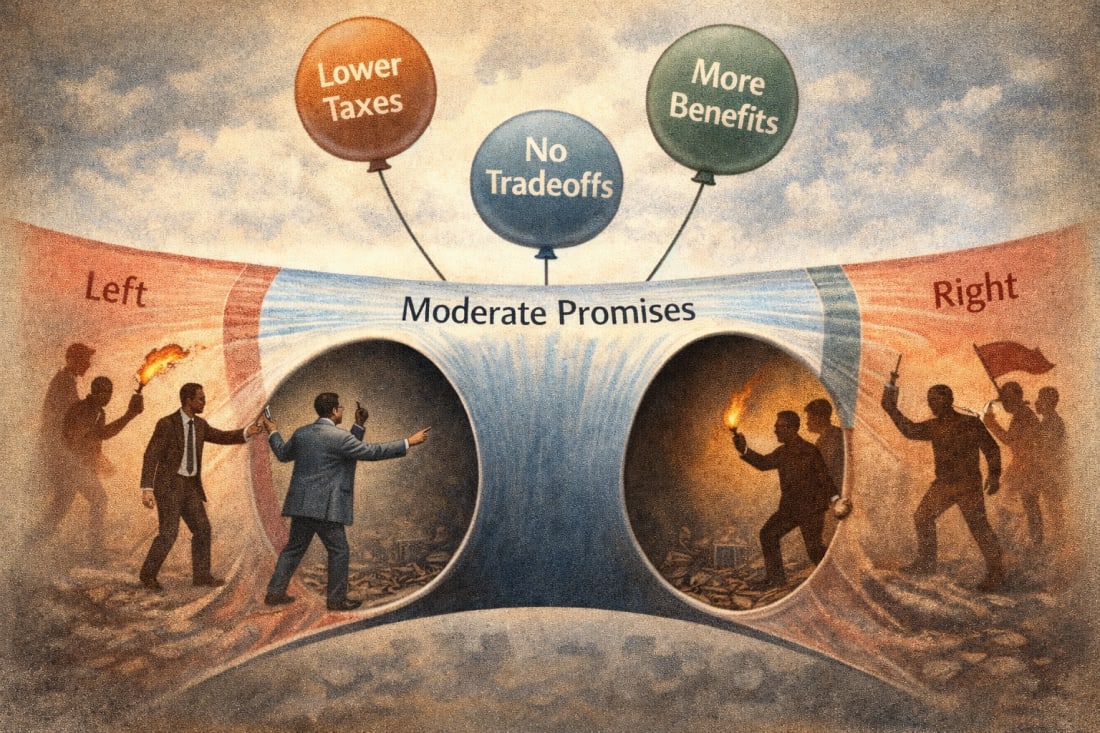
Maybe. But while I, too, am concerned about the decline of civility, commitment, and, I would add, a sense of the sacred in each other, I don’t believe this thoroughly explains the dysfunction so common among democratic governments today. In fact, I see two deadly sins that moderates and extremists, at least in politics, have committed together and led to the chaos we see now. First, they have neglected, for decades, the idea that their policies need to be sustainable over the long term—both economically and democratically. Unfortunately, yesterday’s long-term future has now arrived. Second, and closely related, they fail to see how their attempts to eternalize many of their programmatic judgments—regardless of how legitimate any initial rationale for change might have been—have sharply limited democratic decision-making.
Numbers that Haven’t Added Up for a Long Time
Modern and ancient politicians share many traits. From the Athenians to the Romans, and from America’s founders to Xi Jinping, many have worried that excessive appeals to populism can derail democracy. Nearly always, populism includes excessive giveaways in the form of circuses, tax cuts, and increased spending that lead to fiscal chaos, which then develops into civic and cultural disorder.
But why and how have these problems become urgent now? In short, the risk of fiscal chaos has been increasing for many decades. Now, as it reaches a crisis point, new leaders shift both their focus and that of voters away from the tough decisions that have become increasingly required for rational governance and toward an irrational politics of blame and retribution.
Let’s look back at some history, recognizing that in a democracy, politicians can only stay in office by convincing voters that they improve lives.
With ongoing progress and industrial growth in recent centuries, one saving grace, economic expansion, allowed politicians to offer new benefits to voters continually. Even when lawmakers indulged in the venial sin of temporary budgetary recklessness, revenues would nearly double within a generation or two at a real economic growth rate of 1 to 3 percent, even without any tax rate increase. Their only required penance was to be a bit less reckless for a while, as those revenues increased faster than any new giveaways. Legislators didn’t have to formally take anything away from people to maintain a sustainable budget.
Let’s now focus on modern U.S. history, which shares similarities with the experiences of many other countries. Besides revenue growth from economic expansion, tax rates increased significantly in the mid-20th century in response to the Depression and World War II. Additionally, the post-war period of peace under Pax Americana and the establishment of international institutions such as the United Nations and the International Monetary Fund resulted in a substantial peace dividend.
Economic growth, higher wartime-inherited tax rates, and defense spending cuts: it was a trifecta for elected officials eager to show their constituents how generous they could be with the money flowing into government coffers. Broadly speaking, during the three decades that French demographer Jean Fourastié called Les Trente Glorieuses, or the Glorious 30, the U.S. and most of the developed world saw a multitude of measures that increased spending and cut taxes through these three sources.
Even the tax cuts were often offset by a fourth source of increasing revenues called income tax bracket creep (higher average rates as incomes rise) and a fifth source, Social Security tax rate increases, which faced limited political opposition because the benefits promised to early generations would be a vast multiple of what they paid in taxes.
That “easy financing” era began to wane during Jimmy Carter’s presidency. Richard Nixon had already presided over the most significant increase in domestic spending as a share of GDP of any President before him, even as the debt-to-GDP ratio reached a post-war low in 1974, a level never since achieved. Both Democrats and Republicans disliked Carter because he couldn’t maintain past levels of giveaways without significantly increasing the debt-to-GDP ratio. Then Ronald Reagan, at least in 1981, tried to bring back the era of easy financing, but through a huge giveaway centered entirely on tax cuts.
A brief period of fiscal sanity from about 1982 to 1993 included five moderate deficit-reduction packages, with a 1983 package focused on Social Security. Along with some temporary good luck, such as baby boomers being in peak earning years, those efforts helped turn some annual deficits into brief surpluses around the end of the century. Yet those reforms never addressed long-term issues, even though the warnings were clear for everyone to see. Even Social Security actuarial reports beginning in the early 1990s started warning that its trust funds would run out in the 2030s, well before what had been forecast by the 1983 Social Security reformers.
Basically, few elected officials since the end of Les Trente Glorieuses have been willing to admit that their policies have become increasingly unsustainable for the long term.
Eternal Promises
In the early postwar period, Congress and the President made nearly all spending decisions through an annual discretionary budget process. Today, past legislators, many long dead, have predetermined most of what must be spent today and tomorrow by establishing programs intended to last forever, with the large retirement and healthcare programs also containing rules for perpetual growth at rates faster than the economy would grow. These so-called “mandatory” programs, which generally require no new legislative approval from elected officials, now account for about three-quarters of current federal outlays.
By 2035, the projected increases in spending on Social Security, Medicare, and debt interest alone will soak up all expected revenue growth. Everything else can only be financed by higher deficits. Meanwhile, a series of tax cuts, also meant to last forever, makes the situation worse.
Consider the significant shift from the early decades after World War II. Then, revenues grew much faster than the limited mandated spending. Today, mandated spending, which is now substantial, increases much faster than revenues, even before accounting for rising interest costs from recent tax cuts. Essentially, economic growth no longer offers a reliable means for current legislators to enact new spending or tax cuts, whether for good or ill, because past legislators had already put into law how all revenues, other than those raised through additional borrowing, would be spent.
Yet each political party still acts as if we are in Les Trente Glorieuses. When each gains power, it tries to allocate resources that are no longer available to make even more lasting commitments, locking in an ever-growing share of society’s future resources to its own vision of what that future should be.
The Lack of Fiscal Democracy Endangers Democracy Itself
Today, the main task for presidents and legislators is to establish a new fiscal order that restores fiscal democracy and freedom for today’s and tomorrow’s voters and lawmakers. They can only reach this goal by reneging on unsustainable promises, both for high, automatic spending growth and taxes kept well below spending levels.
Yet they fear that doing their jobs means losing their jobs. Additionally, if Democrats cut the growth rates of Social Security and Medicare, they also believe Republicans will implement additional tax cuts. Conversely, if Republicans raise taxes—especially on the capitalists who have benefited most from tax cuts over recent decades—they believe Democrats will legislate more spending increases.
Throughout most of this century, one result has been an increasingly dysfunctional Congress. As noted, fiscal chaos triggers chaos in other parts of the political system. That’s one reason why Italians turned to Mussolini and Russians to Putin, and why some Americans under the Articles of Confederation wanted to give Washington king-like powers. In democracies around the world today, many people seem intent on turning to populists and aspiring autocrats to help them maintain the denial of the fiscal reality that their tax levels and their benefit levels are part of the problem. The movements today might come more from the right, and tomorrow, more from the left, but the definitions of right and left quickly become distorted to the point that they lose meaning in these circumstances.
For those interested in more details, I’ve outlined the types of solutions I believe are required in two recent books: Abandoned: How Republicans and Democrats Deserted The Working Class, The Young, And The American Dream, and Beyond Zombie Rule: Reclaiming Fiscal Sanity In A Broken Congress.
My main point here is simple: moderates, too, create conditions ripe for democratic chaos and extremism when they support elected officials who implement unsustainable long-term policies and make excessive promises that severely restrict future democratic decision-making.
Please read and share my recent book, Abandoned: How Republicans And Democrats Have Deserted The Working Class, The Young, And The American Dream. It lays out the long-term issues that have led to today’s political morass and how efforts to promote upward mobility and wealth building for all must form a significant part of tomorrow’s agenda.
Please also recommend this column to others. Less importantly, if you’re a free subscriber, you can upgrade to paid.
| ||||||||||

