|
 |
This content is available for free to all subscribers. But you really should consider a paid subscription. This unlocks our afternoon e-mails, our Saturday “What is Jon Reading” e-mail, and analysis on breaking news. Normally a subscription is a modest $7 a month or just $70 for the year.
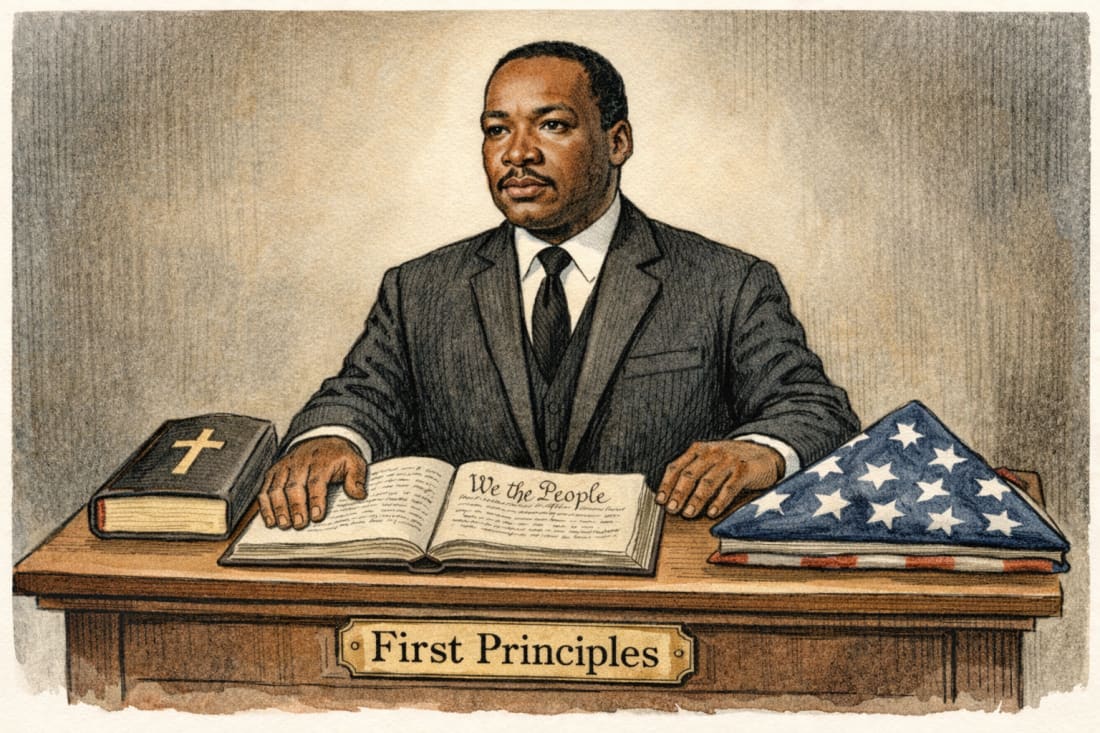
Martin Luther King Jr. Was Making a Constitutional Argument
How King appealed to founding principles, equal protection, and moral restraint rather than partisan politics
|
| |||||||||||||||


 |
🕒 7 min read
The Discipline Behind the Dream
On Martin Luther King Jr. Day, we often hear inspiring words about dreams and destiny. These words are important. However, they can sometimes hide another key part of King’s message: his focus on discipline, moral restraint, and respect for the law as the basis of freedom.
King did not want America to give up its founding principles. He wanted the country to live up to them.
One of his most lasting and misunderstood statements came not from a rally, but from a jail cell in Birmingham.
“Injustice anywhere is a threat to justice everywhere.”
King was not supporting the disorder or ongoing complaints. He was making a constitutional point: a legal system loses its legitimacy when it allows unfair enforcement or selective protection. For King, the answer to injustice was not chaos but reform grounded in moral clarity and respect for the law.
King was jailed over twenty times for his civil disobedience.
A Constitutional Argument, Not a Radical One
For constitutional conservatives, this legacy is not unfamiliar. It is something they know well.
King’s main point was that America’s constitutional promises were good, but not always applied fairly. He looked to the Declaration of Independence and the Constitution as real moral commitments, not old documents. When he called civil rights a promissory note, he wanted the country to enforce its current promises, not create new, permanent group entitlements.
That difference still matters. King strongly believed in equal protection under the law, not in government-imposed labels. He often said people should be judged by their character and actions, not by traits they cannot change. He warned that injustice, even when done for the sake of progress, weakens the rule of law.
Why His Words Still Travel
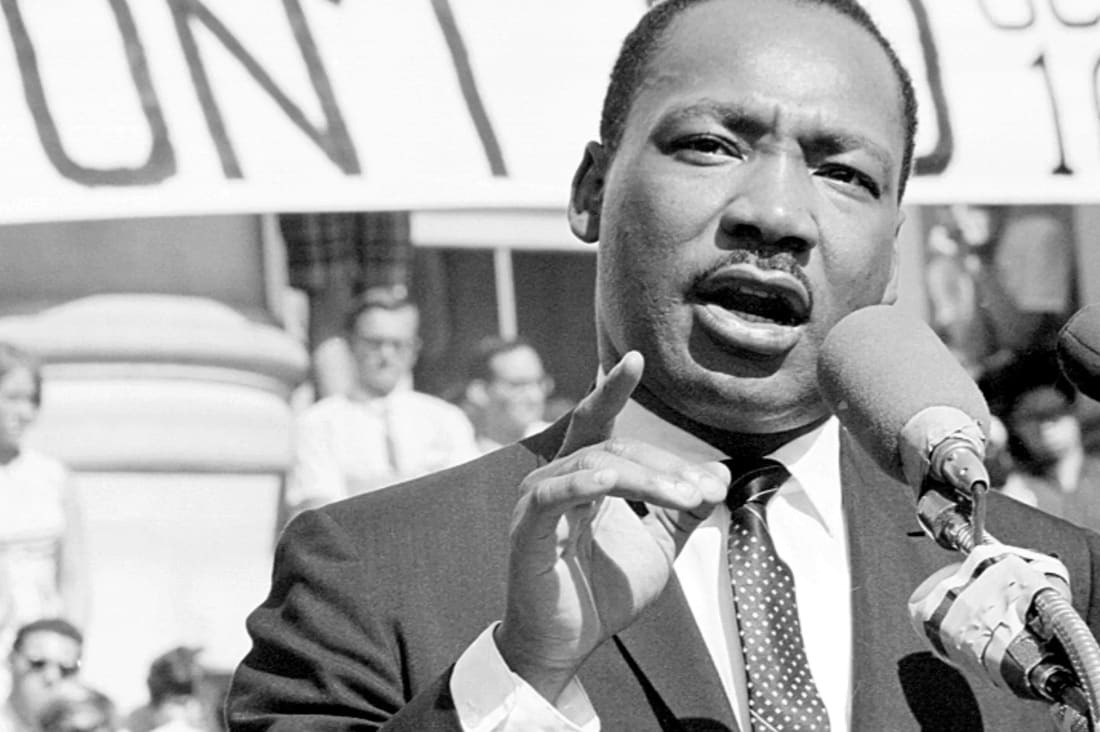 |
Another sign of King’s lasting importance is the number of people who find his message meaningful. On Martin Luther King Jr. Day, his words are quoted in Congress, state capitols, city halls, and campaign speeches all over the country. Presidents, governors, and local leaders often refer to his moral authority.
People with narrow or strongly ideological ideas rarely have this kind of lasting impact. King’s words still matter because they focus on basic principles: equality before the law, moral responsibility, and careful use of power. His ideas are not tied to short-term politics, which is why they are still shared long after his time.
To honor King honestly, we do not have to agree with everything he believed. But we should avoid turning him into a symbol for causes he did not support. He was not a political tool or a party symbol. He was a moral leader who challenged the nation.
The Limits of Politics
King also saw that politics had its limits. Near the end of his life, he became cautious about excessive power in a single place and doubted that government or political groups could replace moral responsibility, strong families, and civic values.
His view of the world was based on faith, not on ideology. He believed laws could help stop injustice, but he also knew that laws alone could not keep a society free. Real change had to come from communities, families, and institutions that existed before government.
This belief made it hard for people to fully claim King’s legacy in his time, and it still does today.
So, Does It Matter?
As we remember Martin Luther King Jr., there are three key points to keep in mind. First, he believed America’s founding principles were sound and that the Constitution’s problem was not its design but its application. Second, he thought justice and moral discipline could not be separated, saying that protest needed restraint and that freedom without order would not last. Third, he knew that while politics can limit injustice, only moral renewal can keep freedom alive over time.
That challenge is still with us. It is one we should take seriously.
Every MLK day, I watch this important speech - his most famous. I invite you to do the same…
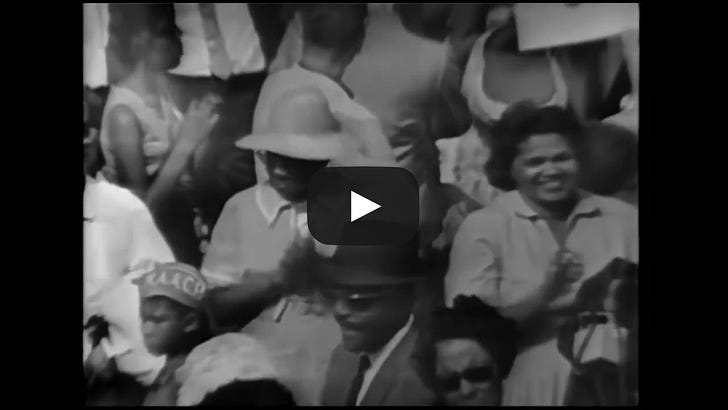
Prefer to read it? We have you covered… But you really are missing out by skipping out on MLK’s intensely dramatic reading…
Speaker: I have the pleasure to present to you Dr. Martin Luther King, J. R.
Martin Luther King, Jr.: I am happy to join with you today in what will go down in history as the greatest
demonstration for freedom in the history of our nation.
Five score years ago, a great American, in whose symbolic shadow we stand today, signed the
Emancipation Proclamation. This momentous decree came as a great beacon light of hope to millions of
Negro slaves who had been seared in the flames of withering injustice. It came as a joyous daybreak to
end the long night of their captivity.
But 100 years later, the Negro still is not free. There are those who are asking the devotees of Civil
Rights: “When will you be satisfied?” We can never be satisfied as long as the Negro is the victim of the
unspeakable horrors of police brutality. We can never be satisfied as long as our children are stripped of
their selfhood and robbed of their dignity by signs stating “For whites only.” No, no we are not satisfied,
and we will not be satisfied until “justice rolls down like waters and righteousness like a mighty stream.”
I have a dream that one day on the red hills of Georgia, sons of former slaves and the sons of former
slave owners will be able to sit down together at the table of brotherhood.
I have a dream that one day, even the state of Mississippi, a state sweltering with the heat of injustice,
sweltering with the heat of oppression, be transformed into an oasis of freedom and justice.
I have a dream that my four little children will one day live in a nation where they will not be judged by
the color of their skin but by the content of their character. I have a dream today.
I have a dream that one day down in Alabama with its vicious racists, with its governor having his lips
dripping with the words of interposition and nullification, one day right down in Alabama little black
boys and black girls will be able to join hands with little white boys and white girls as sisters and brothers. I have a dream today.
I have a dream that one day “every valley shall be exalted, every hill and mountain shall be made low,
the rough places will be made plain, and the crooked places will be made straight, and the glory of the
Lord shall be revealed, and all flesh shall see it together.”
This is our hope, this is the faith that I go back to the South with. With this faith, we will be able to hew
out of the mountain of despair, a stone of hope. With this faith, we will be able to transform the
jangling discords of our nation into a beautiful symphony of brotherhood. With this faith we will be able
to work together, to pray together, to struggle together, to go to jail together, to stand up for freedom
together, knowing that we will be free one day. This will be the day. This will be the day when all of
God’s children will be able to sing with new meaning:
My country, ‘tis of thee, sweet land of liberty, of thee I sing.
Land where my fathers died, land of the pilgrim’s pride,
From every mountainside, let freedom ring!
And if America is to be a great nation, this must become true.
So let freedom ring from the prodigious hilltops of New Hampshire.
Let freedom ring from the mighty mountains of New York.
Let freedom ring from the heightening Alleghenies of Pennsylvania.
Let freedom ring from the snowcapped Rockies of Colorado.
Let freedom ring from the curvaceous slopes of California.
But not only that. Let freedom ring from Stone Mountain of Georgia.
Let freedom ring from Lookout Mountain of Tennessee.
Let freedom ring from every hill and molehill of Mississippi.
From every mountainside, let freedom ring.
And when this happens, when we allow freedom ring, when we let it ring from every village and every
hamlet, from every state and every city, we will be able to speed up that day when all of God’s children,
black men and white men, Jews and Gentiles, Protestants and Catholics, will be able to join hands and
sing in the words of the old Negro spiritual:
Free at last! Free at last!
Thank God Almighty, we are free at last.
[Applause and singing]
Speaker: On behalf of the National Committee on the March on Washington…
Woman singing:
Oh deep in my heart, I do believe, we shall overcome some day.
White man work together, black man work together. We shall overcome some day!
Oh, deep in my heart, I do believe, we shall overcome some day.
Crowd singing:
We’ll walk hand in hand, we’ll walk hand in hand some day!
Oh, deep in my heart, I do believe.
A. Philip Randolph: I think history was written today which will have its effect on coming generations,
with respect to our democracy, with respect to our ideals, with respect to the great struggle of man,
God, freedom, and human dignity.
Narrator: There were many who praised this day and said that there had been a new awakening in the
conscience of the nation. Others called it a national disgrace. In the wake of this day, more violence
was to come, more hatred, but in the long history of man’s cruelty to man, this was a day of hope.
Crowd singing:
Freedom, freedom, freedom, freedom freedom!
Freedom, freedom, freedom, freedom freedom!
You’re currently a free subscriber to So, Does It Matter? California Politics! For the full experience, upgrade your subscription. See how much more you get with an inexpensive, paid subscription, but clicking the button below! Support me in providing hard-hitting, clear-eyed analysis of California politics. I am beholding to no one, and sugar-coat nothing!
| ||||||||||

