In this mailing:
- Khaled Abu Toameh: If Iran's Regime Stays in Place, Trump's Gaza 'Peace' Plan Will Not Have Success
- Ahmed Charai: Iran's Strategy of Delay
by Khaled Abu Toameh • January 19, 2026 at 5:00 am
US President Donald J. Trump's plan for ending the Israel-Hamas war should have included a provision to stipulate the need for a different regime in Iran. That is the fastest, best and, unfortunately, the only way to eradicate Hamas and destroy "[a]ll military, terror, and offensive infrastructure, including tunnels and weapon production facilities" not only in the Gaza Strip, as stated in Trump's 20-point plan, but also the Middle East. Without Iran's support, there also would be no proxies – such as the Houthis, Hezbollah and Venezuela -- nor their alliances with Russia and China. Qatar and Turkey, longtime supporters of Hamas, have also been reinforcing the terror group with money and diplomatic backing. Both Qatar and Turkey -- followers, like Hamas, of the Muslim Brotherhood -- continue to host senior Hamas officials and operatives. That is why it does not seem a prudent decision on the part of Trump to have included Qatar and Turkey on his "Board of Peace" to oversee the postwar management of the Gaza Strip. In addition to Qatar and Turkey, Egypt, and Britain – which, sadly, has not been a dependable friend to Israel -- were appointed as members of the newly established Executive Committee of the Board of Peace, chaired by Trump himself. Providentially, the United Arab Emirates, which, despite extensive turbulence, has been an unwavering supporter of Trump, the US and the West, also serves on the Executive Committee. Like Iran, Qatar and Turkey have an interest in preserving Hamas's presence both as a political and military entity.... they are totally unlikely to participate in any effort to disarm Hamas or demilitarize the territory. The danger is that after Trump leaves office, these countries -- no friends of Israel --will be irresistibly positioned to attack it. Notably, no Arab or Islamic country has so far expressed the slightest readiness to play any role in forcing Hamas and other Palestinian terror groups to surrender their weapons.... After all, so long as terror attacks are directed only against Israel, Hamas and other terror groups in Gaza do not pose a direct threat to their regimes. With the mullahs still in place, there is every reason to believe that the strategic alliance within the "axis of resistance" -- Iran, Russia, China -- will also stay in place. Hamas still uses Iran for its weapons, military training and technology. Although Iran is reportedly bankrupt, the mullahs will continue to pour millions of dollars on Hamas and Hezbollah. Iran cannot afford to lose its two main proxies in the Middle East. It is crucial at this juncture to free the Palestinians from the boot of Hamas and the Iranians from the boot of the mullahs. The disappearance of both would do Trumpian wonders for the entire planet.
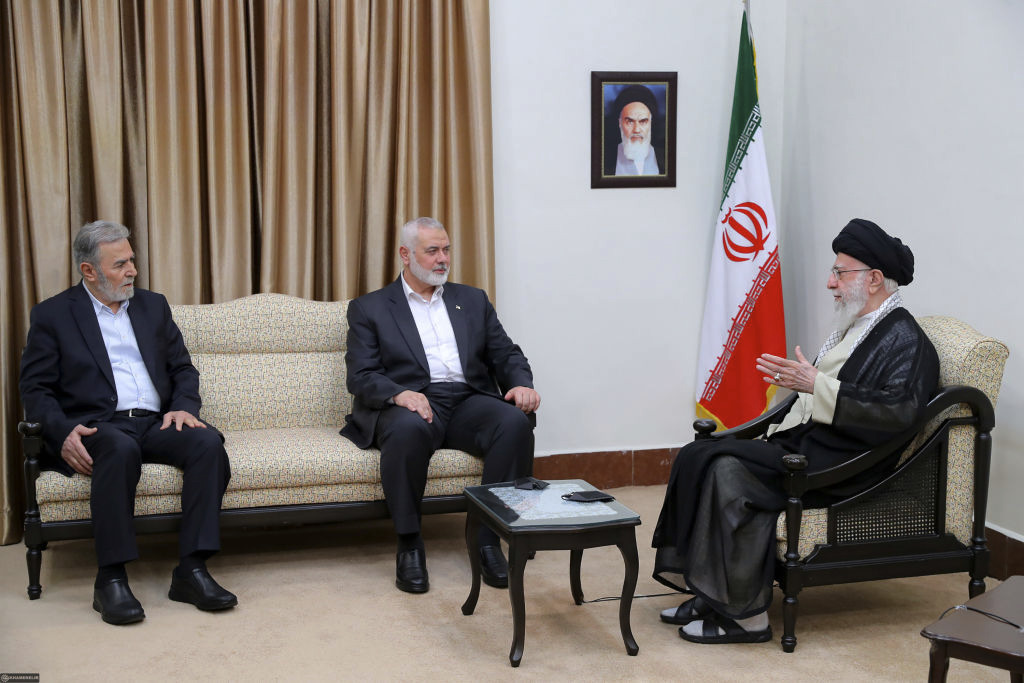
US President Donald J. Trump's plan for ending the Israel-Hamas war exposes the elephant in the room: the Iranian regime. Without Iran's support, Hamas would not have been able to transform the Gaza Strip into a large base for Jihad (holy war) against Israel. Pictured: Ali Khamenei, the Supreme Leader of Iran, meets with Ismail Haniyeh, then leader of Hamas, and Palestinian Islamic Jihad leader Ziyad al-Nakhalah, on July 30, 2024 in Tehran, Iran. (Photo by the Iranian Supreme Leader's Press Office via Getty Images)
US President Donald J. Trump's plan for ending the Israel-Hamas war should have included a provision to stipulate the need for a different regime in Iran. That is the fastest, best and, unfortunately, the only way to eradicate Hamas and destroy "[a]ll military, terror, and offensive infrastructure, including tunnels and weapon production facilities" not only in the Gaza Strip, as stated in Trump's 20-point plan, but also the Middle East.
Continue Reading Article
Iran's Strategy of Delay
The Islamic Republic is gambling on US attention on its brutality eventually subsiding
by Ahmed Charai • January 19, 2026 at 4:00 am
Millions of Iranians took to the streets demanding freedom, dignity, economic opportunity, and basic services that any responsible government should provide. According to multiple credible human rights organizations and international NGOs, the Iranian authorities killed and executed more than 3,500 innocent Iranians during the latest unrest. Thousands more were arrested, tortured, or disappeared. These killings were not spontaneous acts of crowd control; they were deliberate, systematic decisions taken at the highest levels of the state. Repression is not a policy failure of the Islamic Republic — it is its governing method. A regime willing to massacre its own citizens does not suddenly behave responsibly beyond its borders. [W]hen confronted with real pressure, Tehran recalculates. When pressure is lifted, it advances. This context also explains why repeated negotiations with Tehran have failed. The Iranian regime does not negotiate to resolve disputes; it negotiates to gain time. Agreements are used to relieve pressure, stabilize the regime internally, and resume hostile activities under new constraints. Time — more than ideology or diplomacy — is Tehran's most effective strategic weapon. Iran remains the central obstacle to any serious vision of stability, integration, and prosperity in the Middle East. No development strategy can succeed while Tehran continues to invest in repression at home and violence abroad. The Iranian leadership is betting — once again — on time, on US elections, on distractions. That bet must fail. The Iranian people deserve a future. The region deserves stability. And President Trump's leadership demands resolve.
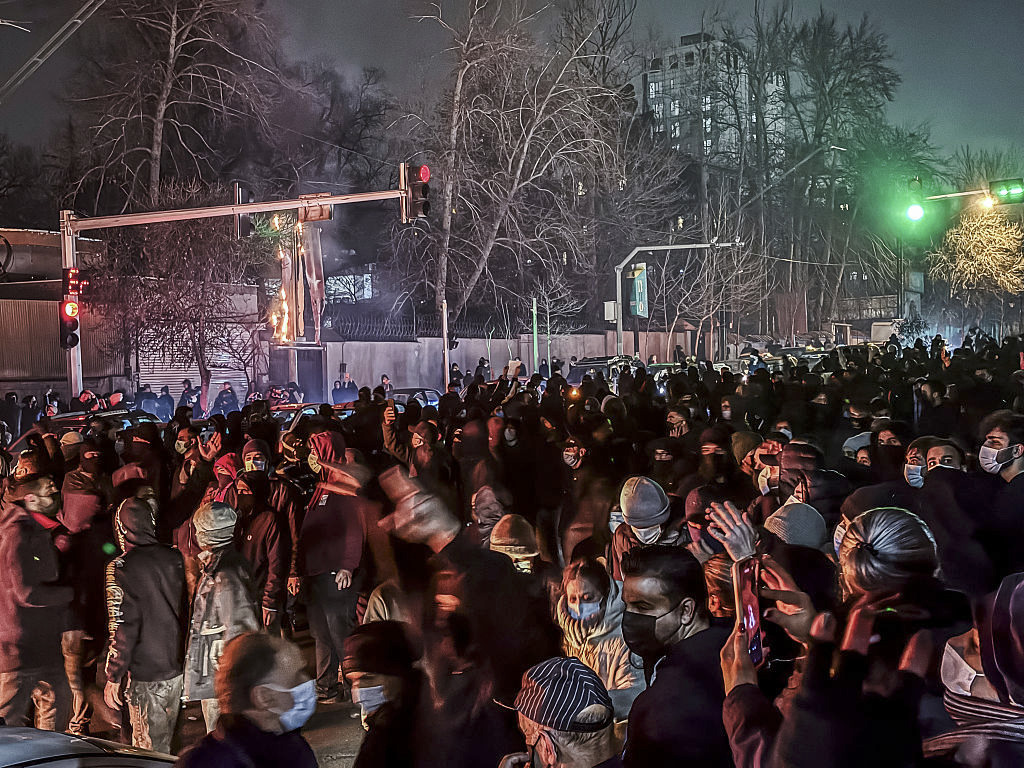
According to multiple credible human rights organizations and international NGOs, the Iranian authorities killed and executed more than 3,500 innocent Iranians during the latest unrest. Thousands more were arrested, tortured, or disappeared. These killings were not spontaneous acts of crowd control; they were deliberate, systematic decisions taken at the highest levels of the state. Repression is not a policy failure of the Islamic Republic — it is its governing method. Pictured: Iranians protest against the regime on January 9, 2026, in Tehran. (Photo by MAHSA/Middle East Images/AFP via Getty Images)
Iran is not a conventional adversary operating within accepted rules of state behavior. It is a regime whose survival depends on repression at home, destabilization abroad, and the systematic manipulation of diplomacy. For more than four decades, Tehran has refined a strategy built on violence, delay, and deception, betting on Western hesitation, election cycles, and diplomatic fatigue to advance its objectives while avoiding consequences. The most recent wave of protests inside Iran exposed this reality with brutal clarity. These demonstrations were not ideological uprisings orchestrated from abroad, as the regime claims. They are rooted in daily hardship. Millions of Iranians took to the streets demanding freedom, dignity, economic opportunity, and basic services that any responsible government should provide.
Continue Reading Article
|
|
|
|