
Email
4,200 reasons to rethink plastic
| From | U.S. PIRG <[email protected]> |
| Subject | 4,200 reasons to rethink plastic |
| Date | January 17, 2026 4:58 PM |
Links have been removed from this email. Learn more in the FAQ.
Links have been removed from this email. Learn more in the FAQ.
:
John,
The convenience of plastic comes with a hidden cost to our health.
That's because plastic can contain thousands of chemicals. Of the 16,000 chemicals used in plastic materials, more than 4,200 may be hazardous to people.[1]
Are some of these chemicals in your kitchen right now? If they are, what can you do?
Let's take a look at some of the most problematic kitchen items -- as well as some healthier, plastic-free alternatives:
While cans themselves are usually made of aluminum or steel, most cans are lined with plastic.[2] And despite some manufacturer phaseouts, many cans are still lined with plastic polymers that contain the chemical bisphenol-A, or BPA. BPA has been linked to obesity, Type 2 Diabetes and other adverse health impacts.[3]
You can still stock your pantry without exposing you or your loved ones to BPA. For beans, vegetables and fruits, use dried, frozen or fresh whenever possible. And when you must purchase a can, opt for one that's labeled BPA-free.
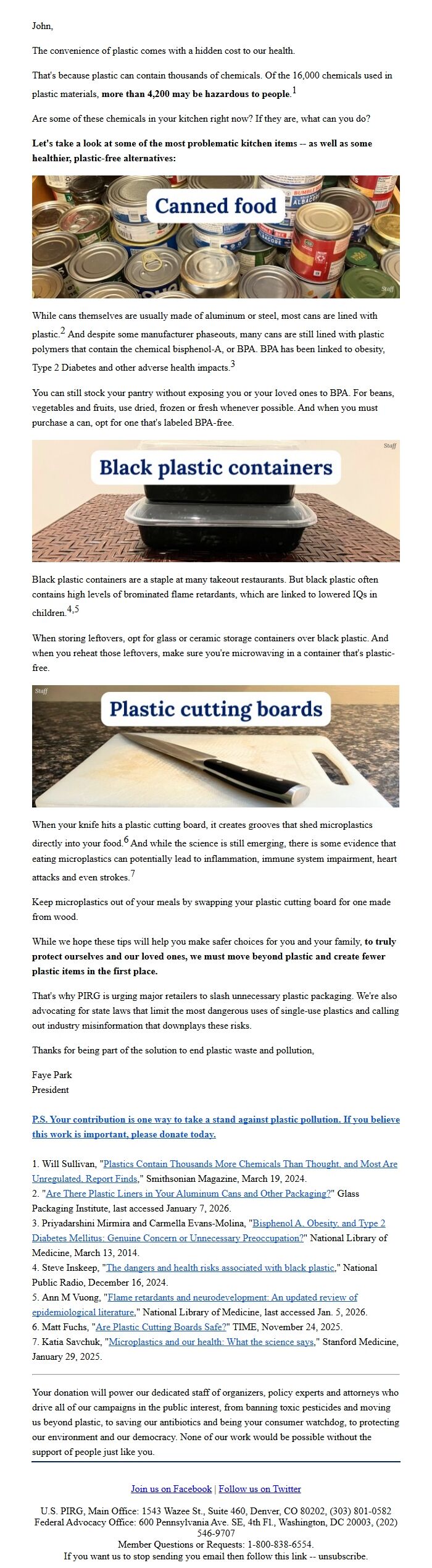
Black plastic containers are a staple at many takeout restaurants. But black plastic often contains high levels of brominated flame retardants, which are linked to lowered IQs in children.[4,5]
[]
When storing leftovers, opt for glass or ceramic storage containers over black plastic. And when you reheat those leftovers, make sure you're microwaving in a container that's plastic-free.
When your knife hits a plastic cutting board, it creates grooves that shed microplastics directly into your food.[6] And while the science is still emerging, there is some evidence that eating microplastics can potentially lead to inflammation, immune system impairment, heart attacks and even strokes.[7]
Keep microplastics out of your meals by swapping your plastic cutting board for one made from wood.
While we hope these tips will help you make safer choices for you and your family, to truly protect ourselves and our loved ones, we must move beyond plastic and create fewer plastic items in the first place.
That's why PIRG is urging major retailers to slash unnecessary plastic packaging. We're also advocating for state laws that limit the most dangerous uses of single-use plastics and calling out industry misinformation that downplays these risks.
Thanks for being part of the solution to end plastic waste and pollution,
Faye Park
President
P.S. Your contribution is one way to take a stand against plastic pollution. If you believe this work is important, please donate today.
[link removed]
1. Will Sullivan, "Plastics Contain Thousands More Chemicals Than Thought, and Most Are Unregulated, Report Finds," Smithsonian Magazine, March 19, 2024.
[link removed]
2. "Are There Plastic Liners in Your Aluminum Cans and Other Packaging?" Glass Packaging Institute, last accessed January 7, 2026.
[link removed]
3. Priyadarshini Mirmira and Carmella Evans-Molina, "Bisphenol A, Obesity, and Type 2 Diabetes Mellitus: Genuine Concern or Unnecessary Preoccupation?" National Library of Medicine, March 13, 2014.
[link removed]
4. Steve Inskeep, "The dangers and health risks associated with black plastic," National Public Radio, December 16, 2024.
[link removed]
5. Ann M Vuong, "Flame retardants and neurodevelopment: An updated review of epidemiological literature," National Library of Medicine, last accessed Jan. 5, 2026.
[link removed]
6. Matt Fuchs, "Are Plastic Cutting Boards Safe?" TIME, November 24, 2025.
[link removed]
7. Katia Savchuk, "Microplastics and our health: What the science says," Stanford Medicine, January 29, 2025.
[link removed]
-----------------------------------------------------------
Your donation will power our dedicated staff of organizers, policy experts and attorneys who drive all of our campaigns in the public interest, from banning toxic pesticides and moving us beyond plastic, to saving our antibiotics and being your consumer watchdog, to protecting our environment and our democracy. None of our work would be possible without the support of people just like you.
-----------------------------------------------------------
Join us on Facebook: [link removed]
Follow us on Twitter: [link removed]
U.S. PIRG
Main Office: 1543 Wazee St., Suite 460, Denver, CO 80202, (303) 801-0582
Federal Advocacy Office: 600 Pennsylvania Ave. SE, 4th Fl., Washington, DC 20003, (202) 546-9707
Member Questions or Requests: 1-800-838-6554
If you want us to stop sending you email then follow this link -- [link removed]
John,
The convenience of plastic comes with a hidden cost to our health.
That's because plastic can contain thousands of chemicals. Of the 16,000 chemicals used in plastic materials, more than 4,200 may be hazardous to people.[1]
Are some of these chemicals in your kitchen right now? If they are, what can you do?
Let's take a look at some of the most problematic kitchen items -- as well as some healthier, plastic-free alternatives:
While cans themselves are usually made of aluminum or steel, most cans are lined with plastic.[2] And despite some manufacturer phaseouts, many cans are still lined with plastic polymers that contain the chemical bisphenol-A, or BPA. BPA has been linked to obesity, Type 2 Diabetes and other adverse health impacts.[3]
You can still stock your pantry without exposing you or your loved ones to BPA. For beans, vegetables and fruits, use dried, frozen or fresh whenever possible. And when you must purchase a can, opt for one that's labeled BPA-free.
Black plastic containers are a staple at many takeout restaurants. But black plastic often contains high levels of brominated flame retardants, which are linked to lowered IQs in children.[4,5]
[]
When storing leftovers, opt for glass or ceramic storage containers over black plastic. And when you reheat those leftovers, make sure you're microwaving in a container that's plastic-free.
When your knife hits a plastic cutting board, it creates grooves that shed microplastics directly into your food.[6] And while the science is still emerging, there is some evidence that eating microplastics can potentially lead to inflammation, immune system impairment, heart attacks and even strokes.[7]
Keep microplastics out of your meals by swapping your plastic cutting board for one made from wood.
While we hope these tips will help you make safer choices for you and your family, to truly protect ourselves and our loved ones, we must move beyond plastic and create fewer plastic items in the first place.
That's why PIRG is urging major retailers to slash unnecessary plastic packaging. We're also advocating for state laws that limit the most dangerous uses of single-use plastics and calling out industry misinformation that downplays these risks.
Thanks for being part of the solution to end plastic waste and pollution,
Faye Park
President
P.S. Your contribution is one way to take a stand against plastic pollution. If you believe this work is important, please donate today.
[link removed]
1. Will Sullivan, "Plastics Contain Thousands More Chemicals Than Thought, and Most Are Unregulated, Report Finds," Smithsonian Magazine, March 19, 2024.
[link removed]
2. "Are There Plastic Liners in Your Aluminum Cans and Other Packaging?" Glass Packaging Institute, last accessed January 7, 2026.
[link removed]
3. Priyadarshini Mirmira and Carmella Evans-Molina, "Bisphenol A, Obesity, and Type 2 Diabetes Mellitus: Genuine Concern or Unnecessary Preoccupation?" National Library of Medicine, March 13, 2014.
[link removed]
4. Steve Inskeep, "The dangers and health risks associated with black plastic," National Public Radio, December 16, 2024.
[link removed]
5. Ann M Vuong, "Flame retardants and neurodevelopment: An updated review of epidemiological literature," National Library of Medicine, last accessed Jan. 5, 2026.
[link removed]
6. Matt Fuchs, "Are Plastic Cutting Boards Safe?" TIME, November 24, 2025.
[link removed]
7. Katia Savchuk, "Microplastics and our health: What the science says," Stanford Medicine, January 29, 2025.
[link removed]
-----------------------------------------------------------
Your donation will power our dedicated staff of organizers, policy experts and attorneys who drive all of our campaigns in the public interest, from banning toxic pesticides and moving us beyond plastic, to saving our antibiotics and being your consumer watchdog, to protecting our environment and our democracy. None of our work would be possible without the support of people just like you.
-----------------------------------------------------------
Join us on Facebook: [link removed]
Follow us on Twitter: [link removed]
U.S. PIRG
Main Office: 1543 Wazee St., Suite 460, Denver, CO 80202, (303) 801-0582
Federal Advocacy Office: 600 Pennsylvania Ave. SE, 4th Fl., Washington, DC 20003, (202) 546-9707
Member Questions or Requests: 1-800-838-6554
If you want us to stop sending you email then follow this link -- [link removed]
Message Analysis
- Sender: n/a
- Political Party: n/a
- Country: n/a
- State/Locality: n/a
- Office: n/a
-
Email Providers:
- ActionKit