
| From | Wayne Pacelle <[email protected]> |
| Subject | New national law gives kids plant-based milk options |
| Date | January 15, 2026 7:57 PM |
Links have been removed from this email. Learn more in the FAQ.
Links have been removed from this email. Learn more in the FAQ.
͏ ͏ ͏ ͏ ͏ ͏ ͏ ͏ ͏ ͏ ͏ ͏ ͏ ͏ ͏ ͏ ͏ ͏ ͏ ͏ ͏ ͏ ͏ ͏ ͏ ͏ ͏ ͏ ͏ ͏ ͏ ͏ ͏ ͏ ͏ ͏ ͏ ͏ ͏ ͏ ͏ ͏ ͏ ͏ ͏ ͏ ͏ ͏ ͏ ͏ ͏ ͏ ͏ ͏ ͏ ͏ ͏ ͏ ͏ ͏ ͏ ͏ ͏ ͏ ͏ ͏ ͏ ͏ ͏ ͏ ͏ ͏ ͏ ͏ ͏ ͏ ͏ ͏ ͏ ͏ ͏ ͏ ͏ ͏ ͏ ͏ ͏ ͏ ͏ ͏ ͏ ͏ ͏ ͏ ͏ ͏ ͏ ͏ ͏ ͏ ͏ ͏ ͏ ͏ ͏ ͏ ͏ ͏ ͏ ͏ ͏ ͏ ͏ ͏ ͏ ͏ ͏If you’d like to unsubscribe, click here. [[link removed]]
[link removed] [[link removed]]
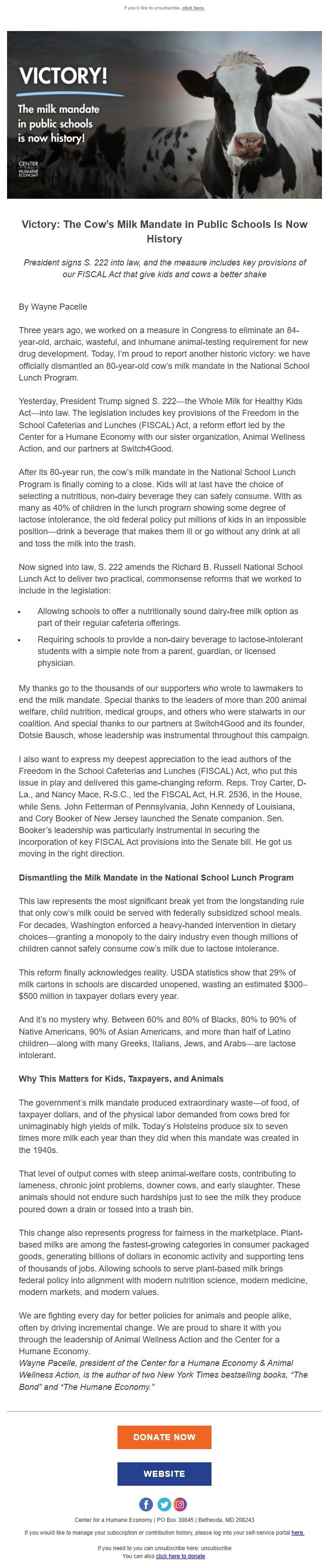
Victory: The Cow’s Milk Mandate in Public Schools Is Now History
President signs S. 222 into law, and the measure includes key provisions of our FISCAL Act that give kids and cows a better shake
By Wayne Pacelle
Three years ago, we worked on a measure in Congress to eliminate an 84-year-old, archaic, wasteful, and inhumane animal-testing requirement for new drug development. Today, I’m proud to report another historic victory: we have officially dismantled an 80-year-old cow’s milk mandate in the National School Lunch Program.
Yesterday, President Trump signed S. 222—the Whole Milk for Healthy Kids Act—into law. The legislation includes key provisions of the Freedom in the School Cafeterias and Lunches (FISCAL) Act, a reform effort led by Animal Wellness Action with our sister organization, the Center for a Humane Economy, and our partners at Switch4Good.
After its 80-year run, the cow’s milk mandate in the National School Lunch Program is finally coming to a close. Kids will at last have the choice of selecting a nutritious, non-dairy beverage they can safely consume. With as many as 40% of children in the lunch program showing some degree of lactose intolerance, the old federal policy put millions of kids in an impossible position—drink a beverage that makes them ill or go without any drink at all and toss the milk into the trash.
Now signed into law, S. 222 amends the Richard B. Russell National School Lunch Act to deliver two practical, commonsense reforms that we worked to include in the legislation:
* Allowing schools to offer dairy-free milk options—such as soy, oat, or almond milk—as part of their regular cafeteria offerings.
* Requiring schools to provide a nutritionally sound non-dairy beverage to lactose-intolerant students with a simple note from a parent, guardian, or licensed physician.
My thanks go to the thousands of our supporters who wrote to lawmakers to end the milk mandate. Special thanks to the leaders of more than 200 animal welfare, child nutrition, medical groups, and others who were stalwarts in our coalition. And special thanks to our partners at Switch4Good and its founder, Dotsie Bausch, whose leadership was instrumental throughout this campaign.
I also want to express my deepest appreciation to the lead authors of the Freedom in the School Cafeterias and Lunches (FISCAL) Act, who put this issue in play and delivered this game-changing reform. Reps. Troy Carter, D-La., and Nancy Mace, R-S.C., led the FISCAL Act, H.R. 2536, in the House, while Sens. John Fetterman of Pennsylvania, John Kennedy of Louisiana, and Cory Booker of New Jersey launched the Senate companion. Sen. Booker’s leadership was particularly instrumental in securing the incorporation of key FISCAL Act provisions into the Senate bill. He got us moving in the right direction.
Dismantling the Milk Mandate in the National School Lunch Program
This law represents the most significant break yet from the longstanding rule that only cow’s milk could be served with federally subsidized school meals. For decades, Washington enforced a heavy-handed intervention in dietary choices—granting a monopoly to the dairy industry even though millions of children cannot safely consume cow’s milk due to lactose intolerance.
This reform finally acknowledges reality. USDA statistics show that 29% of milk cartons in schools are discarded unopened, wasting an estimated $300–$500 million in taxpayer dollars every year.
And it’s no mystery why. Between 60% and 80% of Blacks, 80% to 90% of Native Americans, 90% of Asian Americans, and more than half of Latino children—along with many Greeks, Italians, Jews, and Arabs—are lactose intolerant.
Why This Matters for Kids, Taxpayers, and Animals
The government’s milk mandate produced extraordinary waste—of food, of taxpayer dollars, and of the physical labor demanded from cows bred for unimaginably high yields of milk. Today’s Holsteins produce six to seven times more milk each year than they did when this mandate was created in the 1940s.
That level of output comes with steep animal-welfare costs, contributing to lameness, chronic joint problems, downer cows, and early slaughter. These animals should not endure such hardships just to see the milk they produce poured down a drain or tossed into a trash bin.
This change also represents progress for fairness in the marketplace. Plant-based milks are among the fastest-growing categories in consumer packaged goods, generating billions of dollars in economic activity and supporting tens of thousands of jobs. Allowing schools to serve plant-based milk brings federal policy into alignment with modern nutrition science, modern medicine, modern markets, and modern values.
We are fighting every day for better policies for animals and people alike, often by driving incremental change. We are proud to share it with you through the leadership of Animal Wellness Action and the Center for a Humane Economy.
Wayne Pacelle, president of the Center for a Humane Economy & Animal Wellness Action, is the author of two New York Times bestselling books, “The Bond” and “The Humane Economy.”
[[link removed]] DONATE NOW [[link removed]]
[[link removed]] WEBSITE [[link removed]]
[link removed] [[link removed]] [link removed] [[link removed]] [link removed] [[link removed]]
Center for a Humane Economy | PO Box 30845 | Bethesda, MD 208243
If you would like to manage your subscription or contribution history, please log into your self-service portal here. [[link removed]]
If you need to you can unsubscribe here: unsubscribe: [link removed]
You can also click here to donate [[link removed]] .
[link removed] [[link removed]]
Victory: The Cow’s Milk Mandate in Public Schools Is Now History
President signs S. 222 into law, and the measure includes key provisions of our FISCAL Act that give kids and cows a better shake
By Wayne Pacelle
Three years ago, we worked on a measure in Congress to eliminate an 84-year-old, archaic, wasteful, and inhumane animal-testing requirement for new drug development. Today, I’m proud to report another historic victory: we have officially dismantled an 80-year-old cow’s milk mandate in the National School Lunch Program.
Yesterday, President Trump signed S. 222—the Whole Milk for Healthy Kids Act—into law. The legislation includes key provisions of the Freedom in the School Cafeterias and Lunches (FISCAL) Act, a reform effort led by Animal Wellness Action with our sister organization, the Center for a Humane Economy, and our partners at Switch4Good.
After its 80-year run, the cow’s milk mandate in the National School Lunch Program is finally coming to a close. Kids will at last have the choice of selecting a nutritious, non-dairy beverage they can safely consume. With as many as 40% of children in the lunch program showing some degree of lactose intolerance, the old federal policy put millions of kids in an impossible position—drink a beverage that makes them ill or go without any drink at all and toss the milk into the trash.
Now signed into law, S. 222 amends the Richard B. Russell National School Lunch Act to deliver two practical, commonsense reforms that we worked to include in the legislation:
* Allowing schools to offer dairy-free milk options—such as soy, oat, or almond milk—as part of their regular cafeteria offerings.
* Requiring schools to provide a nutritionally sound non-dairy beverage to lactose-intolerant students with a simple note from a parent, guardian, or licensed physician.
My thanks go to the thousands of our supporters who wrote to lawmakers to end the milk mandate. Special thanks to the leaders of more than 200 animal welfare, child nutrition, medical groups, and others who were stalwarts in our coalition. And special thanks to our partners at Switch4Good and its founder, Dotsie Bausch, whose leadership was instrumental throughout this campaign.
I also want to express my deepest appreciation to the lead authors of the Freedom in the School Cafeterias and Lunches (FISCAL) Act, who put this issue in play and delivered this game-changing reform. Reps. Troy Carter, D-La., and Nancy Mace, R-S.C., led the FISCAL Act, H.R. 2536, in the House, while Sens. John Fetterman of Pennsylvania, John Kennedy of Louisiana, and Cory Booker of New Jersey launched the Senate companion. Sen. Booker’s leadership was particularly instrumental in securing the incorporation of key FISCAL Act provisions into the Senate bill. He got us moving in the right direction.
Dismantling the Milk Mandate in the National School Lunch Program
This law represents the most significant break yet from the longstanding rule that only cow’s milk could be served with federally subsidized school meals. For decades, Washington enforced a heavy-handed intervention in dietary choices—granting a monopoly to the dairy industry even though millions of children cannot safely consume cow’s milk due to lactose intolerance.
This reform finally acknowledges reality. USDA statistics show that 29% of milk cartons in schools are discarded unopened, wasting an estimated $300–$500 million in taxpayer dollars every year.
And it’s no mystery why. Between 60% and 80% of Blacks, 80% to 90% of Native Americans, 90% of Asian Americans, and more than half of Latino children—along with many Greeks, Italians, Jews, and Arabs—are lactose intolerant.
Why This Matters for Kids, Taxpayers, and Animals
The government’s milk mandate produced extraordinary waste—of food, of taxpayer dollars, and of the physical labor demanded from cows bred for unimaginably high yields of milk. Today’s Holsteins produce six to seven times more milk each year than they did when this mandate was created in the 1940s.
That level of output comes with steep animal-welfare costs, contributing to lameness, chronic joint problems, downer cows, and early slaughter. These animals should not endure such hardships just to see the milk they produce poured down a drain or tossed into a trash bin.
This change also represents progress for fairness in the marketplace. Plant-based milks are among the fastest-growing categories in consumer packaged goods, generating billions of dollars in economic activity and supporting tens of thousands of jobs. Allowing schools to serve plant-based milk brings federal policy into alignment with modern nutrition science, modern medicine, modern markets, and modern values.
We are fighting every day for better policies for animals and people alike, often by driving incremental change. We are proud to share it with you through the leadership of Animal Wellness Action and the Center for a Humane Economy.
Wayne Pacelle, president of the Center for a Humane Economy & Animal Wellness Action, is the author of two New York Times bestselling books, “The Bond” and “The Humane Economy.”
[[link removed]] DONATE NOW [[link removed]]
[[link removed]] WEBSITE [[link removed]]
[link removed] [[link removed]] [link removed] [[link removed]] [link removed] [[link removed]]
Center for a Humane Economy | PO Box 30845 | Bethesda, MD 208243
If you would like to manage your subscription or contribution history, please log into your self-service portal here. [[link removed]]
If you need to you can unsubscribe here: unsubscribe: [link removed]
You can also click here to donate [[link removed]] .
Message Analysis
- Sender: Center for a Humane Economy
- Political Party: n/a
- Country: United States
- State/Locality: n/a
- Office: n/a
-
Email Providers:
- EveryAction