|
 |
The FBI Didn’t Just Raid a Reporter’s Home. It Crossed a Precedent.
What happens when investigative power no longer respects its own guardrails?
|

| |||||||||||||||


 |
When FBI agents raid a reporter’s home and seize her devices, the target isn’t just one journalist. It’s the boundary between power and accountability. That critical line was crossed this week when federal agents searched the home of Hannah Natanson, a reporter for the Washington Post, and seized her phone, laptops, and even a watch as part of a leak investigation tied to a Pentagon contractor. The Justice Department has emphasized that Natanson herself is not the target of the investigation.
That distinction is meant to reassure the public.
It shouldn’t.
Let me be clear about something upfront. If a government employee unlawfully removes or mishandles classified information, that should be investigated and prosecuted. I spent years working in national security, responsible for protecting classified systems and information as well as safeguarding people whose lives depended on that protection. Those obligations are real. They matter. But that is not what is at issue here.
What is at issue is the government’s decision to use one of the most intrusive investigative tools available—executing a search warrant at a journalist’s home—in a case where the reporter is not accused of wrongdoing.
That choice changes the equation entirely.
This Was an Escalation, Not Standard Practice
In leak investigations, there is a well-established escalation ladder. It exists for a reason. Typically, authorities begin with:
Narrow subpoenas
Negotiation with counsel
Court challenges that allow judicial review
Carefully scoped requests designed to avoid sweeping up protected newsgathering materials
Raiding a reporter’s home bypasses nearly all of that.
A search warrant executed at a journalist’s residence, with a broad device seizure, is not the default. In my experience, it is what you do when you want to override friction, not when you want to resolve a case carefully. It minimizes judicial scrutiny and maximizes pressure, whether or not intimidation is the stated intent.
That is why this moment matters. This raid did not happen in a vacuum.
Last year, Attorney General Pam Bondi rolled back Biden-era Justice Department policies that had sharply limited prosecutors’ ability to seize journalists’ records during leak investigations. Those safeguards were put in place after bipartisan backlash under multiple administrations, precisely because of the chilling effect such actions have on press freedom. Restoring these authorities was framed as necessary to protect national security.
What we are now seeing is how quickly those tools can migrate, from targeting leakers to pressuring the journalists who report on the consequences of government action.
The Chilling Effect Is Not Hypothetical
Within hours of the raid, journalists across newsrooms took defensive steps: locking down devices, disabling biometric access, reassuring confidential sources, and reconsidering how they communicate. That reaction tells you everything you need to know. You do not need to arrest reporters to suppress journalism. You only need to make sources afraid.
I’ve seen this logic before. When uncertainty and fear replace trust, people stop coming forward–not because they’ve done something wrong, but because the personal risk becomes too high. Accountability erodes quietly, without a single censorship law ever being passed.
That dynamic was reinforced by a public statement from FBI Director Kash Patel, who described the search as involving “an individual at the Washington Post” allegedly “obtaining and reporting classified, sensitive military information.”
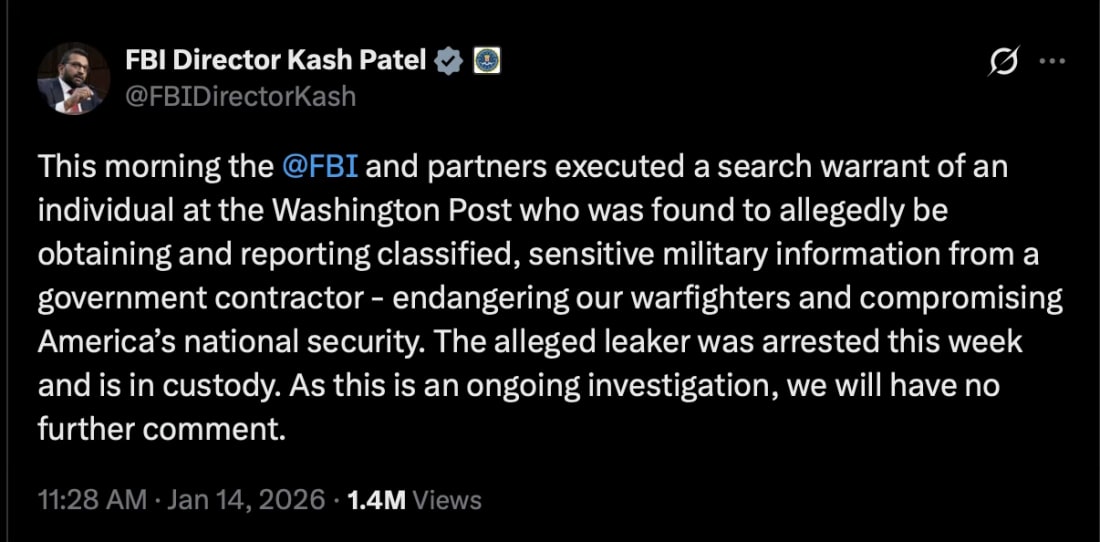 |
That language matters.
It collapses a critical distinction between journalism and criminal conduct, without charges, without a public affidavit, and without courtroom safeguards.
This is a familiar pattern. When authorities want to chill behavior without formally charging it, they rely on ambiguity. They imply criminality without having to prove it. They let the suggestion do the work.
That uncertainty is not accidental. It is the point.
Here is the part that often gets lost. The greatest long-term national security risk is not that journalists report on classified systems. It is that misconduct, mismanagement, and policy failure go unreported because sources go silent. Internal reporting channels have been weakened. Inspectors general have been sidelined. Whistleblower protections have been hollowed out. In that environment, journalism becomes the last meaningful accountability mechanism.
Undermining it doesn’t make the country safer. It makes failure easier to hide.
The Double Standard People Will Notice
This concern is magnified by selective enforcement.
The administration declined to pursue an aggressive investigation when highly sensitive military information was disclosed through senior officials’ communications. Yet it moved swiftly and forcefully against a reporter who did what journalists are supposed to do: verify information, protect sources, and inform the public.
When enforcement punishes scrutiny but spares power, trust collapses. Trust is not a luxury in national security. It is an operational requirement.
Raiding a reporter’s home doesn’t happen in isolation. It happens in environments where scrutiny itself is treated as a threat. We’re seeing the same escalation logic elsewhere:
Federal authority expanding
Oversight mechanisms eroding
Dissent and investigation reframed as danger
History remembers such moments not as victories, but as grave warnings.
As the Washington Post Editorial Board notes, journalism will continue. But the question isn’t whether reporters will keep working—it’s whether the public will keep hearing the truth, or only what survives intimidation.
A free press doesn’t vanish overnight. It erodes when those in power realize they can cross the threshold unchallenged. Whether our democracy endures or withers will depend on how we answer that knock at the door.
Until next time,
Olivia
This Substack is reader-supported. Paid subscriptions allow me to continue to pour significant time and energy into breaking down the headlines and keeping my content available to others. Thank you for your support!
Have an idea or feedback? Reply directly to this email.
| ||||||||||

