american_flag.jpg

2026 General Assembly Session Begins

Greetings,


I hope everyone had a wonderful Christmas and a Happy New Year. Well, it’s that time again. I am heading to Richmond to be your voice and represent the needs of the 9th Senate District. What an honor. 


The 2026 General Assembly session will begin today at noon. This is a 60-day session, otherwise known as the “long session.” This length is due to the needed actions on the new biennial state budget.  

 Throughout 2025, I dedicated significant time and effort to crafting my legislative agenda for the 2026 General Assembly session. While I will be providing more detailed information about each bill in future communications, I would like to take this opportunity to briefly highlight a few key initiatives in this newsletter. These selected bills represent a few areas I believe are especially important to our citizens, and I look forward to sharing further details with you as the session progresses.


I am bringing back a legislative policy that failed last session, but perseverance leads to success. In this current economic climate, any policy that positively impacts small businesses and job creation is vital.  My legislation will give merchants credit for on-time sales tax payments to help offset credit card fees. At one point, most customers paid cash, so credit card fees were minimal. Now that up to 80% of sales are paid by credit cards, those fees have become quite astronomical for small businesses. Hopefully, this bill will pass this year and help take some of the financial burden off our small business owners.


The Virginia Constitution, Article I, Section 11, ensures that “every person shall have remedy by due course of law.” According to the Virginia Bar Association, the American Bar Association (ABA) defines legal deserts as areas with so few attorneys per capita that residents face insurmountable obstacles in accessing legal help.  According to the 2022 ABA Profile of the Legal Profession, over 1,300 U.S. counties have fewer than one lawyer per 1,000 residents.  This includes multiple counties in the 9th Senate District. 


Charlotte County has just two active attorneys, both focused on real estate and estate planning. The county lacks consistent availability for criminal or family law representation, and Mecklenburg County, though relatively populous, has attorney coverage clustered near the county seat, with entire outlying communities lacking any general practice representation. In far Southwest Virginia, Craig County has no full-time private-practice attorney. 


With the help and encouragement of Mecklenburg County Commonwealth’s Attorney, Allen Nash, during the break between the 2025 and 2026 sessions, I convened a task force of subject-matter experts to discuss legal deserts in Virginia. A wide variety of recommendations to address the matter were put forward. To continue this process, I am introducing a bill to create a one-year legislative legal desert task force to take a deep dive and to make legislative recommendations on how we can best address the issue across the Commonwealth. The initial action is to define legal desert in the Code of Virginia, which will serve as a guide for the enactment of subsequent policy. I am optimistic that my colleagues will support my efforts to address access to legal representation. 


If you are planning to visit the General Assembly during the session, I encourage you to contact my office in advance. My staff and I are always eager to connect with constituents and value the opportunity to hear from you directly. By reaching out ahead of your visit, we can arrange for me or a member of my team to set aside time to meet with you. We look forward to the chance to discuss your thoughts, concerns, or questions, and to ensure your visit is both productive and welcoming to “The People’s House.” 


I wish each of you a joyous and prosperous New Year. As always, my staff and I are here to assist you with any issues or concerns. Please don’t hesitate to reach out if we can be of service. You can reach us at the District telephone 434.374.5129, Capitol telephone 804-698-7509 or by email at [email protected]  

 Governor Glenn Youngkin Reports General Fund Revenues Surge in December, Well Ahead of Forecast

Revenue increased $642 million in December and $1.2 billion in first six months of fiscal year


Governor Glenn Youngkin announced that Virginia’s general fund revenues grew 21.0 percent ($641.9 million) in December compared with the same month last year, exceeding projections by 10.7 percent and marking one of the strongest monthly revenue performances of the fiscal year, reinforcing the Commonwealth’s position of fiscal strength entering the second half of Fiscal Year 2026. 


Through the first six months of the fiscal year, general fund revenues are up 8.6 percent ($1.2 billion) and now stand 2.6 percent ($395.4 million) ahead of the official forecast which was increased by $822.5 million in the Governor’s December budget submission, driven primarily by year-over-year growth in individual income tax nonwithholding payments of 62.7 percent ($399.6 million) and an increase in withholding payments of 11.3 percent ($170.9 million). 


“The strong year-over-year increase is not noise, it is real. It reflects strong job creation, rising incomes, healthy consumer activity, and disciplined fiscal stewardship,” said Governor Glenn Youngkin. “Because of this performance, revenues could decline by 1.6 percent over the rest of the year, and we would still meet our forecast. That is the strength of the Commonwealth’s financial position under our commonsense agenda – more jobs and lower tax burdens yield strong revenues.” 


“With half the fiscal year complete, Virginia’s revenue performance is not only strong, but also resilient,” said Secretary of Finance Stephen E. Cummings. “Collections are growing nearly three times faster than the 3.0 percent growth assumed in the forecast, giving the Commonwealth a substantial cushion against future economic uncertainty. Even with moderating national job growth and mixed macroeconomic signals, Virginia’s core revenue streams—income and sales taxes—continue to perform at levels that position us well to exceed spending priorities in the 2026–28 Biennial Budget.”  

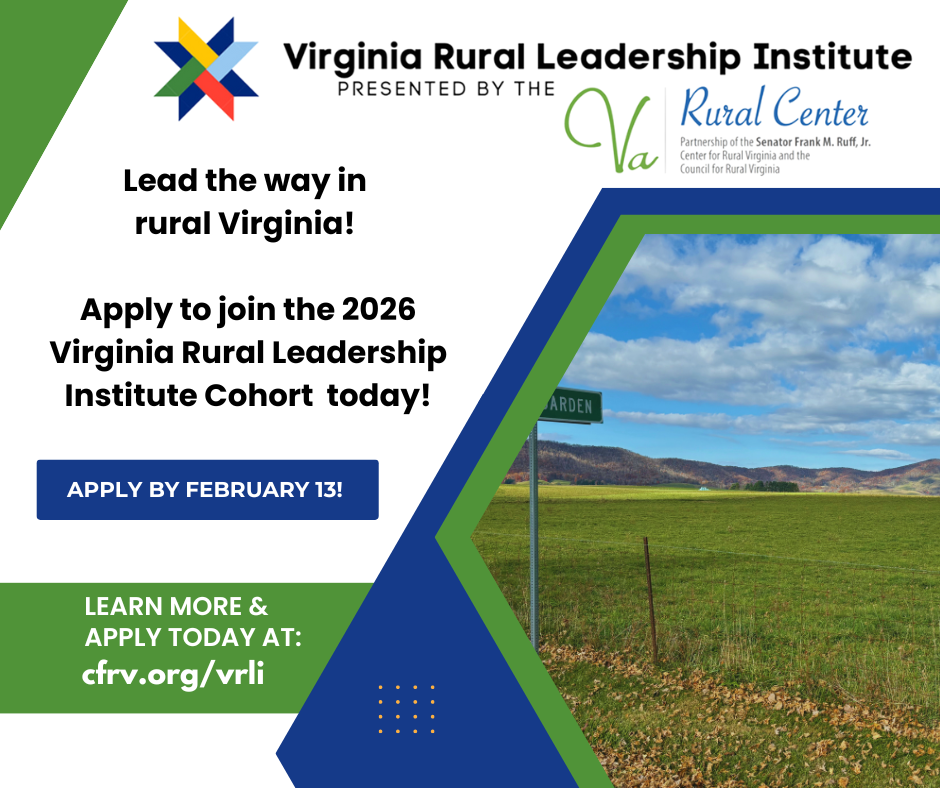
Applications Now Open for the Virginia Rural Leadership Institute (VRLI)!


VRLI is a groundbreaking initiative by the Virginia Rural Center, and it is the only program in the Commonwealth dedicated to retaining and attracting rural Virginians. VRLI fosters the development of innovative, responsible, and civic-minded leaders who can strengthen regional communities. Applications are due by February 13th. For more details, visit cfrv.org/vrli


Through four comprehensive sessions, VRLI Cohort Members will gain essential leadership and economic development skills, empowering them to drive long-term economic growth in their communities and regions. The program also promotes enhanced cooperation, collaboration, and coordination across a diverse range of organizations and sectors. Interested individuals can apply directly through this link, and if you know someone who would be a great fit, you can refer them here!


For any questions, feel free to contact the Virginia Rural Center team at [email protected].


P.O. Box 145,

Clarksville, VA 23927

(434) 374 5129

X Share This Email
LinkedIn Share This Email