
Email
Iran’s Escalating Human Rights Crisis: Killings, Internet Blackouts, and Repression
| From | NIAC Human Rights Tracker <[email protected]> |
| Subject | Iran’s Escalating Human Rights Crisis: Killings, Internet Blackouts, and Repression |
| Date | January 13, 2026 9:58 PM |
Links have been removed from this email. Learn more in the FAQ.
Links have been removed from this email. Learn more in the FAQ.
John, the latest Human Rights Tracker update from NIAC is here.Click here to view this update in your browser. [[link removed]]
# [#]
[link removed] [[link removed]] Iran’s Escalating Human Rights Crisis: Killings, Internet Blackouts, and Repression [[link removed]]
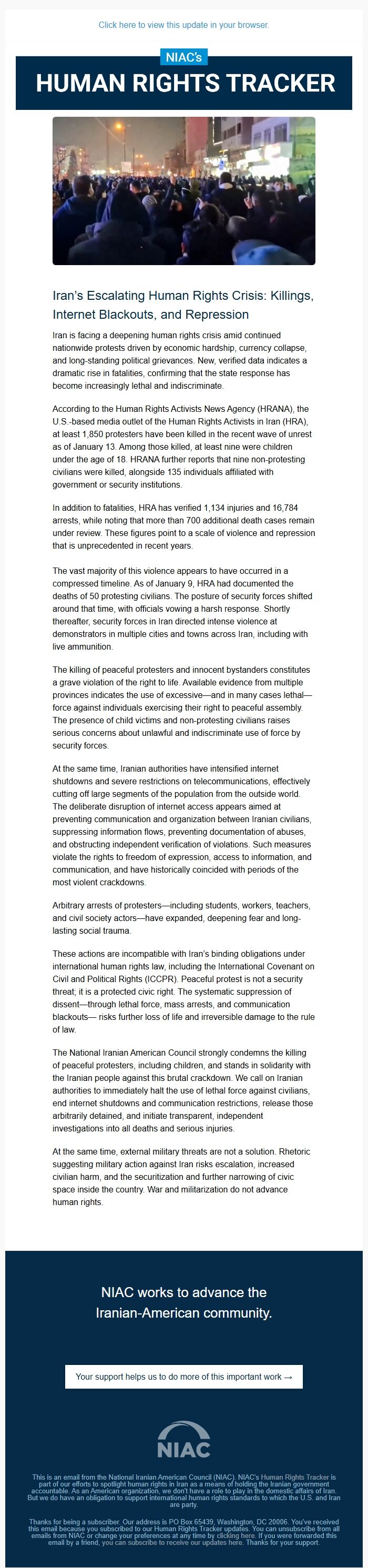
Iran is facing a deepening human rights crisis amid continued nationwide protests driven by economic hardship, currency collapse, and long-standing political grievances. New, verified data indicates a dramatic rise in fatalities, confirming that the state response has become increasingly lethal and indiscriminate.
According to the Human Rights Activists News Agency (HRANA), the U.S.-based media outlet of the Human Rights Activists in Iran (HRA), at least 1,850 protesters have been killed in the recent wave of unrest as of January 13. Among those killed, at least nine were children under the age of 18. HRANA further reports that nine non-protesting civilians were killed, alongside 135 individuals affiliated with government or security institutions.
In addition to fatalities, HRA has verified 1,134 injuries and 16,784 arrests, while noting that more than 700 additional death cases remain under review. These figures point to a scale of violence and repression that is unprecedented in recent years.
The vast majority of this violence appears to have occurred in a compressed timeline. As of January 9, HRA had documented the deaths of 50 protesting civilians. The posture of security forces shifted around that time, with officials vowing a harsh response. Shortly thereafter, security forces in Iran directed intense violence at demonstrators in multiple cities and towns across Iran, including with live ammunition.
The killing of peaceful protesters and innocent bystanders constitutes a grave violation of the right to life. Available evidence from multiple provinces indicates the use of excessive—and in many cases lethal—force against individuals exercising their right to peaceful assembly. The presence of child victims and non-protesting civilians raises serious concerns about unlawful and indiscriminate use of force by security forces.
At the same time, Iranian authorities have intensified internet shutdowns and severe restrictions on telecommunications, effectively cutting off large segments of the population from the outside world. The deliberate disruption of internet access appears aimed at preventing communication and organization between Iranian civilians, suppressing information flows, preventing documentation of abuses, and obstructing independent verification of violations. Such measures violate the rights to freedom of expression, access to information, and communication, and have historically coincided with periods of the most violent crackdowns.
Arbitrary arrests of protesters—including students, workers, teachers, and civil society actors—have expanded, deepening fear and long-lasting social trauma.
These actions are incompatible with Iran’s binding obligations under international human rights law, including the International Covenant on Civil and Political Rights (ICCPR). Peaceful protest is not a security threat; it is a protected civic right. The systematic suppression of dissent—through lethal force, mass arrests, and communication blackouts— risks further loss of life and irreversible damage to the rule of law.
The National Iranian American Council strongly condemns the killing of peaceful protesters, including children, and stands in solidarity with the Iranian people against this brutal crackdown. We call on Iranian authorities to immediately halt the use of lethal force against civilians, end internet shutdowns and communication restrictions, release those arbitrarily detained, and initiate transparent, independent investigations into all deaths and serious injuries.
At the same time, external military threats are not a solution. Rhetoric suggesting military action against Iran risks escalation, increased civilian harm, and the securitization and further narrowing of civic space inside the country. War and militarization do not advance human rights.
NIAC works to advance the Iranian-American community.
Your support helps us to do more of this important work → [[link removed]]
[link removed] [[link removed]]
This is an email from the National Iranian American Council (NIAC). NIAC's Human Rights Tracker [[link removed]] is part of our efforts to spotlight human rights in Iran as a means of holding the Iranian government accountable. As an American organization, we don't have a role to play in the domestic affairs of Iran. But we do have an obligation to support international human rights standards to which the U.S. and Iran are party.
Thanks for being a subscriber. Our address is PO Box 65439, Washington, DC 20006. You've received this email because you subscribed to our Human Rights Tracker updates. You can unsubscribe from all emails from NIAC or change your preferences at any time by clicking here [[link removed]] . If you were forwarded this email by a friend, you can subscribe to receive our updates here [[link removed]] . Thanks for your support.
# [#]
[link removed] [[link removed]] Iran’s Escalating Human Rights Crisis: Killings, Internet Blackouts, and Repression [[link removed]]
Iran is facing a deepening human rights crisis amid continued nationwide protests driven by economic hardship, currency collapse, and long-standing political grievances. New, verified data indicates a dramatic rise in fatalities, confirming that the state response has become increasingly lethal and indiscriminate.
According to the Human Rights Activists News Agency (HRANA), the U.S.-based media outlet of the Human Rights Activists in Iran (HRA), at least 1,850 protesters have been killed in the recent wave of unrest as of January 13. Among those killed, at least nine were children under the age of 18. HRANA further reports that nine non-protesting civilians were killed, alongside 135 individuals affiliated with government or security institutions.
In addition to fatalities, HRA has verified 1,134 injuries and 16,784 arrests, while noting that more than 700 additional death cases remain under review. These figures point to a scale of violence and repression that is unprecedented in recent years.
The vast majority of this violence appears to have occurred in a compressed timeline. As of January 9, HRA had documented the deaths of 50 protesting civilians. The posture of security forces shifted around that time, with officials vowing a harsh response. Shortly thereafter, security forces in Iran directed intense violence at demonstrators in multiple cities and towns across Iran, including with live ammunition.
The killing of peaceful protesters and innocent bystanders constitutes a grave violation of the right to life. Available evidence from multiple provinces indicates the use of excessive—and in many cases lethal—force against individuals exercising their right to peaceful assembly. The presence of child victims and non-protesting civilians raises serious concerns about unlawful and indiscriminate use of force by security forces.
At the same time, Iranian authorities have intensified internet shutdowns and severe restrictions on telecommunications, effectively cutting off large segments of the population from the outside world. The deliberate disruption of internet access appears aimed at preventing communication and organization between Iranian civilians, suppressing information flows, preventing documentation of abuses, and obstructing independent verification of violations. Such measures violate the rights to freedom of expression, access to information, and communication, and have historically coincided with periods of the most violent crackdowns.
Arbitrary arrests of protesters—including students, workers, teachers, and civil society actors—have expanded, deepening fear and long-lasting social trauma.
These actions are incompatible with Iran’s binding obligations under international human rights law, including the International Covenant on Civil and Political Rights (ICCPR). Peaceful protest is not a security threat; it is a protected civic right. The systematic suppression of dissent—through lethal force, mass arrests, and communication blackouts— risks further loss of life and irreversible damage to the rule of law.
The National Iranian American Council strongly condemns the killing of peaceful protesters, including children, and stands in solidarity with the Iranian people against this brutal crackdown. We call on Iranian authorities to immediately halt the use of lethal force against civilians, end internet shutdowns and communication restrictions, release those arbitrarily detained, and initiate transparent, independent investigations into all deaths and serious injuries.
At the same time, external military threats are not a solution. Rhetoric suggesting military action against Iran risks escalation, increased civilian harm, and the securitization and further narrowing of civic space inside the country. War and militarization do not advance human rights.
NIAC works to advance the Iranian-American community.
Your support helps us to do more of this important work → [[link removed]]
[link removed] [[link removed]]
This is an email from the National Iranian American Council (NIAC). NIAC's Human Rights Tracker [[link removed]] is part of our efforts to spotlight human rights in Iran as a means of holding the Iranian government accountable. As an American organization, we don't have a role to play in the domestic affairs of Iran. But we do have an obligation to support international human rights standards to which the U.S. and Iran are party.
Thanks for being a subscriber. Our address is PO Box 65439, Washington, DC 20006. You've received this email because you subscribed to our Human Rights Tracker updates. You can unsubscribe from all emails from NIAC or change your preferences at any time by clicking here [[link removed]] . If you were forwarded this email by a friend, you can subscribe to receive our updates here [[link removed]] . Thanks for your support.
Message Analysis
- Sender: National Iranian American Council
- Political Party: n/a
- Country: United States
- State/Locality: n/a
- Office: n/a
-
Email Providers:
- EveryAction