|
 |
The Corner Newsletter: January 13th, 2025
Google Flexes its TV Monopoly & OMI’s Testimony on Netflix-Warner Bros
|
| |||||||||||||||


Welcome to The Corner. In this issue, we explore Google’s growing power in the television industry, as the tech giant uses YouTube TV to squeeze major TV programmers like Fox and Disney.
Programming Note: The Corner is moving to the Substack platform in 2026. This transition will require no action from you and will not require you to download or subscribe to any new services.
 |
YouTube TV’s Willingness to Block Fox and Disney Underscores Google’s Growing Threat to Democracy
Karina Montoya
Netflix’s effort to acquire Warner Bros. Discovery (WBD) has put a spotlight on how streaming giants are driving more consolidation in media and entertainment. But beyond the realization that Netflix has built up real power over the making of films and television, a vastly more powerful corporation has also been concentrating even more control over how we access video content: Google with its live TV streaming platform YouTube TV.
Google launched YouTube TV in 2017 as an internet-based replacement for cable. Just like a cable or satellite provider does, YouTube TV pays fees to carry content made by programmers such as Disney or Fox, although YouTube TV needs only a smart TV plus an internet connection to work. Since 2017, YouTube TV’s subscriber base has grown to 10 million, making it the top live TV streamer in the U.S., and the third-largest provider of linear TV programming.
And Google is increasingly willing to exploit this power. In late 2025, YouTube TV clashed over carriage fees with four of the biggest TV programmers — NBCUniversal, TelevisaUnivision, Fox, and Disney. In two instances, NBCUniversal and Fox, the corporations struck a deal with YouTube after months of tensions, thereby averting a Google threat to black out their channels. In the case of Fox, the deal came after Federal Communications Commission (FCC) Chair Brendan Carr intervened with a tweet.
The dispute between Disney and TelevisaUnivision took a different turn. In the case of Disney, Google stopped carrying ESPN, ABC, FX, and other channels for 15 days in November. Google imposed an even harsher penalty on TelevisaUnivision and it’s Spanish-language shows, cutting them off for almost two months, until a deal was reached in November. The deal came only after President Trump posted on Truth Social that the conflict was “very bad for Republicans.” In both cases, Google gave a few dollars back in credit to subscribers for their “trouble.”
Disputes over TV carriage fees used to be reserved for cable providers negotiating with TV programmers and local broadcasters. But cable companies are required by law to negotiate with media companies, and the process for calculating carriage fees is relatively straightforward. But for Google and other Big Tech corporations operating any type of video streaming service — most notably Amazon — it’s the Wild West. They are not legally obligated to negotiate, and their vast wealth means that any losses due to the embargo of content distribution hurt them less than they hurt the TV programmers.
The standoff with Disney offers a good example of who is most hurt by such cutoffs. Google shutting off Disney’s programming means that YouTube TV customers don’t receive ESPN and ABC, which may somewhat slow the growth of Google’s streaming business. But any losses pale in comparison to Google’s total revenues, which in 2024 hit $350 billion — mostly from selling ads on search and regular YouTube. By contrast, Disney stood to lose over $2 billion in annual affiliate revenue without YouTube TV’s distribution.
“Legacy media companies are used to negotiating [carriage fees] one way,” said Anthony Palomba, expert in media and entertainment industry at University of Virginia Darden School of Business. “But when you have tech companies for whom this [live TV] business is just one of many, they’re not afraid to push back. Meta, Apple, Amazon, Netflix, Google, they all command so much user time and engagement. They are not afraid of anything.”
From one perspective, Google is simply one more powerful player in an already consolidated media market. AT&T’s takeover of Time Warner in 2018 is a prime example of such consolidation, even though AT&T soon decided it had made a mistake and spinning off the WBD that operates independently today.
But it’s vital to keep in mind that YouTube TV is an arm of the most powerful corporation in the information economy. YouTube TV, for instance, was made possible only because Google in 2006 was able to acquire YouTube, which already dominated online video sharing. Since then, Google engineered YouTube into a platform that works in fundamentally different ways than the traditional media corporations. And its growth has benefited from being integrating with two vast monopolies - Google’s search engine and advertising technologies - both of which have since been declared illegal.
If Republicans and Democrats today continue to allow Google to compete unhindered in the streaming wars — without any form of regulation — the result may well pave the way to two other monopolies: over live TV streaming and linear TV distribution overall.
And as the corporation’s recent hardball tactics with Fox, Disney, and NBCUniversal/Comcast shows, Google is more than willing to impose its power not merely on individual users but on some of the most powerful political actors in our society.
 |
Center for Journalism & Liberty at Open Markets Submits Testimony on Warner Bros Deal
The Center for Journalism and Liberty at the Open Markets Institute submitted written testimony to Congress urging lawmakers and antitrust enforcers to block a potential acquisition of Warner Bros. Discovery (WBD) by Netflix or other major media conglomerates. CJL@OMI’s submission argues that any deal that would place WBD under the ownership of a corporation with a major stake in news, entertainment, or distribution would reduce viewpoint diversity, weaken press independence, raise prices, diminish quality and choice for consumers, and accelerate job losses across creative industries. The testimony was submitted to the House Judiciary Subcommittee on Antitrust to inform its January 7 hearing, Full Stream Ahead: Competition and Consumer Choice in Digital Streaming. “As control over news and entertainment is increasingly concentrated in the hands of a few powerful corporations, the risks to democracy, freedom of expression, and a free press grow ever more severe,” CJL@OMI’s testimony read. Read the full testimony here.
Open Markets Institute Welcomes Research Fellow Matt Scherer to Focus on AI Bubble Risks
The Open Markets Institute welcomed research fellow Matt Scherer, whose work will highlight the growing risks of the AI bubble to the U.S. and global economies. His research will outline how policymakers can mitigate the fallout from the bubble’s inevitable bursting without bailing out the tech companies and financial institutions that inflated it. The two key components of his project are a report that will be published early this spring followed by draft legislative text early in the fall. A lawyer who specializes in AI and technology policy, Scherer led the workers’ rights project at the Center for Democracy & Technology before joining Open Markets Institute.
📝 WHAT WE’RE UP TO
Courtney Radsch, director of Center for Journalism & Liberty at Open Markets Institute, published an op-ed in The Guardian calling on federal antitrust enforcers to block bids by both Netflix and Paramount-Skydance to acquire Warner Bros. Discovery. “Neither deal serves the public interest, and both are dangerous for the future of free expression,” Radsch wrote. “Both would produce an unprecedented concentration of power over what Americans watch and which stories get told.”
Open Markets Institute’s EU Research fellow Claire Lavin coauthored an op-ed in Tech Policy Press calling on European authorities to open an investigation into Google’s $32 billion purchase of cloud security company Wiz in what would be the Big Tech giant’s largest acquisition to date. “This marks a pivotal moment, not only for the future of cloud markets, but also for whether European competition policy is finally willing to confront the expanding power of Big Tech companies,” Lavin and her coauthors wrote.
Courtney Radsch, director of Center for Journalism & Liberty at Open Markets Institute, published an article in Tech Policy Press, arguing that AI systems are increasingly encroaching on our freedom of thought. “As people increasingly rely on these systems to express themselves, do things for them, and act on their behalf, they are not just users, they are also subjects of a corrosive logic of extraction, prediction, and optimization that threatens freedom of thought and cognitive autonomy,” she writes.
Open Markets legal director Sandeep Vaheesan participated in a roundtable discussion hosted by nonprofit news outlet Truthout on the movement for publicly owned energy systems. “Publicly owned utilities are focused on high quality, affordable, and sustainable electricity,” Vaheesan said. “They’re not pressured to deliver big profits to shareholders.”
Vaheesan published an article for LPE Project exploring the debate between antitrust reformers and Marxist critics, arguing that antitrust law can serve as a tool for democratizing economic life. “Reconstructed antitrust, especially when paired with strong regulation on labor, corporate, securities, consumer protection, and related issues, can channel business competition in more socially beneficial directions, check domination in economic life, and create space for more democratic alternatives to for-profit corporations,” he wrote.
The Open Markets Institute condemned the Trump administration for imposing travel bans targeting European officials for regulating Big Tech. “The administration must stop acting as enablers for oligarchs intent on dismantling democracy and imposing systems of total control,” executive director Barry Lynn said.
Speaking on a podcast hosted by The Lever, Open Markets food program manager Claire Kelloway explained how Agri Stats’ secretive data practices enable meat processors to raise prices while blocking buyers, farmers, and workers from accessing the same information, leading to penalties that often pale in comparison to the profits gained. “If they end up paying less than what they made in excess profits by engaging in the conspiracy, it’s totally rational for them to continue price-fixing,” she said. Kelloway’s comments were cited in Jacobin.
After Brendan Carr, chair of the Federal Communication Commission, refused to guarantee press freedom under the First Amendment in a Senate hearing, CJL@OMI director Courtney Radsch released a statement calling for Carr’s removal. “This episode of open, dangerous censorship must also serve as a wake-up call about the extreme concentration of media ownership and platform control over communications and information in this country,” she said.
Open Markets policy director Phil Longman warned in Washington Monthly that unchecked Big Tech and AI monopolies are rapidly undermining the economic foundations of a free press and urged public support for policy-focused journalism as essential to preserving democracy and meaningful freedom of speech.
🔊 ANTI-MONOPOLY WINS:
A new California law allowing residents to purge their personal information from hundreds of online data brokers is now fully in effect after the launch of online opt-out platform The Drop this month. (The Guardian)
Dish Network is suing Disney in federal court over its programmed content bundling practices in an antitrust case that could have far-reaching consequences for television watchers. The lawsuit is the latest in a series of legal showdowns between programmed live television providers and major programmers over how content is packaged and licensed in the streaming era. (The Hollywood Reporter)
Italian antitrust authorities issued a $300 million fine to budget airline RyanAir for abusing its dominant position to make it prohibitively difficult for travel agencies to offer its flights as part of their services. (Reuters)
📈 VITAL STAT: $27,000
The price of one H200 AI chip made by Nvidia, which is asking Chinese customers for full upfront payment to hedge against uncertainty over Beijing’s approval of shipments. Chinese technology companies have reportedly ordered two million of the chips — which are used for training of advanced AI models — exceeding Nvidia’s inventory of 700,000 chips. (Reuters)
📚 WHAT WE’RE READING:
1929: Inside the Greatest Crash in Wall Street History—And How It Shattered a Nation — New York Times and CNBC journalist Aaron Sorkin takes a sweeping look at the history of the stock market collapse of 1929. In his ambitious account, Sorkin sheds new light on the decision makers in dominant corporations and government who created the crisis and how they navigated the fallout.
Pre- Order Chief Economist Brian Callaci’s new book
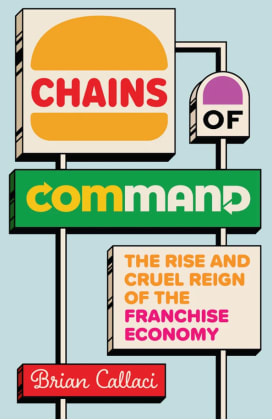 |
Open Markets Institute’s chief economist Brian Callaci will publish his first book Chains of Command: The Rise and Cruel Reign of the Franchise Economy on April 20 through University of Chicago Press. The book offers a sharp critique of the franchise model used by many fast food chains, which has shaped labor markets, corporate power, and inequality in the U.S. In Chains of Command, Callaci shows how franchisors have altered the legal treatment of corporations in their favor through a decades-long crusade of lobbying and litigation, and argues for greater cooperation between workers and small franchise owners. Pre-order the book here.
DISCOUNT CODE: CHAINS2025
Written and edited by: Karina Montoya, Barry Lynn, Ezmeralda Makhamreh, Austin Ahlman, and Anita Jain
Open Markets Institute
655 15th St NW, Suite 310
Washington, DC xxxxxx
We thought you'd like to be in the know about competition policy news. Liked what you read? Please forward to a friend or colleague and subscribe for more updates.
| ||||||||||

