
Email
Preventable atrocities uncovered in India’s sugar industry underscore urgent need for WSR
| From | Coalition of Immokalee Workers <[email protected]> |
| Subject | Preventable atrocities uncovered in India’s sugar industry underscore urgent need for WSR |
| Date | January 13, 2026 3:18 PM |
Links have been removed from this email. Learn more in the FAQ.
Links have been removed from this email. Learn more in the FAQ.
[[link removed]]
[link removed] [[link removed]]
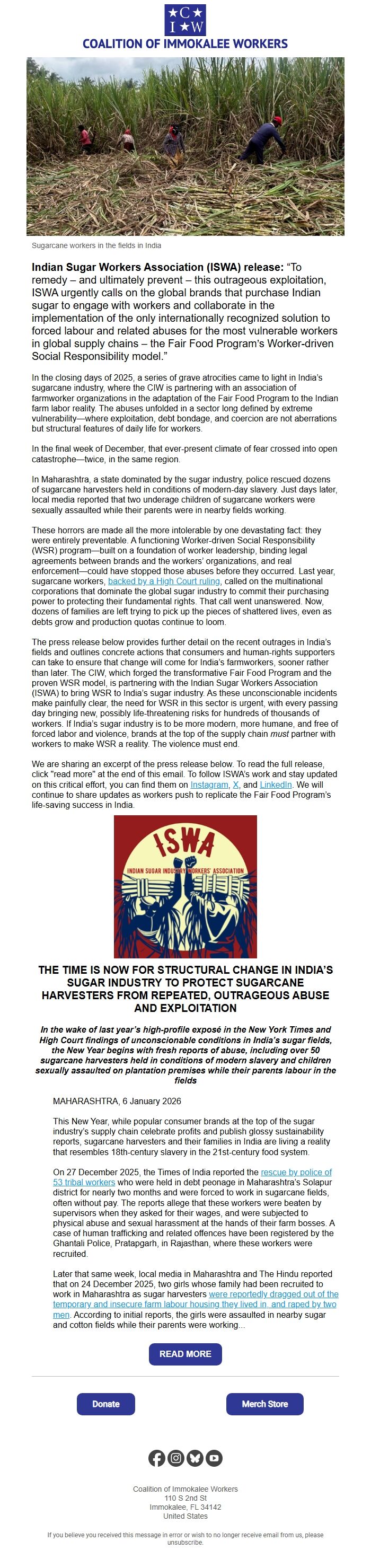
Sugarcane workers in the fields in India
Indian Sugar Workers Association (ISWA) release: “To remedy – and ultimately prevent – this outrageous exploitation, ISWA urgently calls on the global brands that purchase Indian sugar to engage with workers and collaborate in the implementation of the only internationally recognized solution to forced labour and related abuses for the most vulnerable workers in global supply chains – the Fair Food Program’s Worker-driven Social Responsibility model.”
In the closing days of 2025, a series of grave atrocities came to light in India’s sugarcane industry, where the CIW is partnering with an association of farmworker organizations in the adaptation of the Fair Food Program to the Indian farm labor reality. The abuses unfolded in a sector long defined by extreme vulnerability—where exploitation, debt bondage, and coercion are not aberrations but structural features of daily life for workers.
In the final week of December, that ever-present climate of fear crossed into open catastrophe—twice, in the same region.
In Maharashtra, a state dominated by the sugar industry, police rescued dozens of sugarcane harvesters held in conditions of modern-day slavery. Just days later, local media reported that two underage children of sugarcane workers were sexually assaulted while their parents were in nearby fields working.
These horrors are made all the more intolerable by one devastating fact: they were entirely preventable. A functioning Worker-driven Social Responsibility (WSR) program—built on a foundation of worker leadership, binding legal agreements between brands and the workers’ organizations, and real enforcement—could have stopped those abuses before they occurred. Last year, sugarcane workers, backed by a High Court ruling [[link removed]] , called on the multinational corporations that dominate the global sugar industry to commit their purchasing power to protecting their fundamental rights. That call went unanswered. Now, dozens of families are left trying to pick up the pieces of shattered lives, even as debts grow and production quotas continue to loom.
The press release below provides further detail on the recent outrages in India’s fields and outlines concrete actions that consumers and human-rights supporters can take to ensure that change will come for India’s farmworkers, sooner rather than later. The CIW, which forged the transformative Fair Food Program and the proven WSR model, is partnering with the Indian Sugar Workers Association (ISWA) to bring WSR to India’s sugar industry. As these unconscionable incidents make painfully clear, the need for WSR in this sector is urgent, with every passing day bringing new, possibly life-threatening risks for hundreds of thousands of workers. If India’s sugar industry is to be more modern, more humane, and free of forced labor and violence, brands at the top of the supply chain must partner with workers to make WSR a reality. The violence must end.
We are sharing an excerpt of the press release below. To read the full release, click "read more" at the end of this email. To follow ISWA’s work and stay updated on this critical effort, you can find them on Instagram [[link removed]] , X [[link removed]] , and LinkedIn [[link removed]] . We will continue to share updates as workers push to replicate the Fair Food Program’s life-saving success in India.
[link removed] [[link removed]]
THE TIME IS NOW FOR STRUCTURAL CHANGE IN INDIA’S SUGAR INDUSTRY TO PROTECT SUGARCANE HARVESTERS FROM REPEATED, OUTRAGEOUS ABUSE AND EXPLOITATION
In the wake of last year’s high-profile exposé in the New York Times and High Court findings of unconscionable conditions in India’s sugar fields, the New Year begins with fresh reports of abuse, including over 50 sugarcane harvesters held in conditions of modern slavery and children sexually assaulted on plantation premises while their parents labour in the fields
MAHARASHTRA, 6 January 2026
This New Year, while popular consumer brands at the top of the sugar industry’s supply chain celebrate profits and publish glossy sustainability reports, sugarcane harvesters and their families in India are living a reality that resembles 18th‑century slavery in the 21st‑century food system.
On 27 December 2025, the Times of India reported the rescue by police of 53 tribal workers [[link removed]] who were held in debt peonage in Maharashtra’s Solapur district for nearly two months and were forced to work in sugarcane fields, often without pay. The reports allege that these workers were beaten by supervisors when they asked for their wages, and were subjected to physical abuse and sexual harassment at the hands of their farm bosses. A case of human trafficking and related offences have been registered by the Ghantali Police, Pratapgarh, in Rajasthan, where these workers were recruited.
Later that same week, local media in Maharashtra and The Hindu reported that on 24 December 2025, two girls whose family had been recruited to work in Maharashtra as sugar harvesters were reportedly dragged out of the temporary and insecure farm labour housing they lived in, and raped by two men [[link removed]] . According to initial reports, the girls were assaulted in nearby sugar and cotton fields while their parents were working...
READ MORE [[link removed]]
Donate [[link removed]] Merch Store [[link removed]]
[link removed] [[link removed]] [link removed] [[link removed]] [link removed] [[link removed]] [link removed] [[link removed]]
Coalition of Immokalee Workers
110 S 2nd St
Immokalee, FL 34142
United States
If you believe you received this message in error or wish to no longer receive email from us, please unsubscribe: [link removed] .
[link removed] [[link removed]]
Sugarcane workers in the fields in India
Indian Sugar Workers Association (ISWA) release: “To remedy – and ultimately prevent – this outrageous exploitation, ISWA urgently calls on the global brands that purchase Indian sugar to engage with workers and collaborate in the implementation of the only internationally recognized solution to forced labour and related abuses for the most vulnerable workers in global supply chains – the Fair Food Program’s Worker-driven Social Responsibility model.”
In the closing days of 2025, a series of grave atrocities came to light in India’s sugarcane industry, where the CIW is partnering with an association of farmworker organizations in the adaptation of the Fair Food Program to the Indian farm labor reality. The abuses unfolded in a sector long defined by extreme vulnerability—where exploitation, debt bondage, and coercion are not aberrations but structural features of daily life for workers.
In the final week of December, that ever-present climate of fear crossed into open catastrophe—twice, in the same region.
In Maharashtra, a state dominated by the sugar industry, police rescued dozens of sugarcane harvesters held in conditions of modern-day slavery. Just days later, local media reported that two underage children of sugarcane workers were sexually assaulted while their parents were in nearby fields working.
These horrors are made all the more intolerable by one devastating fact: they were entirely preventable. A functioning Worker-driven Social Responsibility (WSR) program—built on a foundation of worker leadership, binding legal agreements between brands and the workers’ organizations, and real enforcement—could have stopped those abuses before they occurred. Last year, sugarcane workers, backed by a High Court ruling [[link removed]] , called on the multinational corporations that dominate the global sugar industry to commit their purchasing power to protecting their fundamental rights. That call went unanswered. Now, dozens of families are left trying to pick up the pieces of shattered lives, even as debts grow and production quotas continue to loom.
The press release below provides further detail on the recent outrages in India’s fields and outlines concrete actions that consumers and human-rights supporters can take to ensure that change will come for India’s farmworkers, sooner rather than later. The CIW, which forged the transformative Fair Food Program and the proven WSR model, is partnering with the Indian Sugar Workers Association (ISWA) to bring WSR to India’s sugar industry. As these unconscionable incidents make painfully clear, the need for WSR in this sector is urgent, with every passing day bringing new, possibly life-threatening risks for hundreds of thousands of workers. If India’s sugar industry is to be more modern, more humane, and free of forced labor and violence, brands at the top of the supply chain must partner with workers to make WSR a reality. The violence must end.
We are sharing an excerpt of the press release below. To read the full release, click "read more" at the end of this email. To follow ISWA’s work and stay updated on this critical effort, you can find them on Instagram [[link removed]] , X [[link removed]] , and LinkedIn [[link removed]] . We will continue to share updates as workers push to replicate the Fair Food Program’s life-saving success in India.
[link removed] [[link removed]]
THE TIME IS NOW FOR STRUCTURAL CHANGE IN INDIA’S SUGAR INDUSTRY TO PROTECT SUGARCANE HARVESTERS FROM REPEATED, OUTRAGEOUS ABUSE AND EXPLOITATION
In the wake of last year’s high-profile exposé in the New York Times and High Court findings of unconscionable conditions in India’s sugar fields, the New Year begins with fresh reports of abuse, including over 50 sugarcane harvesters held in conditions of modern slavery and children sexually assaulted on plantation premises while their parents labour in the fields
MAHARASHTRA, 6 January 2026
This New Year, while popular consumer brands at the top of the sugar industry’s supply chain celebrate profits and publish glossy sustainability reports, sugarcane harvesters and their families in India are living a reality that resembles 18th‑century slavery in the 21st‑century food system.
On 27 December 2025, the Times of India reported the rescue by police of 53 tribal workers [[link removed]] who were held in debt peonage in Maharashtra’s Solapur district for nearly two months and were forced to work in sugarcane fields, often without pay. The reports allege that these workers were beaten by supervisors when they asked for their wages, and were subjected to physical abuse and sexual harassment at the hands of their farm bosses. A case of human trafficking and related offences have been registered by the Ghantali Police, Pratapgarh, in Rajasthan, where these workers were recruited.
Later that same week, local media in Maharashtra and The Hindu reported that on 24 December 2025, two girls whose family had been recruited to work in Maharashtra as sugar harvesters were reportedly dragged out of the temporary and insecure farm labour housing they lived in, and raped by two men [[link removed]] . According to initial reports, the girls were assaulted in nearby sugar and cotton fields while their parents were working...
READ MORE [[link removed]]
Donate [[link removed]] Merch Store [[link removed]]
[link removed] [[link removed]] [link removed] [[link removed]] [link removed] [[link removed]] [link removed] [[link removed]]
Coalition of Immokalee Workers
110 S 2nd St
Immokalee, FL 34142
United States
If you believe you received this message in error or wish to no longer receive email from us, please unsubscribe: [link removed] .
Message Analysis
- Sender: Coalition of Immokalee Workers
- Political Party: n/a
- Country: United States
- State/Locality: Florida Immokalee, Florida
- Office: n/a
-
Email Providers:
- EveryAction