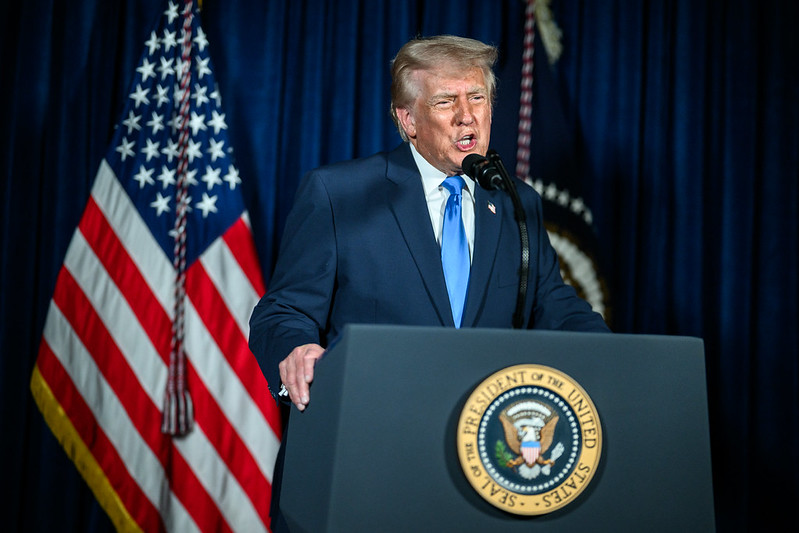
- More Actions than in All Four Years of Trump 1 Combined: The more than 500 immigration executive actions the administration has taken in the last 12 months are more than the 472 carried out during Trump’s entire first term. Roughly one-sixth of the 225 executive orders signed by Trump so far are immigration-focused.
- All-of-Government Mission Yields More Arrests and Detention: Bolstered immigration enforcement has been the defining feature of the administration’s approach so far, involving not only traditional agencies such as U.S. Immigration and Customs Enforcement (ICE) but also previously uninvolved ones including the Internal Revenue Service (IRS) and the military. ICE arrests have more than quadrupled since Trump took office last January, while average daily detention doubled.
- Lots of Deportations—but Not a Record: 622,000 noncitizens were deported between Trump’s inauguration on January 20, 2025, and December 19, according to the Department of Homeland Security (DHS). That number is high, but well short of the 1 million annual deportations officials had pledged, and well below the 778,000 overall repatriations during the final full fiscal year of the Biden administration.
- New Pressure and Scrutiny on the Legally Present: Legally present immigrants living in the United States have been subjected to new vetting for “anti-Americanism,” among other things. Would-be arrivals face the prospect of visa bonds, fees, and other barriers. The approach may be reducing some interest in coming to the United States, as evidenced by the significant drop in foreign student enrollment this fall.
- A Split-Screen at the Courts: Legal challenges were the undoing of many policies of the first Trump administration. This time around, the results are more mixed. While the administration has suffered several major losses in federal district courts, it has had far more success at appellate levels, including the Supreme Court. Notably, more than one-third of the orders through the Supreme Court’s emergency docket in 2025 were on immigration-related matters.
|
|
Did You Know? The cap of 7,500 refugees for fiscal year (FY) 2026 is the lowest in the 46-year history of the U.S. refugee resettlement program. After a recent high of more than 100,000 refugees resettled in FY 2024, the Trump administration’s cuts to the program set the stage for record lows. About one-third of resettled refugees in FY 2025 came from the Middle East and South Asia, and a similar share came from Africa. Afghans were the largest group, accounting for 18 percent of admitted refugees, and more refugees went to Texas than any other state. Find key information about people entering the United States as refugees or receiving a grant of asylum, in our article “Refugees and Asylees in the United States.” |
|
New from MPI Trump Administration Public-Charge Rule Would Amplify Harms to Immigrant Families
By Julia Gelatt Making Preschool Classroom Assessments Work for Dual Language Learners
By Katherine Habben, Victoria Kim, and Lorena Mancilla Security Reforms in Ecuador Should Not Be the Last Word
By Diego Chaves-González Europe’s Talent Race Starts at the Visa Counter
By Kate Hooper, Nurbanu Hayır, and María Belén Zanzuchi To Leave or Stay? Examining the Role of Counseling and Reintegration Assistance in the Return Decision-Making of Migrants Ordered to Leave the Netherlands
By Ravenna Sohst, Camille Le Coz, and Hanne Beirens Best Practices for Designing and Managing Labor Migration Corridors to Europe
By Kate Hooper, María Belén Zanzuchi, Abigail Goldfarb, Ravenna Sohst, and Bertrand Steiner |
|
Did Somebody Forward You This Email?
Sign up to get the U.S. Policy Beat in your inbox every month. |
|
Migration Information Source
Read MPI's journal, which publishes interesting articles that delve into U.S. and global migration issues; profile countries' migration histories, trends, and laws; and offer accessible, data-rich spotlights of U.S. immigrant populations. |
|
|