|
 |
This content is available for free to all subscribers. But you really should consider a paid subscription. This unlocks our afternoon e-mails, our Saturday “What is Jon Reading” e-mail, and analysis on breaking news. Normally a subscription is a modest $7 a month or just $70 for the year.
7 Ways The CA Legislative Analyst Torches Newsom’s Proposed Budget
How the state’s top fiscal referee says California is heading toward deeper, structural deficits
|

| |||||||||||||||


 |
Our morning content is free for all subscribers and site visitors! Typically, our afternoon content is reserved for our paid subscribers.
🕒 7 min read
The Legislative Analyst Sounds the Alarm
Normally, California governors get the benefit of the doubt when they introduce a January budget. This year was different. Yesterday, the California Legislative Analyst’s Office released a strongly critical review of Governor Gavin Newsom’s proposed 2026–27 budget.
The California Legislative Analyst’s Office uses unusually plain language to warn that Governor Newsom’s proposed 2026–27 budget is only balanced on paper, fragile in reality, and out of touch with long-term fiscal needs. Their critique is not about politics. It is based on technical and sustainability concerns.
When the state’s nonpartisan fiscal expert raises so many warnings at once, lawmakers and taxpayers should pay attention.
Here are seven strong critiques from Gabriel Petek, the independent, nonpartisan legislative analyst…
Reason #1: The Budget Depends on Rosy Revenue Assumptions
The Governor’s budget is built on an optimistic revenue forecast that assumes the stock market will stay strong. The Legislative Analyst warns that several reliable indicators show the market may be overheated and at risk of a downturn.
California’s tax system exacerbates that risk. Because the state relies heavily on high earners and capital gains, revenues drop sharply when markets fall rather than decline slowly. By excluding this reality from the budget, the administration’s plan only works if favorable conditions persist.
This is not careful budgeting. It is based on weak assumptions.
Reason #2: Revenue Risk Is Acknowledged, Then Set Aside
The Analyst’s critique is even stronger because the administration itself admits the downside risk in its own documents. It concedes that recent revenue gains are linked to speculative market activity and may not last.
Still, the budget does little to protect the state if revenues drop. Instead of building reserves or reducing commitments, the plan assumes the best-case scenario will occur.
Admitting there is risk but not preparing for it leaves the state vulnerable.
Reason #3: California’s Deficits Are Chronic, Not Cyclical
The Legislative Analyst makes clear that California’s budget problems are no longer solely about the economy's ups and downs. Even as the economy grows, the state’s spending continues to outpace what it can sustainably raise.
Both the administration’s projections and the Analyst’s more cautious view indicate the state will face years of tens-of-billions-of-dollars operating deficits. This is the fourth consecutive year with these kinds of forecasts.
If deficits continue even when revenues grow, the problem is not timing. It is a deeper, structural imbalance.
Reason #4: Short-Term Fixes Create Long-Term Damage
Many of the Governor’s budget fixes rely on one-time measures such as delaying payments, suspending reserve deposits, and shifting accounting. These moves make the current year look better but increase future obligations.
The Legislative Analyst warns that these tactics do not fix the real gap between revenues and spending. Instead, they push costs into the future, making the expected deficits even worse.
Short-term relief comes at the expense of long-term fiscal security.
Reason #5: Fiscal Buffers Are Reduced as Risks Increase
With revenue uncertainty high, the Governor suggests suspending required deposits into the state’s main reserves and delaying education funding instead of saving money.
The Legislative Analyst is clear: these choices make it harder for the state to handle an economic downturn. Reserves are meant to protect against shocks, and weakening them as risks rise defeats their purpose.
The state is giving up resilience for short-term flexibility.
Reason #6: The Budget Does Not Seriously Address Future Deficits
The administration proposes about $5 billion in ongoing budget fixes. The Legislative Analyst notes that at least twice that amount is needed to begin reducing future deficits.
Instead of addressing the problem's size now, the budget leaves the hardest decisions to future lawmakers and, likely, a future governor.
Delaying action is not neutral. It makes the problem harder to solve later.
Reason #7: Kicking the Can Raises the Risk of Crisis
The Legislative Analyst also warns that waiting to take real action until later in the budget process shortens lawmakers' review time and limits public oversight.
With a new administration coming soon, delaying action increases the likelihood that major financial decisions will occur during the transition, when accountability is low and quick fixes are more tempting. The outcome is rarely favorable.
So, Does It Matter?
This matters because the Legislative Analyst’s warning shows a clear and responsible way forward, but the Governor has chosen not to follow it.
At the very least, the administration should lower its tax revenue forecasts by about $16 billion to start closing the gap between the Governor’s forecast and the Legislative Analyst’s more cautious view. Then it should adjust spending targets accordingly. This would force tough but necessary choices now, rather than just making things appear balanced.
Instead, Californians receive a budget that assumes everything will go well, delays tough decisions, and weakens protections as risks grow. This approach might be politically easier, but it is financially reckless.
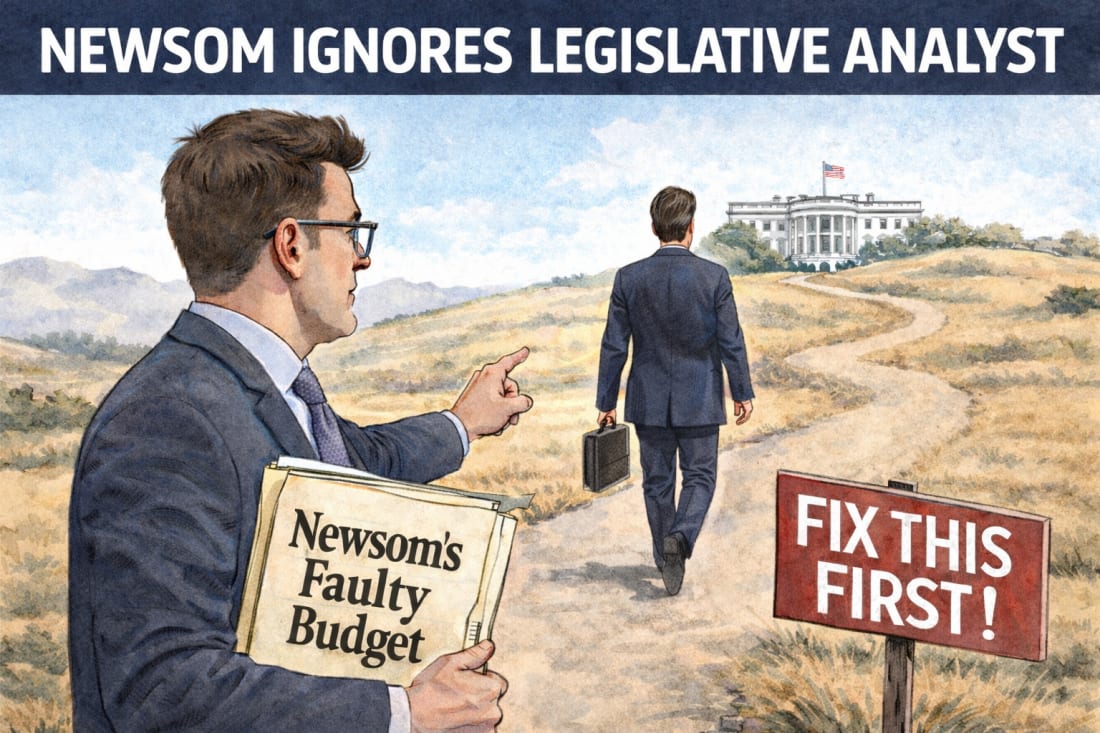
This budget seems less like a serious plan for California’s future and more like one written by a Governor whose focus is already elsewhere—on the White House, not the people who elected him to Sacramento.
You’re currently a free subscriber to So, Does It Matter? California Politics! For the full experience, upgrade your subscription. See how much more you get with an inexpensive, paid subscription, but clicking the button below! Support me in providing hard-hitting, clear-eyed analysis of California politics. I am beholding to no one, and sugar-coat nothing!
| ||||||||||

