
FOR IMMEDIATE RELEASE
January 13, 2026
Contact: [email protected]
New Ranking Puts Michigan in Top 5 in Country for Workforce
Michigan Beats California, Texas, and Florida in Workforce Companies Need to Succeed
LANSING, Mich.—Today, Governor Whitmer highlighted Site Selection Magazine’s new workforce report, which ranks Michigan No. 4 in the nation and second in the East North Central region. The ranking cites Michigan’s talented workers and strong colleges, universities, and skilled trades programs, helping companies hire the right workers to fill high-skill, good-paying jobs. It follows recent wins including a No. 6 ranking in CNBC’s Top States for Business and a Top 10 ranking from Area Development.
“Michigan’s talented workers are moving our state forward and putting us in the lead as one of the best states for businesses to expand and create good-paying jobs,” said Governor Whitmer. “Site Selection Magazine’s new rankings show the world what is already clear to Michiganders: our state is open for business and on the move. With our talented workers, companies can build better, more innovative products. I’m proud of the work we’ve done to create opportunity and expand our talent pipeline. Let’s keep working together to grow our economy, create jobs, and help more families ‘make it’ in Michigan.”
In this year’s rankings, Michigan moved up two spots from the 2025 Regional Rankings, highlighting the state’s emphasis on workforce and talent development. Governor Whitmer has made historic investments to help over 100,00 Michiganders get the skills they need for good-paying jobs through Michigan Reconnect, offering any Michigander 25 an older tuition-free associate’s degree or skills training certificate, and the Michigan Achievement Scholarship, lowering the cost of college by thousands for over 62,000 Michigan students. Thanks to the Governor’s work, the number of Michiganders with a postsecondary degree or credential has increased from 45% to 52%.
“Michigan’s recognition as a Top 5 state nationally for workforce development by Site Selection is proof that Team Michigan’s ‘Make It in Michigan’ economic development strategy is working and our efforts to train and retain a strong workforce in the state have not gone unnoticed,” said Quentin L. Messer, Jr., CEO of the Michigan Economic Development Organization (MEDC). “In Michigan, we know that our greatest asset is our people. Work remains to continue climbing the rankings, and we are committed to ensuring every Michigander and those considering Michigan for their home know they can ‘Make It in Michigan.’”
“This recognition reflects the meaningful progress Michigan is making to connect more people with opportunity and prepare workers for in-demand careers,” said Michigan Department of Labor and Economic Opportunity Director Susan Corbin. “We’re grateful for this Site Selection Workforce Development recognition, which highlights our strategic and dedicated efforts to build the workforce of tomorrow. Through investments in career pathways like registered apprenticeships, removing barriers to employment and so much more, we’re committed to making Michigan more prosperous for all and training a highly skilled workforce.”
Site Selection’s revamped Workforce Development rankings were determined based on a unique index incorporating data from ACT, Lumina Foundation, Strada Education Foundation, the U.S. Bureau of Labor Statistics (BLS), SkillsUSA and the National Student Clearinghouse Research Center.
Michigan scored well based on several factors, including ACT National Career Readiness Certificates (both cumulative and per capita), the National Student Clearinghouse data on bachelor’s and associate degrees and improvement in labor productivity.
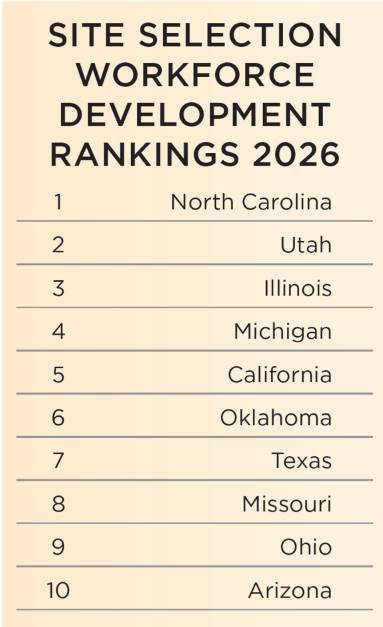
“For many years we’ve reported stories documenting the depth and breadth of workforce talent and talent development in Michigan,” said Adam Bruns, editor in chief of Site Selection. “We’ve also seen the infrastructure for workforce development evolve, helped by organizations such as the Research Universities for Michigan coalition, workforce-oriented institutions such as Kettering University, strong workforce data monitoring by groups such as the Detroit Regional Partnership and MEDC, and candid input from organizations such as Business Leaders for Michigan.”
###
| STAY CONNECTED: | |||
 |
 |

|
|
|
Subscriber Services:: |

|
||||
