|
 |
Hello readers, Ryan Busse here. This is a place for political updates, insights, and weekend stories celebrating the beauty of Montana. I’d love to have you as a paid subscriber where you will get special news updates, personalized recipes, and maybe even an occasional fishing report.



You’ve probably heard a lot about the wealth coming into Montana and about how many of us don’t like it. We resist not because of the money, but because the undesired byproducts and exclusions are risking the incredible riches already here: our people, our friendships, and our trust in each other. What follows is a true story about how I found true wealth by just living in this last best place, and, like many Montana stories, it begins in a bar.
Moose’s Saloon was, and still is, a beloved main street watering hole where patrons gather after work to toss peanut shells into sawdust and share stories over cheap beers. I was there as a twenty-something kid, alone, new to a new town, and yet to make a friend. Thankfully, I was in Montana, a place that gave chances and spared judgment. My chance that evening came in the form of a hunting story drifting over the beers from a loud guy at the end of the bar.
The fella floating the words had folded his 6’5” frame onto a random barstool. He was a heavy equipment operator at the landfill just up the road, wore a Stormy Kromer wool hat, like the ranchers I grew up with, and his pontifications grew in volume and color with each swig of his beer.
This guy had a particular way of speaking that commanded attention, plain and authoritative, in the style of a traveling preacher minus the piety. His voice was slow and booming, laced with a Canadian accent and expertly crafted off-color colloquialisms.
I wanted to find a bird-hunting buddy, so I leaned toward him and took a chance with a playful challenge, “What do you know about pheasants?” He stopped mid-sentence, looked away from his audience and shot back, “Quite a goddamned bit. I’m James. Who the hell are you?”
Peanuts in one hand and beer in the other, James had been delivering a stirring sermon about his recent pheasant hunting trip to central Montana. He waved his arms as if in the pulpit and parishioners around the bar listened with rapt attention; “They were flying around like goddamned bees. Everywhere! We were shootin’ the hell outta things, the dogs were crazy as shithouse rats, the birds were piling up like cordwood.” My risky intrusion had brought it all to an uncomfortable standstill.
I grew up on a ranch with hundreds of pheasants, and hunting access to my childhood home felt like currency I could barter, so I offered it along with a handshake. “You think you know pheasant hunting? Well, you ought to see where I grew up.” James turned and gave me his full attention.
He bore a strong resemblance to the iconic Seattle pitcher, Randy Johnson. He stood and looked down his nose with a cocked eyebrow, and I felt as if I was standing at home plate facing the Big Unit. But after a moment of sizing me up, he shook my hand and told the bartender, “Get this guy a beer.”
For James, and in classic Montana fashion, a hint of a new hunting spot was enough to explore friendship with a stranger. A few months later, he and I were following our dogs across the grasslands in the biting cold. I had a lot of respect for someone who would take that sort of gamble on a new friend.
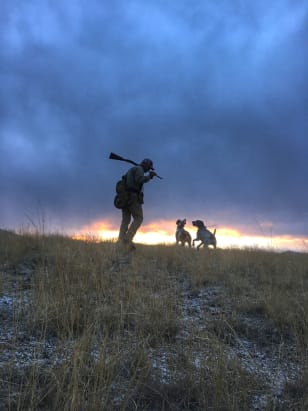 |
Our hunting styles were a match. Like me, James was a born walker. He was like a moose at a distance; first appearing slow and gangly, but up close, he moved with stretched, effortless strides so long and flowing that almost no one could keep up. When birds appeared, he’d swing, shoot, and take a new step all in the same motion, never stopping his forward momentum.
We both possessed an almost addictive love for bird-hunting. Twenty-mile days, blisters, and hunting right up until dusk became common. Other friends labeled our adventures “death marches” and found excuses to avoid getting looped into our hikes.
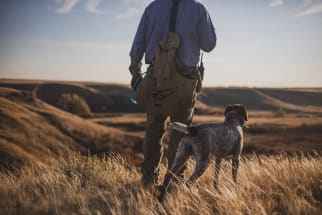
Our shared passion for birds and our dogs drove us to roam across vast swaths of country. In the ensuing decades, we hunted mostly in Montana but explored the high plains from Oklahoma to Canada. In the breaks between our marches, we stumbled into small towns, snuck dogs into dingy hotels, and ate breakfasts in greasy spoons.
 |
We listened in on conversations of old men in small-town cafes on the off chance they might utter a tip. We chatted up crusty bartenders to find the whiskey of choice for ranchers. We lived it all with unapologetic abandon.
James proved to be a great and surprising companion. Besides being an expert operator of D9 Caterpillars and huge excavators, he was also an artist, and stories were his canvas.
I came to respect him as a master of the craft of storytelling, and he had incredible material from which to draw. He mined the experiences to produce his art, including the fact that his dad, Bill, was a renowned wilderness ranger at Schaefer Meadows up the Middle Fork, and his mom, Barbara, was a self-described “Wild River Pioneer.” Sometimes our new adventures were also threads in his projects. No matter what the source, he picked out the interesting components and wove them in the loom of his mind, spinning them together, often for weeks or months, until the fine fabric poured out.
His stories always arrived at unexpected and hilarious places and involved just the right amount of suspense and drama. “Did I tell you about the time I took out an entire motel in a runaway grain truck over on the Clark Fork?” The roadside lodging establishment, at the bottom of a massive hill on Highway 28, was thankfully almost empty due to the late morning timing of his crash, but Jim’s loaded wheat truck nearly killed the last person inside just as she was preparing to check out of room 107. He, too, barely made it out alive. The motel was not so lucky; after the collision, it was rebuilt farther north of the intersection to avoid a repeat attack.
A few years after the wreck, Jim ran into the survivor at the same Montana barstool where he and I had first discussed pheasants. Of course, he started preaching and drinking beer with her, too. They ended up laughing at another of Jim’s stories, even though she was missing a few key internal organs from the impact of Jim’s 40-ton Peterbilt.
James wove the words of his life together with the magnetic pull of the world’s finest novelists. Before long, his storytelling was in high demand by my friends and family. Inquiries about upcoming hunting trips focused less on me and more on whether James was coming along.
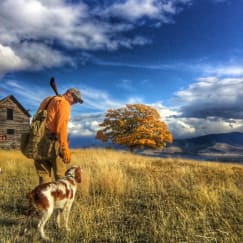
James was the kind of guy you wanted to have on any ride. For me, this was partially because he was silver-tongued when prying permission from even the prickliest ranchers. It was I who had native fluency in ranch language, and thought I was pretty good at the permission game, but James was the best I had ever seen.
After the initial hard “no” through the screen door, Jim would conjure up one of his booming sermonettes. He began slowly, with something familiar, maybe a commentary on a truck, a cow, or the weather. Then an artful transition to a real or imagined memory of a distant cousin they both knew who maybe had a friend or a last name that sounded about right, and then he’d throw in a good joke and one of his unique descriptive terms.
Soon the door would creak open, and Jim would be inside, drinking coffee, eating cookies, and drawing property maps on paper towels. He’d get a warm handshake from the previously frigid rancher, then swagger back to the truck with his wool hat tipped back; a slight grin creeping up from his mustache. After his truck door slammed, he’d look at me and unleash the results, “Hope you got some goddamned ammo, Busse, ‘cause we can hunt ‘er all!” I’d just shake my head in amazement.
 |
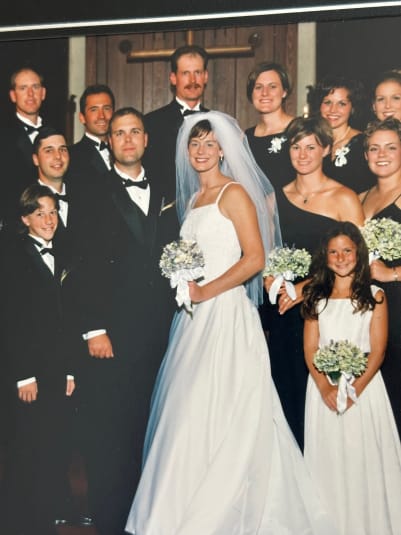
Those ranchers sensed the truth about Jim; you could depend on him to be true and authentic. Perhaps it was this honesty that led James to become a corner post in the wobbly fence of my life, and a couple of years after we became friends, Sara and I were honored to have James in our wedding.
 |
Over time, things got busier, and I traveled more. Life happened. We hunted together less, but it did not change the fundamentals of our friendship. On one of my work trips, my wife Sara called with an emergency. Our beloved but aging German Shorthair was on her last leg. Our vet said she was in pain and advised us to put her down that same day. I could not return for nearly a week, and in tears, I blubbered into the phone, “I’ll call James.”
It was mid-morning when I reached him at work, where he had been promoted to oversee the entire Flathead landfill operation. “Hey, is this the lord of the landfill?” I said in a half-hearted joke, trying not to break down. But Jim knew something was wrong, and he dropped everything and was at Sara’s side within the hour. He cried in the vet clinic waiting room with her, just as I would have for his dogs.
When our first son was born, Sara and I named him Lander James, in honor of our favorite Wyoming Town and my friend Jim. Lander was born in the middle of Jim’s treasured January duck hunting season, but he took the interruption in stride, showing up at the hospital in waders and full camo while promising to someday take the infant to a new spot that he declared, “had a shit load of ducks when things froze up like this.”
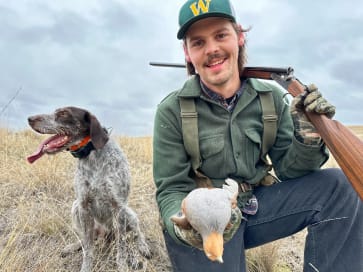 |
More than 25 years have passed since our first beers together in that bar. We’ve walked a thousand miles together and apart. New dogs have come and gone. Birds have indeed piled up like cordwood. Family has passed. And yet despite the march of time, nothing has changed. We are just a couple of bird-hunting buddies looking for the next ridge to hunt, joking with each other about missed shots and permissions gained.
We never wasted time on unimportant diversions. Long Montana walks, bird dogs, and good stories are simple things that are enough for us.
You’re currently a free subscriber to Montana Dispatch -Truth, Beauty & Resistance - by Ryan Busse. For the full experience, upgrade your subscription.
Thank you for reading and sharing this Montana Dispatch with a friend.
| ||||||||||

