
Email
Add your name: Everyday foods shouldn't come with hidden health risks
| From | U.S. PIRG <[email protected]> |
| Subject | Add your name: Everyday foods shouldn't come with hidden health risks |
| Date | January 10, 2026 4:10 PM |
Links have been removed from this email. Learn more in the FAQ.
Links have been removed from this email. Learn more in the FAQ.
:
John,
Take a look at your grocery list and you'll probably see everyday items such as whole wheat bread, flavored yogurt, shredded cheese, maybe a box of granola bars.
Most of us wouldn't think twice about buying these foods. They sound wholesome.
But these everyday staples are likely made with the same ultraprocessed ingredients found in cookies, chips or soda. These type of foods have quietly become the backbone of our diet.[1]
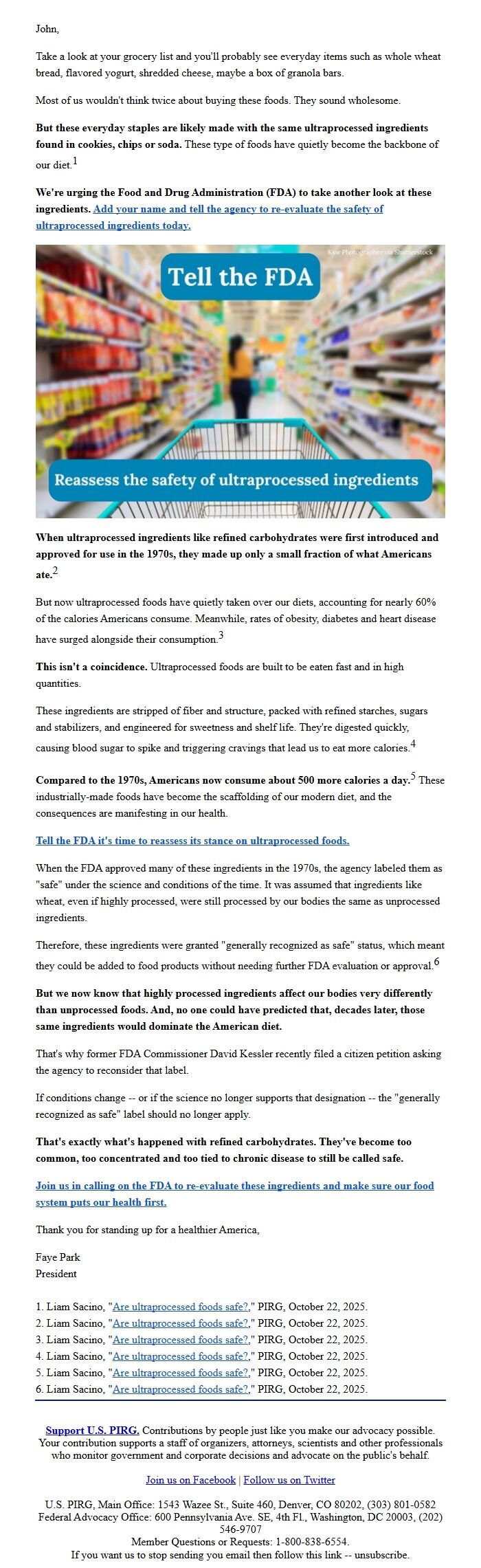
We're urging the Food and Drug Administration (FDA) to take another look at these ingredients. Add your name and tell the agency to re-evaluate the safety of ultraprocessed ingredients today.
[link removed]
When ultraprocessed ingredients like refined carbohydrates were first introduced and approved for use in the 1970s, they made up only a small fraction of what Americans ate.[2]
But now ultraprocessed foods have quietly taken over our diets, accounting for nearly 60% of the calories Americans consume. Meanwhile, rates of obesity, diabetes and heart disease have surged alongside their consumption.[3]
This isn't a coincidence. Ultraprocessed foods are built to be eaten fast and in high quantities.
These ingredients are stripped of fiber and structure, packed with refined starches, sugars and stabilizers, and engineered for sweetness and shelf life. They're digested quickly, causing blood sugar to spike and triggering cravings that lead us to eat more calories.[4]
Compared to the 1970s, Americans now consume about 500 more calories a day.[5] These industrially-made foods have become the scaffolding of our modern diet, and the consequences are manifesting in our health.
Tell the FDA it's time to reassess its stance on ultraprocessed foods.
[link removed]
When the FDA approved many of these ingredients in the 1970s, the agency labeled them as "safe" under the science and conditions of the time. It was assumed that ingredients like wheat, even if highly processed, were still processed by our bodies the same as unprocessed ingredients.
Therefore, these ingredients were granted "generally recognized as safe" status, which meant they could be added to food products without needing further FDA evaluation or approval.[6]
But we now know that highly processed ingredients affect our bodies very differently than unprocessed foods. And, no one could have predicted that, decades later, those same ingredients would dominate the American diet.
That's why former FDA Commissioner David Kessler recently filed a citizen petition asking the agency to reconsider that label.
If conditions change -- or if the science no longer supports that designation -- the "generally recognized as safe" label should no longer apply.
That's exactly what's happened with refined carbohydrates. They've become too common, too concentrated and too tied to chronic disease to still be called safe.
Join us in calling on the FDA to re-evaluate these ingredients and make sure our food system puts our health first.
[link removed]
Thank you for standing up for a healthier America,
Faye Park
President
1. Liam Sacino, "Are ultraprocessed foods safe?," PIRG, October 22, 2025.
[link removed]
2. Liam Sacino, "Are ultraprocessed foods safe?," PIRG, October 22, 2025.
[link removed]
3. Liam Sacino, "Are ultraprocessed foods safe?," PIRG, October 22, 2025.
[link removed]
4. Liam Sacino, "Are ultraprocessed foods safe?," PIRG, October 22, 2025.
[link removed]
5. Liam Sacino, "Are ultraprocessed foods safe?," PIRG, October 22, 2025.
[link removed]
6. Liam Sacino, "Are ultraprocessed foods safe?," PIRG, October 22, 2025.
[link removed]
-----------------------------------------------------------
Donate Today: [link removed]
Join us on Facebook: [link removed]
Follow us on Twitter: [link removed]
U.S. PIRG
Main Office: 1543 Wazee St., Suite 460, Denver, CO 80202, (303) 801-0582
Federal Advocacy Office: 600 Pennsylvania Ave. SE, 4th Fl., Washington, DC 20003, (202) 546-9707
Member Questions or Requests: 1-800-838-6554.
If you want us to stop sending you email then follow this link -- [link removed]
John,
Take a look at your grocery list and you'll probably see everyday items such as whole wheat bread, flavored yogurt, shredded cheese, maybe a box of granola bars.
Most of us wouldn't think twice about buying these foods. They sound wholesome.
But these everyday staples are likely made with the same ultraprocessed ingredients found in cookies, chips or soda. These type of foods have quietly become the backbone of our diet.[1]
We're urging the Food and Drug Administration (FDA) to take another look at these ingredients. Add your name and tell the agency to re-evaluate the safety of ultraprocessed ingredients today.
[link removed]
When ultraprocessed ingredients like refined carbohydrates were first introduced and approved for use in the 1970s, they made up only a small fraction of what Americans ate.[2]
But now ultraprocessed foods have quietly taken over our diets, accounting for nearly 60% of the calories Americans consume. Meanwhile, rates of obesity, diabetes and heart disease have surged alongside their consumption.[3]
This isn't a coincidence. Ultraprocessed foods are built to be eaten fast and in high quantities.
These ingredients are stripped of fiber and structure, packed with refined starches, sugars and stabilizers, and engineered for sweetness and shelf life. They're digested quickly, causing blood sugar to spike and triggering cravings that lead us to eat more calories.[4]
Compared to the 1970s, Americans now consume about 500 more calories a day.[5] These industrially-made foods have become the scaffolding of our modern diet, and the consequences are manifesting in our health.
Tell the FDA it's time to reassess its stance on ultraprocessed foods.
[link removed]
When the FDA approved many of these ingredients in the 1970s, the agency labeled them as "safe" under the science and conditions of the time. It was assumed that ingredients like wheat, even if highly processed, were still processed by our bodies the same as unprocessed ingredients.
Therefore, these ingredients were granted "generally recognized as safe" status, which meant they could be added to food products without needing further FDA evaluation or approval.[6]
But we now know that highly processed ingredients affect our bodies very differently than unprocessed foods. And, no one could have predicted that, decades later, those same ingredients would dominate the American diet.
That's why former FDA Commissioner David Kessler recently filed a citizen petition asking the agency to reconsider that label.
If conditions change -- or if the science no longer supports that designation -- the "generally recognized as safe" label should no longer apply.
That's exactly what's happened with refined carbohydrates. They've become too common, too concentrated and too tied to chronic disease to still be called safe.
Join us in calling on the FDA to re-evaluate these ingredients and make sure our food system puts our health first.
[link removed]
Thank you for standing up for a healthier America,
Faye Park
President
1. Liam Sacino, "Are ultraprocessed foods safe?," PIRG, October 22, 2025.
[link removed]
2. Liam Sacino, "Are ultraprocessed foods safe?," PIRG, October 22, 2025.
[link removed]
3. Liam Sacino, "Are ultraprocessed foods safe?," PIRG, October 22, 2025.
[link removed]
4. Liam Sacino, "Are ultraprocessed foods safe?," PIRG, October 22, 2025.
[link removed]
5. Liam Sacino, "Are ultraprocessed foods safe?," PIRG, October 22, 2025.
[link removed]
6. Liam Sacino, "Are ultraprocessed foods safe?," PIRG, October 22, 2025.
[link removed]
-----------------------------------------------------------
Donate Today: [link removed]
Join us on Facebook: [link removed]
Follow us on Twitter: [link removed]
U.S. PIRG
Main Office: 1543 Wazee St., Suite 460, Denver, CO 80202, (303) 801-0582
Federal Advocacy Office: 600 Pennsylvania Ave. SE, 4th Fl., Washington, DC 20003, (202) 546-9707
Member Questions or Requests: 1-800-838-6554.
If you want us to stop sending you email then follow this link -- [link removed]
Message Analysis
- Sender: n/a
- Political Party: n/a
- Country: n/a
- State/Locality: n/a
- Office: n/a
-
Email Providers:
- ActionKit