|
 |
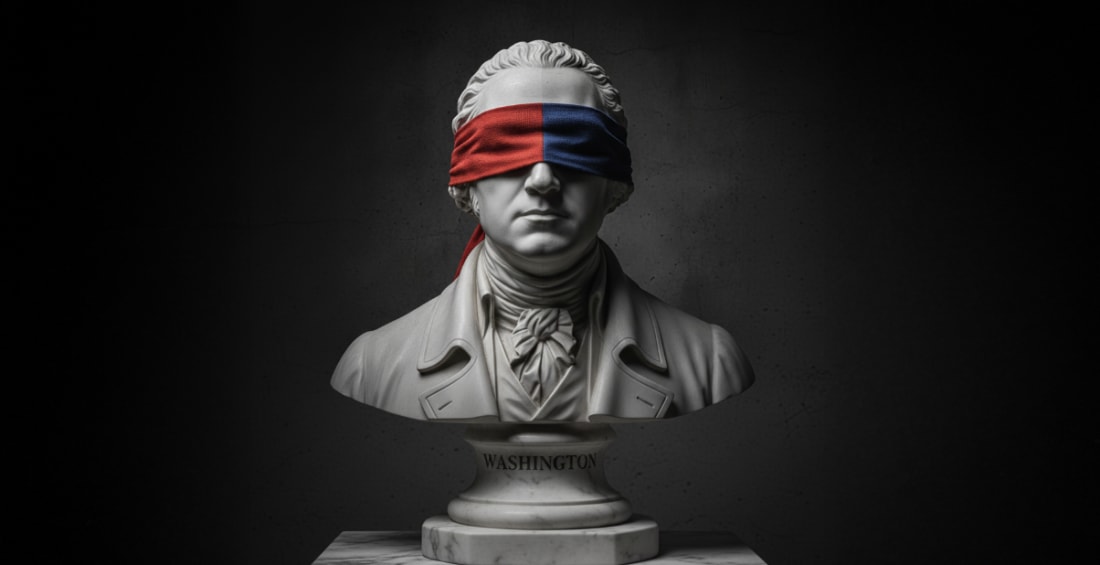
Have we blindfolded ourselves?
Why the Founders didn't trust angels, and George Washington didn't trust parties
| |||||||||||||||


 |
If you read the interview with President Trump in The New York Times (gift link) on Thursday, you might have stopped cold at one specific line. When asked what limits his power as Commander in Chief, the President didn’t cite the Constitution, Congress, or international treaties. He gave a much simpler answer:
“My own morality. My own mind. It’s the only thing that can stop me”.
He added, “I don’t need international law,” making it clear that he sees himself as the final judge of what the United States can and cannot do.
On the surface, this could sound like confidence. But to anyone who knows American history, it ought to sound like an alarm bell. It brings us face-to-face with the exact problem the Founding Fathers tried to solve 250 years ago.
The “Angel” Problem
James Madison, the father of our Constitution, knew that relying on a leader’s “morality” was a dangerous gamble. In Federalist No. 51, he wrote a sentence that should be hung in every hallway of the White House: “If men were angels, no government would be necessary.”
The Founders built our system on a dark truth: leaders are not angels. They knew that even good people can be tempted by power, and that bad people will always seek it. That is why they created a government of laws, not of men. They built “parchment barriers” — written rules — to stop a president when his “own mind” might lead the country off a cliff.
When a leader says their only limit is their “own morality,” they are essentially saying, “trust me.” The Declaration of Independence was written because we decided we didn’t want to trust a King; we wanted to trust the rule of law.
The Party Trap
So, if the President is openly brushing aside laws and treaties, why isn’t Congress stopping him? Why has the legislative branch — which is supposed to have the power of the purse and the power to declare war — become so quiet?
The answer lies in a warning from George Washington that’s been largely ignored.
In his Farewell Address, Washington warned us that the “spirit of party” would be the undoing of our Republic. He predicted that Americans would eventually care more about their political “team” than their country. He warned that if we let factions divide us, the chaos would eventually lead people to seek safety in the “absolute power of an individual.”
We are seeing Washington’s nightmare come true. Today, Congress is often too paralyzed by party loyalty to do its job. If a President is on “their team,” many members of Congress will look the other way, even when he claims powers he shouldn’t have (this is true of both parties, and if you can’t admit it, check your “team spirit”!). Congress has traded its power for party protection.
How to Fix It: Ambition Must Counteract Ambition
We don’t need to reinvent the wheel to fix this — but we do need to use the tools we have. We need a Congress that remembers it is a co-equal branch of government, not simply a fan club OR an opposition group.
Madison argued that “ambition must be made to counteract ambition.” This means Congress should be jealous of its own power. A Senator should feel insulted when a President — any President — bypasses them to start a conflict or spend money, regardless of which party is in charge.
Here some BRIGHT IDEAS worth considering:
Stop the Blank Checks: Congress could say any law granting emergency powers comes with “automatic sunsets.” This means emergency powers or sanctions expire automatically after 60 days unless Congress votes to keep them. This forces our representatives to go on the record and do their jobs, rather than hiding behind the President.
Reclaim the Purse: The Constitution gives Congress the power of the purse. If the Executive branch tries to move money around without permission — like using tariffs as “licensing fees” to bypass courts — Congress could cut off the funds.
Remember Who We Are: As we celebrate our 250th year since the Declaration of Independence, we ought to remember that “national strength” doesn’t come from one person’s unpredictability or willingness to use force. It comes from a stable system where no single person can dictate the law. That’s the entire point of Congress, and one reason we’re in this mess is that it has not been solving the people’s problems for decades. It’s time to explore ideas that would make Congress more effective, express the will of the people while protecting minority rights.
The safety of our freedom should never depend on whether the President is having a good day or a bad day. It should depend on the law. And the only way to ensure that is for Congress to wake up and check the “morality” of the Executive with the authority of the People.
 |
Help us fuel lawsuits against Donald Trump’s abuses of power and break through to disengaged Americans. You’ll never be required to donate in order to be part of Bright America, but an investment of ANY size adds up to a huge impact when enough of us put some money where our minds and hopes are.
| ||||||||||

