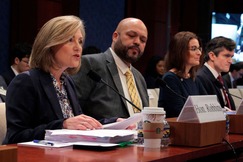
Congressional Fraud Hearing
Reps. Rarick, Hudson and I spent five hours providing details on the staggering amount of fraud in Minnesota, the failures of the Walz Administration to provide adequate internal controls, and details from whistleblowers on how they have been retaliated against.
Throughout the hearing, members of Congress learned of a troubling picture of systemic fraud within Minnesota’s public assistance programs. Several key takeaways emerged that shed light on what Governor Tim Walz knew, and how his administration responded to what has now become a $9 billion—and still growing—fraud crisis affecting Minnesota taxpayers.
THE GOVERNOR WAS AWARE
During the hearing, I was asked to provide specific examples of how the Walz administration impeded or interfered with fraud investigations. One of the most striking examples involved how the criminal investigations of childcare fraud were shut down by the Minnesota Department of Human Services (DHS). Instead of focusing on criminal fraud, this unit was told to focus on identifying overpayments that could possibly be recouped.
Investigators were raising red flags and attempting to follow the money when their work was halted. The evidence clearly shows that the administration was not only aware of the problem but took actions that limited scrutiny rather than strengthened it.
WHISTLEBLOWER FEAR OF RETALIATION
Several members of Congress expressed shock and concern upon learning about the environment of fear faced by whistleblowers inside the Walz administration. Multiple former employees have told us about being intimidated, silenced, or punished for speaking up about waste, fraud, and abuse within our state government.
In some cases, employees were threatened to be terminated “for cause” after raising concerns. This action that effectively strips them of unemployment benefits and severely damages their ability to ever work for the State of Minnesota again. One human services employee told us that after warning her supervisors about what she described as “sloppy contracting practices” and inadequate oversight, she was swiftly escorted out of the building. Stories like this send a chilling message to other employees: speak up, and you risk your livelihood.
TERRORISM FUNDING
When questioned about whether fraudulent welfare dollars may be linked to international terrorist networks, I explained how an informal and unregulated network of money exchangers has been used to transmit funds overseas, particularly to Somalia. There have been criminal convictions demonstrating that some of these funds have flowed directly to Al-Shabaab, a Somali-based terrorist organization with known ties to Al Qaeda. More recently, the concern is that Minnesota tax dollars sent back to Somalia are indirectly funding terrorism because the terrorist group takes a cut of all money transferred into the territory it controls.
This raises serious national security concerns and underscores that this issue is not merely about financial mismanagement—it has implications far beyond Minnesota’s borders.
TARGETING FRAUD, NOT A COMMUNITY
Unfortunately, some Democrats on the committee appeared more focused on partisan attacks than on addressing the undeniable fact that Minnesotans are being defrauded on a massive scale. Rather than confronting the evidence, they attempted to deflect criticism by framing legitimate oversight questions as politically or culturally motivated.
I made it clear that acknowledging where fraud is occurring is not the same as targeting an entire community. While it is true that a significant portion of documented fraud cases have occurred within the Somali community, it is also true, and equally important, that some of the most courageous and effective whistleblowers exposing this fraud come from the Somali community.
When it comes to our work on fraud, it has always been about holding bad actors accountable, protecting honest Minnesotans, and restoring integrity to programs meant to help those truly in need.
After the hearing, I spent Thursday meeting with Senators Joni Ernst (IA) and Ron Johnson (WI), who are also looking at Medicaid fraud issues in Minnesota and around the country. I also met with several members of House and Senate Committee staff who wanted to get more detail on the patterns of fraud and red flags we have identified across different Medicaid programs.
|