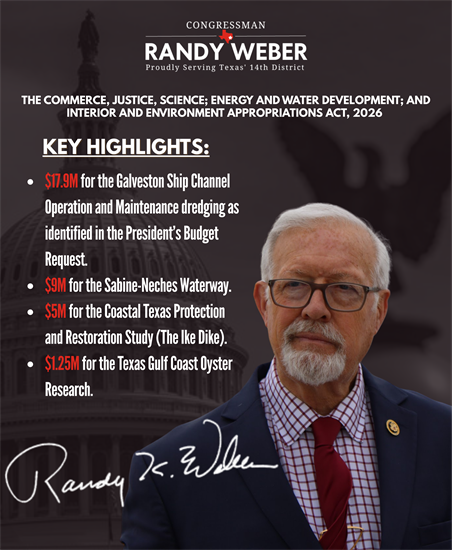
This week, the House passed H.R. 6938, the Fiscal Year 2026 Commerce, Justice, Science; Energy and Water Development; and Interior and Environment Appropriations Act, by an overwhelming 397–28 vote. This package delivers nearly $34 million directly back to communities across Texas’ 14th District to strengthen our ports, protect our coastline, and keep American energy and commerce moving.
Included in this bill:
- $17.9 million for operation and maintenance dredging in the Galveston Ship Channel, ensuring authorized depths are maintained so energy products and goods can move efficiently through one of the nation’s most critical maritime corridors.
- $9.06 million for the U.S. Army Corps of Engineers to continue deepening the Sabine-Neches Waterway to its congressionally authorized 48-foot depth, strengthening port competitiveness and supporting refineries, LNG facilities, and manufacturers that rely on deep-draft access.
- $5 million to advance pre-construction engineering and design for the Texas Coastal Project, locally known as the Ike Dike. This comprehensive coastal resiliency effort could generate $2.31 billion in annual economic savings while protecting more than 6,000 acres of coastal habitat.
- $1.25 million for Texas A&M AgriLife Research to expand oyster research and breeding programs, supporting a growing Gulf Coast aquaculture industry, strengthening domestic seafood production, and reducing pressure on wild fisheries.
Beyond local investments, this package advances clear America First priorities. It includes provisions to block the sale of crude oil from the Strategic Petroleum Reserve, a fight I’ve led by introducing the Protecting America’s Strategic Petroleum Reserve from China Act. With roughly 60 percent of the nation’s SPR located in Texas’ 14th District, keeping these barrels out of the hands of hostile actors is a matter of national security. The bill also strengthens American energy dominance through improvements to ports and waterways and defends Second Amendment rights by prohibiting funds from being used to impose certain firearm export licensing requirements.
These wins did not happen overnight. Securing national priorities starts at the local level, and in Southeast Texas that means protecting the infrastructure that keeps America strong. Our ports, waterways, and energy assets are critical not just to our region, but to the country’s economic and national security. I’ve stayed focused on moving these priorities forward because when Texas’ 14th is strong, America is stronger and ready to meet the challenges ahead.
The FY26 funding package now advances to the U.S. Senate for further consideration. |
This year marks 125 years since oil was first struck at Spindletop, just outside Beaumont. On January 10, 1901, the Lucas Gusher came in at roughly 75,000 to 100,000 barrels of oil per day, at a time when total U.S. production was only about 170,000 barrels per day. The well flowed for nine days before it was brought under control, setting off one of the most significant industrial transformations in American history.
Within its first full year of production, Spindletop produced more than 17 million barrels of oil, accounting for the overwhelming majority of Texas oil output at the time and launching the Texas oil boom. Beaumont’s population surged from fewer than 10,000 residents in 1900 to more than 40,000 by 1903, as hundreds of drilling companies and thousands of workers moved into Southeast Texas. Today, Beaumont is a thriving city of approximately 115,000 people and part of a metropolitan area approaching 400,000 residents across Beaumont, Port Arthur, and Orange, still to this day shaped by energy and industry.
That early success laid the groundwork for the refining, petrochemical, pipeline, and port infrastructure that still defines this region. The Gulf Coast is home to some of the largest refining complexes in the nation, vast petrochemical facilities, and deepwater ports that move millions of barrels of crude and refined products per day. That infrastructure supports tens of thousands of jobs locally, contributes billions of dollars in economic activity statewide, and strengthens American energy security. Spindletop proved a simple truth that still applies today. When America produces energy at home, we are stronger, more secure, and less dependent on hostile regimes. Southeast Texas has powered this country for more than a century, and we are not done yet.
Drill, baby, drill! |
Since Nicolás Maduro’s regime turned Venezuela into a narco-state defined by cartel rule, economic collapse, and mass human suffering, more than 7 million Venezuelans have fled their homeland, one of the largest displacement crises in modern history. Prices spiraled out of control, food and medicine vanished, and basic services like electricity and water became luxuries. What was once one of South America’s wealthiest nations was hollowed out by socialism and authoritarianism. Under this chaos, Russia and China have used Venezuela as a trojan horse to extend influence in the Western Hemisphere, turning a once-neutral gateway into a geopolitical chessboard for hostile powers.
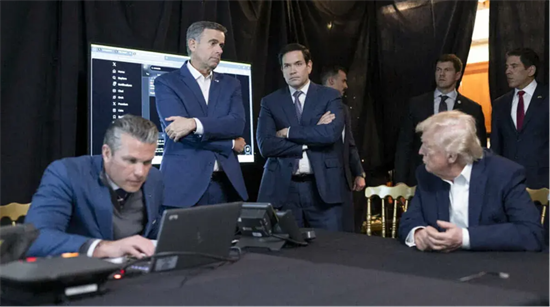
On January 3, 2026, U.S. forces executed Operation Absolute Resolve, capturing Maduro and his wife and bringing them into U.S. custody on drug trafficking and related charges. President Trump has repeatedly stated the United States will not allow hostile powers to challenge U.S. influence in our hemisphere, directly invoking principles rooted in America’s longstanding policy against external meddling.
This action follows a procedural framework rooted in longstanding U.S. legal and policy traditions. The 1823 Monroe Doctrine, has long been interpreted, including through historical corollaries like the Olney interpretation, as establishing U.S. commitment to prevent foreign powers from dominating the Western Hemisphere.
Recent statements by Secretary of State Marco Rubio outlines a three-phase plan for Venezuela’s post-Maduro future: beginning with stabilization, moving into recovery where energy access is reestablished and economic order restored, and ultimately transitioning political authority back to the Venezuelan people. This procedural roadmap underscores that U.S. actions include governance considerations and economic transition planning, not abandonment to chaos.
Here’s what comes next:
- Maduro’s prosecution in U.S. courts continues as he awaits his next court date on March 17th, 2026.
- U.S. policy officials are engaging with interim authorities in Venezuela to restore stability and governance functions, not simply manage power vacuums.
- A structured transition framework aims to pave the way for Venezuelan self-determination with legitimate leadership chosen by the Venezuelan people.
This is the essence of America First in practice. The United States has both the authority and the obligation to prevent hostile regimes from destabilizing our hemisphere and exporting crime, drugs, and chaos into our communities. Russia and China saw an opportunity in Venezuela; America responded by enforcing the law, defending our hemisphere, and acting decisively in defense of U.S. security.
|
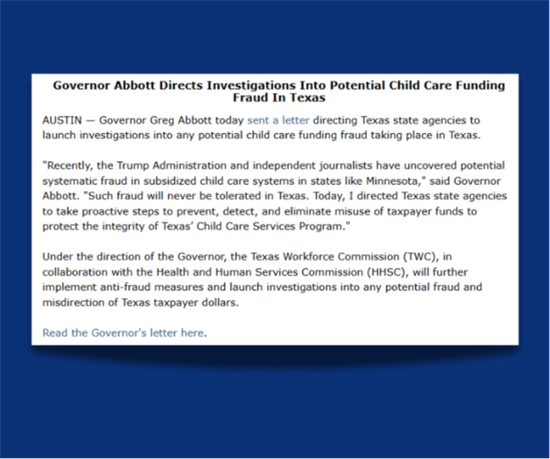
Across the country, investigators are uncovering large-scale fraud tied to taxpayer-funded programs, with losses reaching almost $10 billion. In Minnesota, weak oversight allowed public funds intended for childcare and nonprofit services to move with little accountability, leaving taxpayers on the hook and vulnerable families underserved.
Texas is taking a different approach. Under Governor Abbott, the state has ordered a statewide review of childcare funding to identify vulnerabilities, prevent fraud, and ensure taxpayer dollars are reaching the children and families they are meant to serve.
|
|
|
| |
Do you believe stronger oversight of government-funded nonprofits and childcare programs is necessary to protect taxpayers and vulnerable families?
|
|
|
|
| |
|
|
|
|
| |
|
|
|
|
|
|
|
Submit survey to sign up for updates.*
|
|
What a great start to 2026! So far, YOUR Texas 14th office has successfully returned $36,453.70 directly to constituents who were owed money from the federal government!
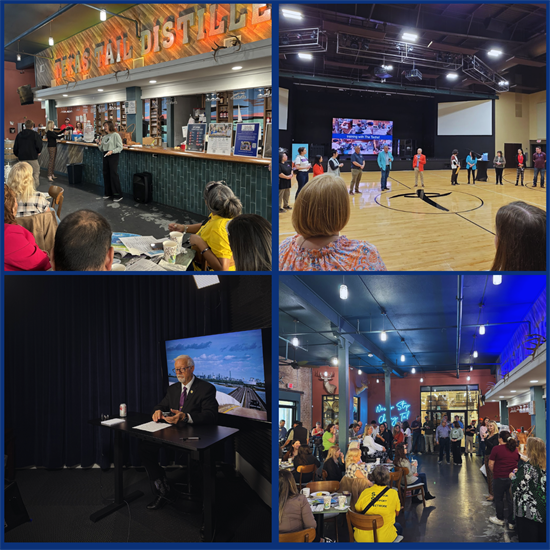
Team Weber stayed active throughout the district, attending and participating in community events across League City, Galveston, Orange, and Angleton. Staff represented the office at local Chamber coffees, mayoral breakfasts, drainage and infrastructure meetings, business ribbon cuttings, and luncheons.
These meetings also provided opportunities to share updates on upcoming Water Resources Development Act priorities, Community Project Funding, and infrastructure planning, helping local governments and organizations prepare for future federal opportunities.
|
- H.R.6336 - Fair Allocation of Interstate Rates Act
- H.R.6336 - To prohibit the allocation of costs for a certain transmission facility to consumers of a State the public officials of which did not expressly consent to such transmission facility, and for other purposes.
- H.R.6276 - To require the Secretary of the Army to consult with stakeholders in determining the scope of contracts entered into for the purposes of maintenance dredging, and for other purposes.
- H.R.6207 - Chip EQUIP Act
- H.R.6191 - No Taxpayer Funded Abortion Travel for Illegal Aliens Act
- H.R.6152- Foreign Robocall Elimination Act
- H.R.5888 - To provide for limitations on the implementation and enforcement of a global carbon tax with respect to the United States.
|
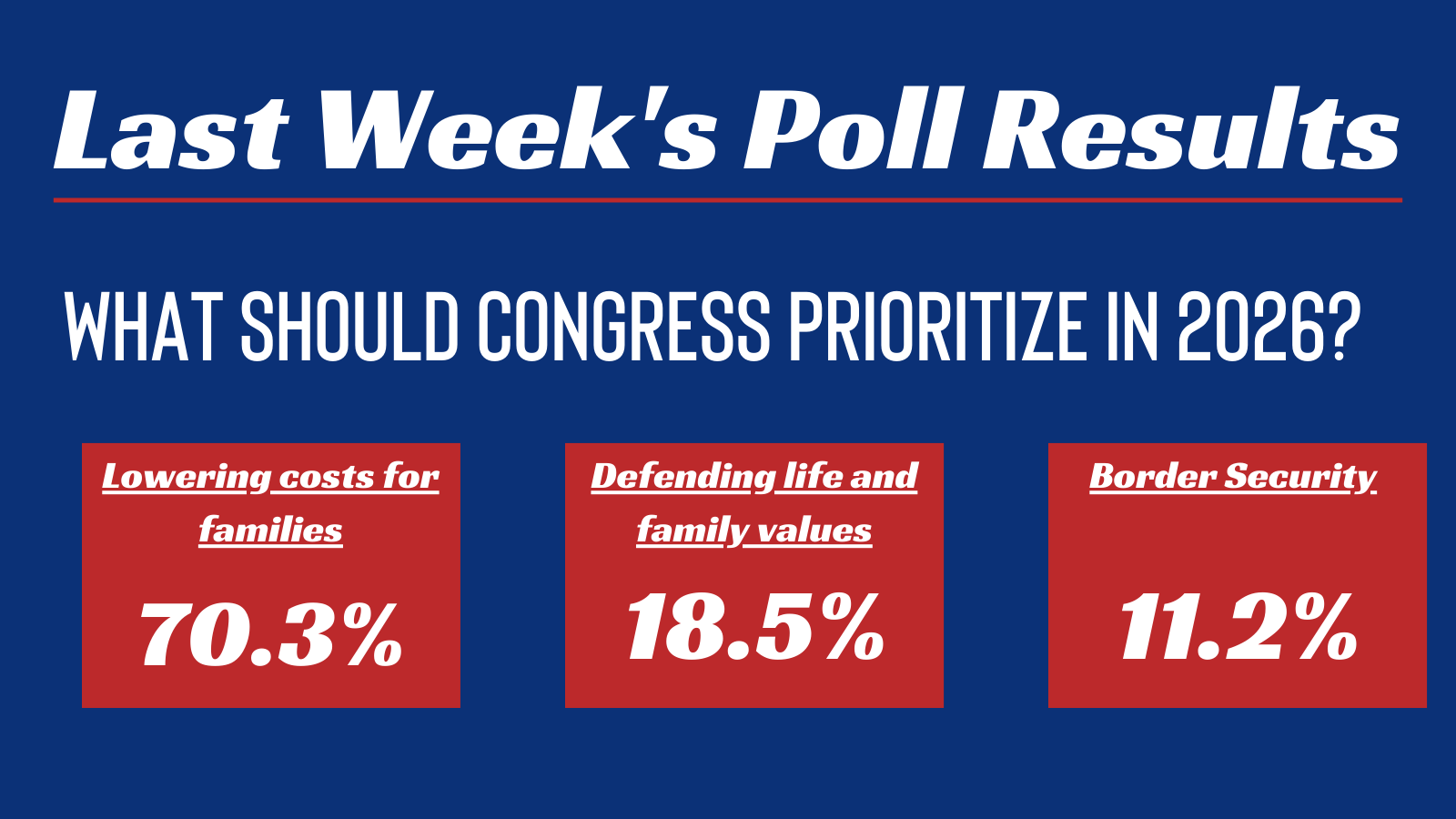
What should Congress prioritize in 2026?
Lowering costs for families: 70.3% Defending life and family values: 18.5% Border Security:11.2% |
It is a privilege to represent our district in Congress. While we’ve faced many challenges in recent years, through strength and prayer, we have persevered. Please know that we are always a resource for you. Call or stop by any of the offices (YOUR offices, we work for you), whenever you need assistance or want to talk about an issue before Congress.
For assistance or more information, please call or go online to visit us at weber.house.gov.
God Bless you and God Bless Texas! |
|
Sincerely,
|
|
|
|
|
|
Randy K. Weber
|
|
|
|