|
 |
Thank you for being a free subscriber to So, Does It Matter? Please support what we do. And also get 100% of our content (right now you get about 60% of it!).
Issue Tool Kit: Top 8 Reasons Why Abundant Water Reserves Will Not Lower Your Bill
California finally has water, but the system has no reason to reward you for it
|

| |||||||||||||||


 |
Most of our afternoon content is for paid subscribers. Just like an iceberg, only a small part of this post is visible to everyone. To read the rest, you’ll need a paid subscription.
Sometimes we publish columns to help readers explain important issues. We call these Issue Tool Kits.
⏱️ 7 min read
The Hard Truth About Water Prices
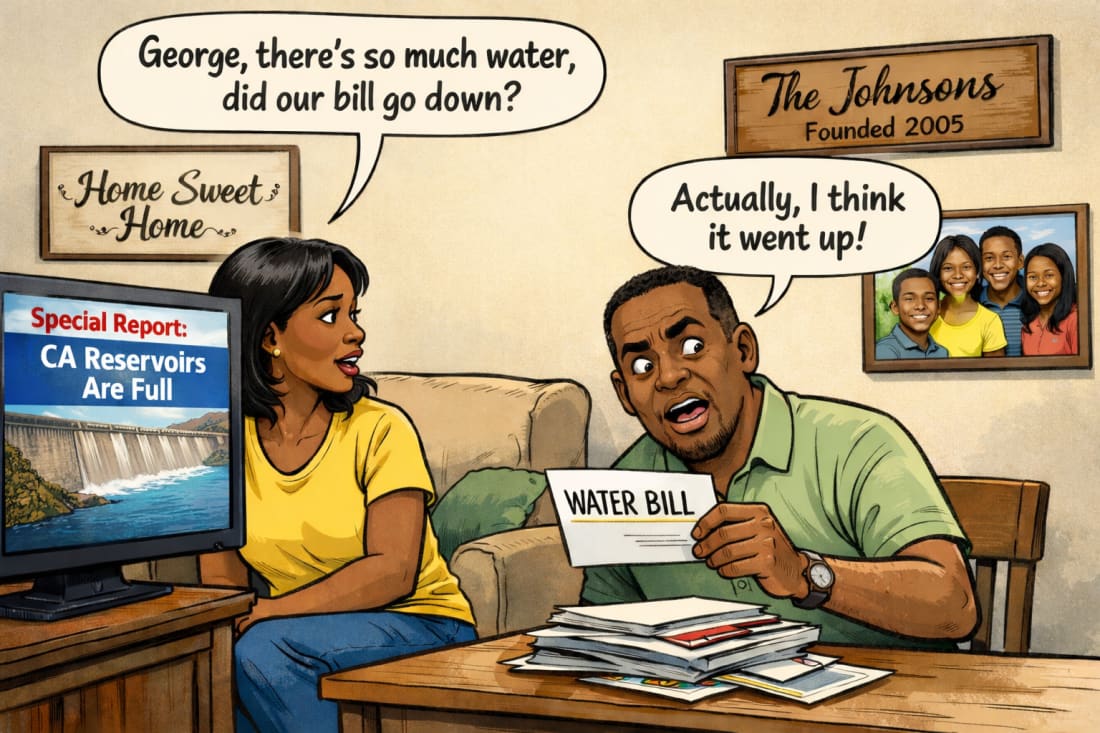
For years, Californians were warned to expect water shortages. Droughts made headlines, and emergency restrictions became normal. Every discussion about water focused on the lack of it. Now, the story has changed. Reservoirs are full or nearly full, the snowpack has recovered, and the state is no longer in crisis.
But do not expect to see any relief on your next water district bill.
This gap is not just a delay or a mistake. It shows how California sets water prices and what those prices are meant to protect. When you see this, high bills during wet years make sense—they are part of the system.
Reason 1: Water Rates Are Built Around Fixed Costs, Not Supply Levels
Water agencies do not set prices like regular markets. Rates do not change with rainfall or reservoir levels. Instead, they are set to cover costs, most of which are fixed.
Employees still need to be paid. Treatment plants must keep running. Pipes need regular inspection, repair, and replacement. Water quality testing, monitoring, and reporting go on whether reservoirs are full or empty. Emergency capacity must be ready, even if it is not used.
Once these costs are built into the rate structure, having more water does not change the numbers much. A wet year might help for a short time, but it does not reduce payroll, maintenance, or compliance needs. The system is designed to deliver steady revenue, not to lower customers' bills. Rates go up when costs increase, but rarely go down when things get better.
🔒 BELOW THE PAYWALL:
• Why infrastructure debt keeps your bill high, no matter how much rain falls
• How conservation lowers usage but pushes rates higher
• Why the drought-era temporary spending quietly becomes permanent
• How wholesale water contracts insulate suppliers from abundance
• Why California’s thousands of obscure local water districts face little real accountability to ratepayers
• What full reservoirs actually change and why your bill is not one of them...
Keep reading with a 7-day free trial
Subscribe to FlashReport Presents: So, Does It Matter? On CA Politics! to keep reading this post and get 7 days of free access to the full post archives.
A subscription gets you:
 | Subscriber-only Afternoon Posts. Analysis on breaking News |
| Saturday’s Popular “What is Jon Reading” Column |
| 100% percent of our site content is yours! |
| ||||||||||

