Expert analysis made easy. Breaking down the news with data, charts, and maps.
Edited by Brady Africk and Carter Hutchinson
Happy Thursday! In today’s newsletter, we examine the growth of America’s upper-middle class, new polling on US intervention in Venezuela, and rising electricity costs.
Don’t forget—subscribe and send DataPoints to a friend!
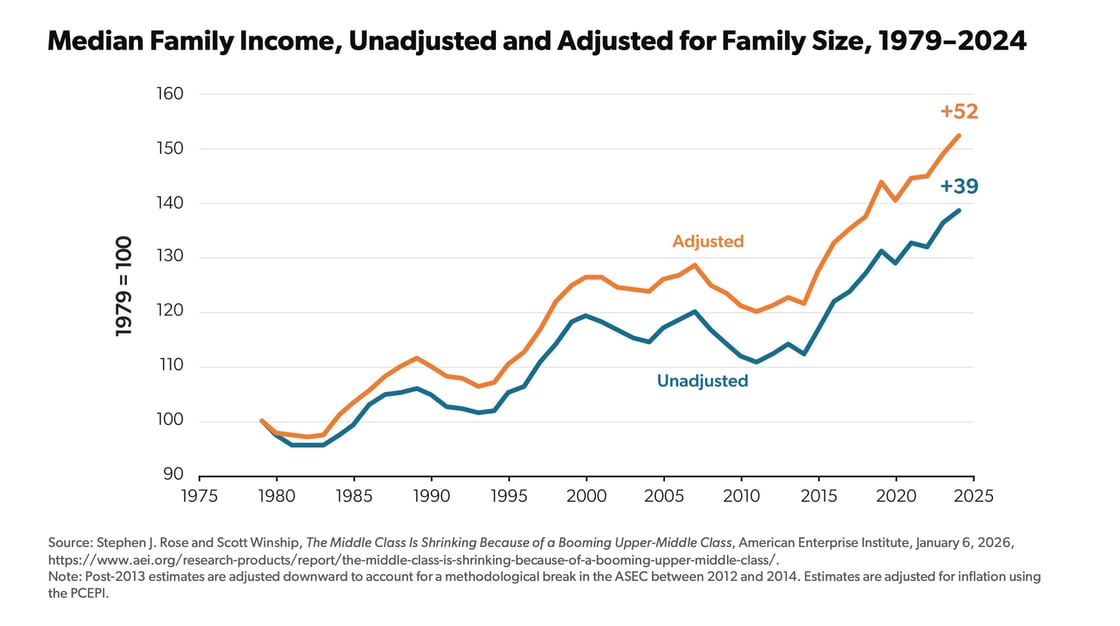
Topline: Populists on both sides of the aisle worry that the middle class has become an unattainable standard for many American families. But while the middle class has shrunk, AEI’s Scott Winship and Stephen J. Rose find that this is due to more families transitioning to the upper-middle class. In 1979, 10 percent of families qualified as upper-middle class, compared with 31 percent in 2024.
American Anxiety: Slower growth and rising inequality have created concern that the middle class is no longer economically secure or achievable, but American families in all income brackets have seen significant gains in the past 50 years. Overall economic growth, more professional opportunities for women, and a robust safety net have fostered gains for American families across incomes.
Family Matters: Winship and Rose’s analysis adjusts income for family size, as American family size has declined since 1979, with falling fertility and marriage rates. Mean family size fell from 2.7 to 2.3 from 1979 to 2024. A family of four and a family of two have different qualities of life at the same income, while a larger family can get by with proportionally fewer resources. Accounting for inflation and declining family size, median family income rose 52 percent from 1979 to 2024.
"Decrying a shrinking or hollowed-out middle class is just a gloomy way of saying the upper-middle class has boomed and fewer families are in hardship.”
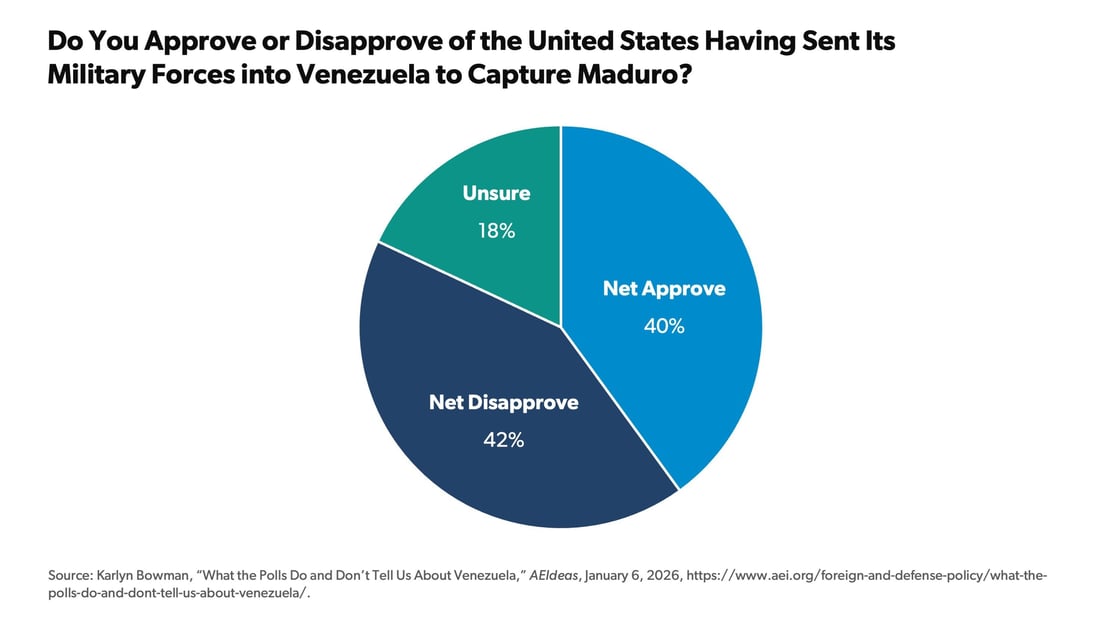
Topline: In initial polling, 40 percent of Americans support the Trump administration’s intervention in Venezuela, while 42 percent oppose the actions taken on January 3. AEI’s Karlyn Bowman analyzes how poll responses to this recent action compare with general trends of the past.
Partisan Polling: Partisan divides over executive action are particularly stark in the Trump era. Seventy-four percent of Republicans polled approved of the operation, while 76 percent of Democrats disapproved. For independents, 42 percent disapproved and 34 percent approved, but a large group remained unsure. Bowman identifies that, in the coming weeks, shifts among those who described themselves as “unsure” in the immediate wake of the intervention will be key drivers of public opinion on the action.
Congress and the Executive: Poll respondents generally prefer the president to act in accordance with Congress, and 63 percent of respondents believe the administration’s actions should have required congressional approval. While the military is historically popular, Congress as an institution has faced declining support from Americans in recent years. While polling about support for the military in the wake of the administration’s action has not yet been released, Bowman believes the military as an institution will maintain strong support from the American public.
"The early polls provide clues about the public’s reaction to the administration’s actions. More polls in the weeks to come will give us clearer answers.”
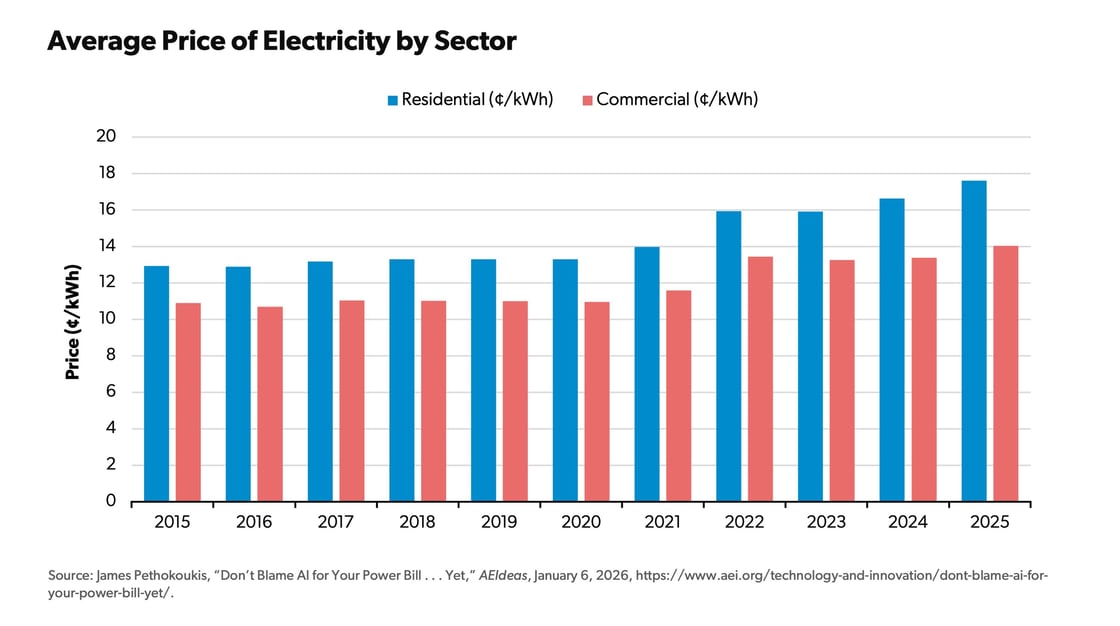
Topline: Residential electricity costs have increased from 12.93 cents per kilowatt-hour in 2015 to 17.62 cents per kilowatt-hour in 2025. Commercial electricity costs have increased along a similar trajectory. AEI’s James Pethokoukis writes that while AI data centers seem like an easy scapegoat for rising costs, the true culprit is the US power grid.
Energy Infrastructure: The costs of keeping the grid in working order and making it more resilient to storms and other disasters have risen sharply in recent years. Compounding this are rising prices of key components like transformers and wires, which are growing faster than inflation. The rising cost of retail electricity prices is often driven by higher spending on transmission and distribution, like investments to replace aging infrastructure.
The Future of AI Data Centers: Though AI data centers use a lot of electricity, they mostly accelerate the rising energy costs in specific regions. As of now, these centers push prices higher in locations where the grid is already stretched. Over the next decade, data centers could become a key national source for energy consumption.
"Modernizing electricity regulation—rather than singling out data centers—is the best way to keep power affordable and preserve America’s edge in AI.”