
Email
Los Angeles Mayor Karen Bass: Power, Fear, and Federal Overreach
| From | Jaime Harrison <[email protected]> |
| Subject | Los Angeles Mayor Karen Bass: Power, Fear, and Federal Overreach |
| Date | January 6, 2026 2:51 PM |
Links have been removed from this email. Learn more in the FAQ.
Links have been removed from this email. Learn more in the FAQ.
View this post on the web at [link removed]
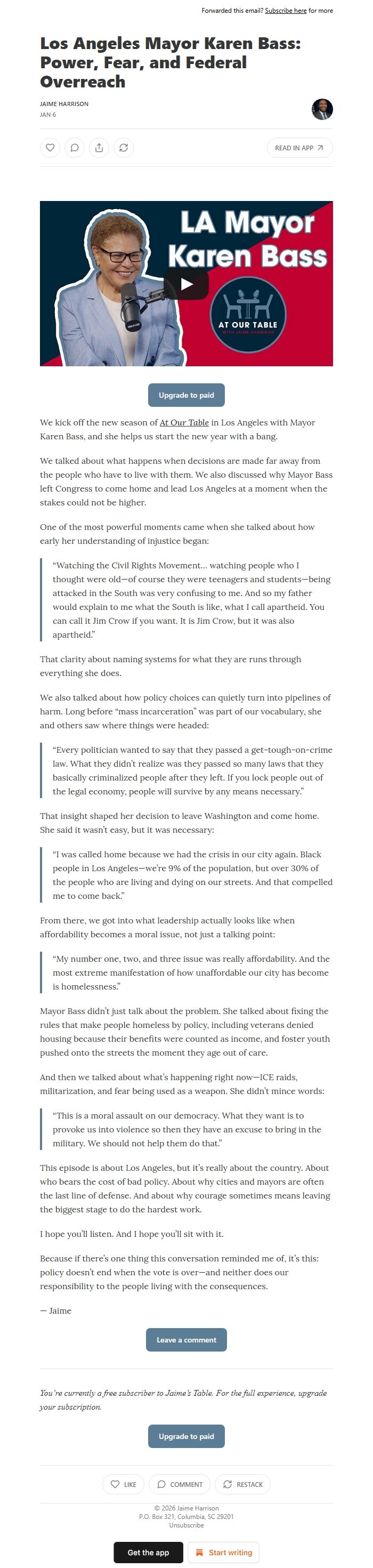
We kick off the new season of At Our Table [ [link removed] ] in Los Angeles with Mayor Karen Bass, and she helps us start the new year with a bang.
We talked about what happens when decisions are made far away from the people who have to live with them. We also discussed why Mayor Bass left Congress to come home and lead Los Angeles at a moment when the stakes could not be higher.
One of the most powerful moments came when she talked about how early her understanding of injustice began:
“Watching the Civil Rights Movement… watching people who I thought were old—of course they were teenagers and students—being attacked in the South was very confusing to me. And so my father would explain to me what the South is like, what I call apartheid. You can call it Jim Crow if you want. It is Jim Crow, but it was also apartheid.”
That clarity about naming systems for what they are runs through everything she does.
We also talked about how policy choices can quietly turn into pipelines of harm. Long before “mass incarceration” was part of our vocabulary, she and others saw where things were headed:
“Every politician wanted to say that they passed a get-tough-on-crime law. What they didn’t realize was they passed so many laws that they basically criminalized people after they left. If you lock people out of the legal economy, people will survive by any means necessary.”
That insight shaped her decision to leave Washington and come home. She said it wasn’t easy, but it was necessary:
“I was called home because we had the crisis in our city again. Black people in Los Angeles—we’re 9% of the population, but over 30% of the people who are living and dying on our streets. And that compelled me to come back.”
From there, we got into what leadership actually looks like when affordability becomes a moral issue, not just a talking point:
“My number one, two, and three issue was really affordability. And the most extreme manifestation of how unaffordable our city has become is homelessness.”
Mayor Bass didn’t just talk about the problem. She talked about fixing the rules that make people homeless by policy, including veterans denied housing because their benefits were counted as income, and foster youth pushed onto the streets the moment they age out of care.
And then we talked about what’s happening right now—ICE raids, militarization, and fear being used as a weapon. She didn’t mince words:
“This is a moral assault on our democracy. What they want is to provoke us into violence so then they have an excuse to bring in the military. We should not help them do that.”
This episode is about Los Angeles, but it’s really about the country. About who bears the cost of bad policy. About why cities and mayors are often the last line of defense. And about why courage sometimes means leaving the biggest stage to do the hardest work.
I hope you’ll listen. And I hope you’ll sit with it.
Because if there’s one thing this conversation reminded me of, it’s this: policy doesn’t end when the vote is over—and neither does our responsibility to the people living with the consequences.
— Jaime
Unsubscribe [link removed]?
We kick off the new season of At Our Table [ [link removed] ] in Los Angeles with Mayor Karen Bass, and she helps us start the new year with a bang.
We talked about what happens when decisions are made far away from the people who have to live with them. We also discussed why Mayor Bass left Congress to come home and lead Los Angeles at a moment when the stakes could not be higher.
One of the most powerful moments came when she talked about how early her understanding of injustice began:
“Watching the Civil Rights Movement… watching people who I thought were old—of course they were teenagers and students—being attacked in the South was very confusing to me. And so my father would explain to me what the South is like, what I call apartheid. You can call it Jim Crow if you want. It is Jim Crow, but it was also apartheid.”
That clarity about naming systems for what they are runs through everything she does.
We also talked about how policy choices can quietly turn into pipelines of harm. Long before “mass incarceration” was part of our vocabulary, she and others saw where things were headed:
“Every politician wanted to say that they passed a get-tough-on-crime law. What they didn’t realize was they passed so many laws that they basically criminalized people after they left. If you lock people out of the legal economy, people will survive by any means necessary.”
That insight shaped her decision to leave Washington and come home. She said it wasn’t easy, but it was necessary:
“I was called home because we had the crisis in our city again. Black people in Los Angeles—we’re 9% of the population, but over 30% of the people who are living and dying on our streets. And that compelled me to come back.”
From there, we got into what leadership actually looks like when affordability becomes a moral issue, not just a talking point:
“My number one, two, and three issue was really affordability. And the most extreme manifestation of how unaffordable our city has become is homelessness.”
Mayor Bass didn’t just talk about the problem. She talked about fixing the rules that make people homeless by policy, including veterans denied housing because their benefits were counted as income, and foster youth pushed onto the streets the moment they age out of care.
And then we talked about what’s happening right now—ICE raids, militarization, and fear being used as a weapon. She didn’t mince words:
“This is a moral assault on our democracy. What they want is to provoke us into violence so then they have an excuse to bring in the military. We should not help them do that.”
This episode is about Los Angeles, but it’s really about the country. About who bears the cost of bad policy. About why cities and mayors are often the last line of defense. And about why courage sometimes means leaving the biggest stage to do the hardest work.
I hope you’ll listen. And I hope you’ll sit with it.
Because if there’s one thing this conversation reminded me of, it’s this: policy doesn’t end when the vote is over—and neither does our responsibility to the people living with the consequences.
— Jaime
Unsubscribe [link removed]?
Message Analysis
- Sender: n/a
- Political Party: n/a
- Country: n/a
- State/Locality: n/a
- Office: n/a