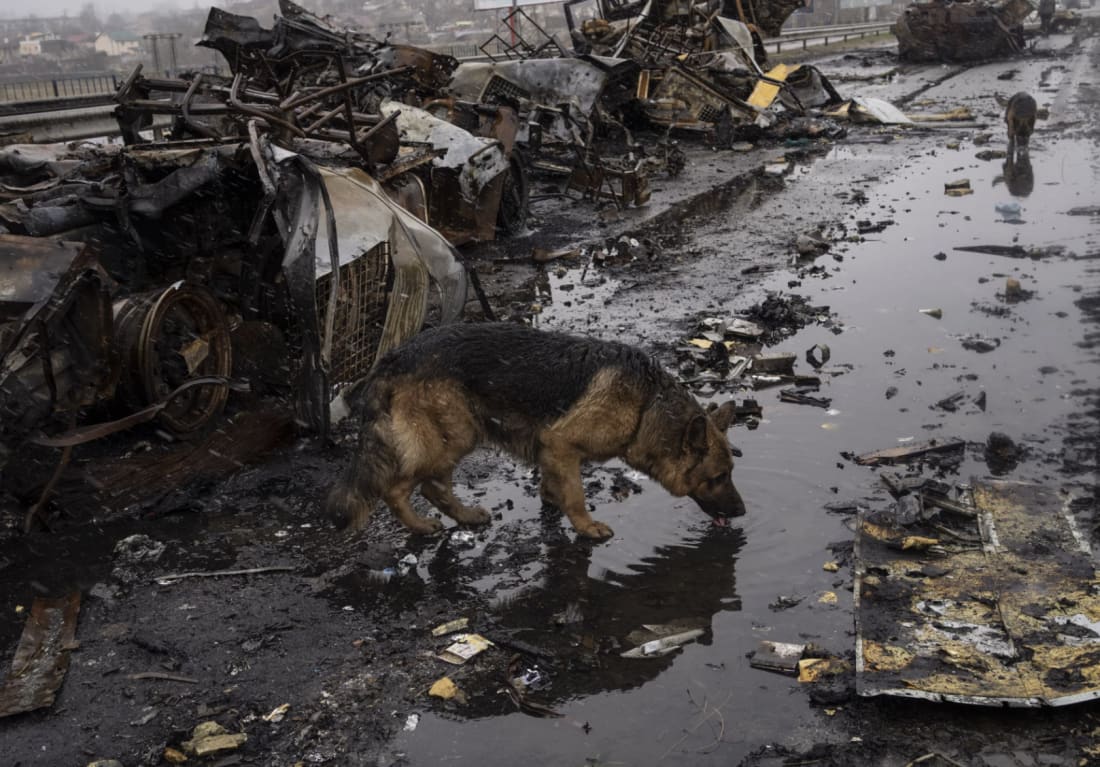
Abandoned dogs search for food in war-ravaged Ukraine.
The United States announced today that it has attacked Venezuela and captured its leader, Nicholas Maduro, and his wife. The apparent reason for the abduction borders on the absurd, including firearms charges based on a 1934 law. (When did a foreign leader having possession of guns become a basis for abduction, much less war?) But the general theme of Trump’s allegations is that Maduro was a “narco-terrorist.” There has been no evidence presented of this charge which, even if true, would not justify military intervention. Setting aside violations of international law, US intervention to replace “criminal” leaders of foreign states has a 0% success rate (Haiti, Afghanistan, Iraq, Libya) over the last 30 years.
But in this blog, I want to briefly address a different issue: the impact of war on animals. War has devastating consequences on the most vulnerable in society. And by far the most vulnerable beings on Earth are animals. Yet the story of war’s horrifying consequences on animals is mostly untold.
The Simple Heart is a reader-supported publication. To receive new posts and support my work, consider becoming a free or paid subscriber.
Let’s start with those animals closest to us: companion animals such as dogs and cats. Wherever war occurs, populations are forced to flee. The most vulnerable are often left behind. This includes companion animals, who are often trapped in buildings with no access to food and water. In the recent Ukraine war, this likely happened to hundreds of thousands. While there have been no credible accounts of famine among human refugees, there are numerous instances of dogs left to starve to death, including at a shelter where 300 dogs were left in cages without food and water for a month.
Things are even worse for farm animals. The war in Gaza has been catastrophic to the human population. Roughly 3.5% of the human population has died. But things are far worse for farm animals. Half the population of farm animals in Gaza has been killed by direct hits on their facilities, or by the destruction of infrastructure that left them to starve. The populations of cattle and poultry have been essentially exterminated. There can be no dispute as to the genocide committed against animals.
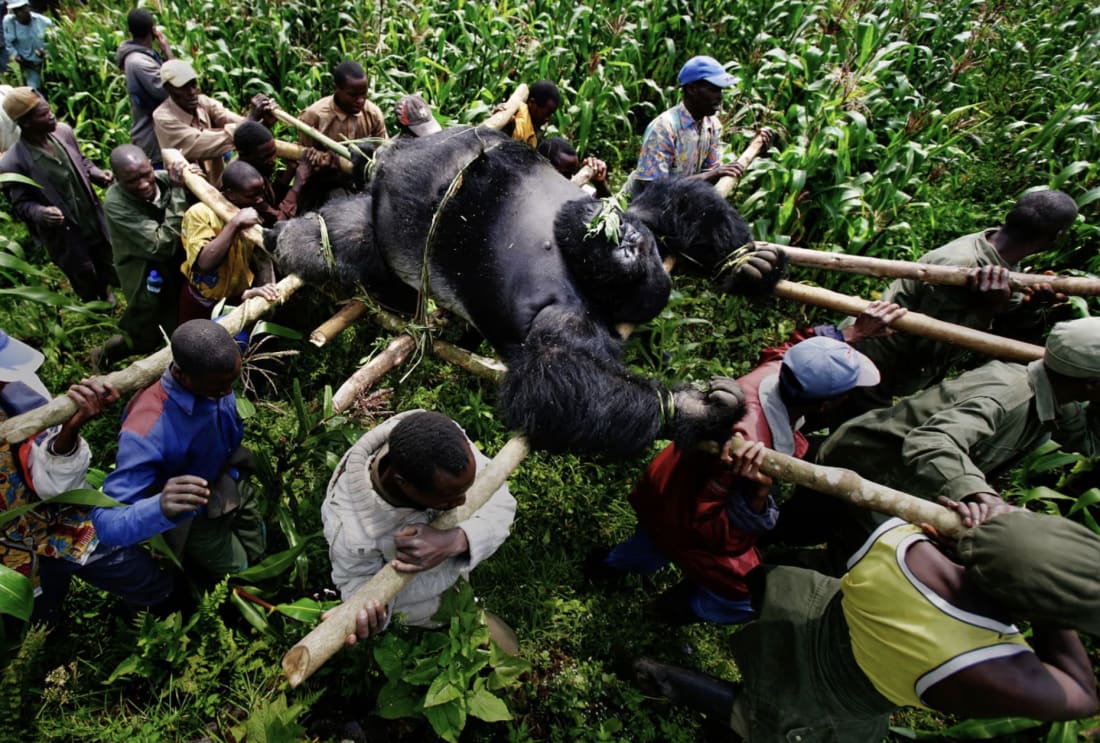
And then there is perhaps the most hidden victim: the wild animals. We are experiencing the Sixth Mass Extinction, with hundreds of thousands of species disappearing forever and trillions of individual animals facing suffering and death. And one of the primary drivers of this is war. Where humans are in conflict, they deplete and destroy ecosystems on a scale unprecedented in the planet’s history. One study in Nature found that human conflicts are “the single most important predictor of wildlife population trends.” And while precise estimates of wild animal populations are hard to come by, one national park measured population declines of 95% during a period of human conflict.
Rangers carry out a gorilla killed during conflict in the Congo.
We don’t yet know what will unfold in Venezuela. We do know, however, that the nation is home to some of the most marvelous — and endangered — animals on earth, including the Amazon river dolphin. If war breaks out, it’s likely that human populations desperate to survive will decimate the river dolphin and countless other animals. There are many reasons to be against war. But, statistically, the most important one is its devastating impact on animals.
The Simple Heart is a reader-supported publication. To receive new posts and support my work, consider becoming a free or paid subscriber.