|



On January 3, 1521, Martin Luther was excommunicated by Pope Leo X. On a personal level, Luther’s confrontation with ecclesial authorities was the result of a conflict that had been brewing in the Augustinian’s soul since his tortured days as a young monk, struggling to trust the assurance of pardon offered by his confessor. Since his awakening to the good news of grace, Luther had become increasingly convinced that his personal anguish wasn’t an individual shortcoming but an institutional failure. The church that existed to minister God’s grace had stolen it from him.
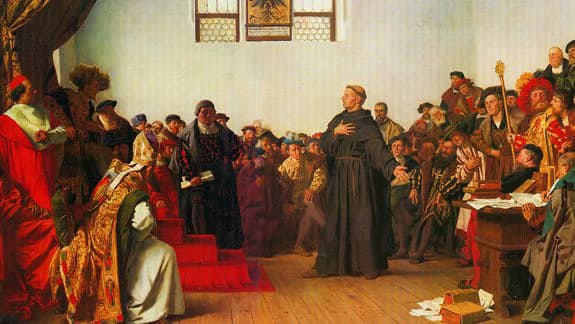
When Luther posted his 95 theses criticizing the abuses of the church in 1517, he turned his conviction into public theology. In a political context where church leadership and government were tightly interwoven, the young monk wasn’t simply defying his religious superiors. He was mounting a protest against the government, which prompted legal proceedings. Before a court at Worms, Luther was invited to renounce his public defiance before facing the judgement of ecclesiastical authorities. “Here I stand,” he famously replied, “I cannot do otherwise.” His excommunication by the pope meant that he was subject to execution.
 |
But Luther did not become a martyr. Instead, his public act of conscience sparked a movement that would remake the church and politics.
The finer theological points of Luther’s protest feel far removed from the anxieties of most people six centuries after the Protestant Reformation. Even the average Christian in 21st-century America would find it difficult to comprehend the passion with which Luther argued about the church’s teaching on Holy Communion in The Babylonian Captivity of the Church. But if we recall how much the church’s authority influenced government in Luther’s world, anyone who lived through 2025 in the United States can see how his words might have been paraphrased as a speech at No Kings protest:
Since the [President] has ceased to be a [President] and has become a tyrant, I fear none of his decrees; for I know that it is not within his power… to make new articles of faith.
605 years ago, Martin Luther learned what many Americans are learning again: the accumulation of money and power in the hands of a few who claim religious sanction for their actions is dangerous. A kleptocracy that sells indulgences will steal your very soul, Luther knew from painful experience. Through our own collective anguish, Americans have learned that a government in the hands of politicians who belong the highest bidder will sell out our health insurance for billionaires, our public lands for corporations, our personal data for the favor of technological feudalists, and our children for the promise of artificial intelligence. In such a world it is not only possible but increasingly probable that we wake to news that our military has been used to overthrow another country’s government to serve interests that lobby the government at private clubs. The public trust of generations is dictated by Mar-a-Lago’s mafia.
Amidst such brutal realities, we remember the witness of Martin Luther’s protest as an act of public theology with repercussions far beyond what he could have imagined in 1521. Martin Luther’s stand inspired the political tradition that would embolden imperfect men in the American colonies to risk their own property, liberty, and lives to defy a tyrant and declare independence – a tradition whose 250th anniversary Americans mark this year.
After a century and a half of America’s experiment with a new form of government, Luther’s stand continued to inspire the victims of Jim Crow apartheid who knew that both their faith and American democracy promised something better than their reality. White supremacy sanctioned by slaveholder religion robbed generations of Americans of their liberty. But when Baptist parents in Atlanta, Georgia, named their son “Martin Luther” in 1929, they were laying claim to a tradition of public theology that insisted they need not – indeed, they must not – accept the world as it was. The Ebeneezer Baptist Church prayed and worked for Martin Luther King, Jr. to live into his name.
We embrace the legacy of Martin Luther whenever we insist that political tyranny is personal because it pretends it can take what belongs by right to every human being in order to enrich the powerful and their friends. The grace of God is not for sale, just as our common goods, our public lands, our personal data, and our children’s well-being are sacred trusts. The Epstein class without conscience and Mar-a-Lago’s mafia without mores have become as offensive to Americans in 2026 as the corrupt church leaders were to everyday people in 1521. To stand up to them may mean incurring their wrath, but it also means tapping the power of the people that has propelled moral protest movements for six centuries.
We pray that more and more of us can live into that tradition in 2026.
You’re currently a free subscriber to Our Moral Moment, which is and always will be a free publication. Paid subscribers support this publication and the moral movement. All proceeds from Our Moral Moment are donated to organizations that are building a moral fusion movement for a Third Reconstruction of America.
| ||||||||||

