
Email
Op-Ed: Connecticut Republicans and the Nancy Kerrigan Problem
| From | Jonathan Goldstein and Dr. Michael Goldstein from The Goldstein Substack <[email protected]> |
| Subject | Op-Ed: Connecticut Republicans and the Nancy Kerrigan Problem |
| Date | January 3, 2026 3:23 PM |
Links have been removed from this email. Learn more in the FAQ.
Links have been removed from this email. Learn more in the FAQ.
View this post on the web at [link removed]
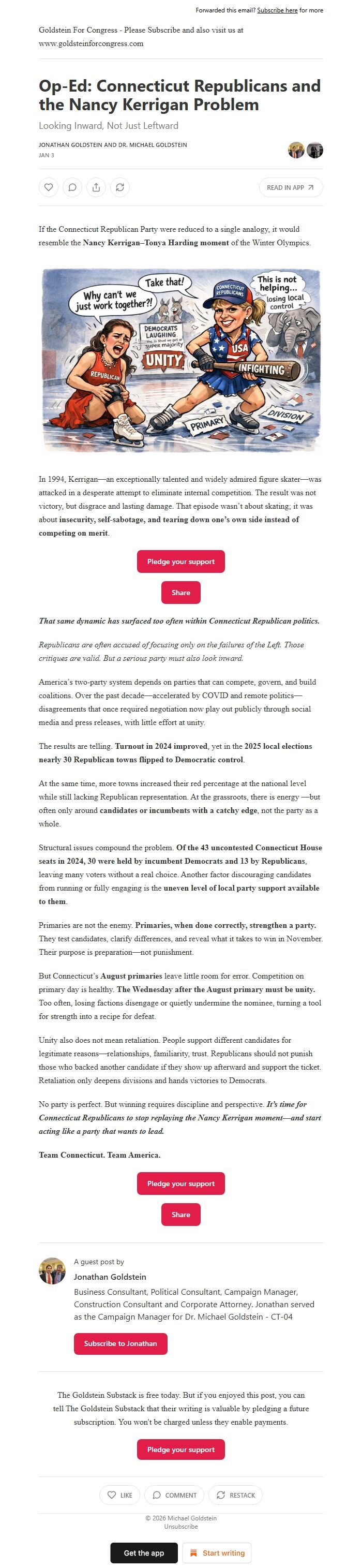
If the Connecticut Republican Party were reduced to a single analogy, it would resemble the Nancy Kerrigan–Tonya Harding moment of the Winter Olympics.
In 1994, Kerrigan—an exceptionally talented and widely admired figure skater—was attacked in a desperate attempt to eliminate internal competition. The result was not victory, but disgrace and lasting damage. That episode wasn’t about skating; it was about insecurity, self-sabotage, and tearing down one’s own side instead of competing on merit.
That same dynamic has surfaced too often within Connecticut Republican politics.
Republicans are often accused of focusing only on the failures of the Left. Those critiques are valid. But a serious party must also look inward.
America’s two-party system depends on parties that can compete, govern, and build coalitions. Over the past decade—accelerated by COVID and remote politics—disagreements that once required negotiation now play out publicly through social media and press releases, with little effort at unity.
The results are telling. Turnout in 2024 improved, yet in the 2025 local elections nearly 30 Republican towns flipped to Democratic control.
At the same time, more towns increased their red percentage at the national level while still lacking Republican representation. At the grassroots, there is energy —but often only around candidates or incumbents with a catchy edge, not the party as a whole.
Structural issues compound the problem. Of the 43 uncontested Connecticut House seats in 2024, 30 were held by incumbent Democrats and 13 by Republicans, leaving many voters without a real choice. Another factor discouraging candidates from running or fully engaging is the uneven level of local party support available to them.
Primaries are not the enemy. Primaries, when done correctly, strengthen a party. They test candidates, clarify differences, and reveal what it takes to win in November. Their purpose is preparation—not punishment.
But Connecticut’s August primaries leave little room for error. Competition on primary day is healthy. The Wednesday after the August primary must be unity. Too often, losing factions disengage or quietly undermine the nominee, turning a tool for strength into a recipe for defeat.
Unity also does not mean retaliation. People support different candidates for legitimate reasons—relationships, familiarity, trust. Republicans should not punish those who backed another candidate if they show up afterward and support the ticket. Retaliation only deepens divisions and hands victories to Democrats.
No party is perfect. But winning requires discipline and perspective. It’s time for Connecticut Republicans to stop replaying the Nancy Kerrigan moment—and start acting like a party that wants to lead.
Team Connecticut. Team America.
Unsubscribe [link removed]?
If the Connecticut Republican Party were reduced to a single analogy, it would resemble the Nancy Kerrigan–Tonya Harding moment of the Winter Olympics.
In 1994, Kerrigan—an exceptionally talented and widely admired figure skater—was attacked in a desperate attempt to eliminate internal competition. The result was not victory, but disgrace and lasting damage. That episode wasn’t about skating; it was about insecurity, self-sabotage, and tearing down one’s own side instead of competing on merit.
That same dynamic has surfaced too often within Connecticut Republican politics.
Republicans are often accused of focusing only on the failures of the Left. Those critiques are valid. But a serious party must also look inward.
America’s two-party system depends on parties that can compete, govern, and build coalitions. Over the past decade—accelerated by COVID and remote politics—disagreements that once required negotiation now play out publicly through social media and press releases, with little effort at unity.
The results are telling. Turnout in 2024 improved, yet in the 2025 local elections nearly 30 Republican towns flipped to Democratic control.
At the same time, more towns increased their red percentage at the national level while still lacking Republican representation. At the grassroots, there is energy —but often only around candidates or incumbents with a catchy edge, not the party as a whole.
Structural issues compound the problem. Of the 43 uncontested Connecticut House seats in 2024, 30 were held by incumbent Democrats and 13 by Republicans, leaving many voters without a real choice. Another factor discouraging candidates from running or fully engaging is the uneven level of local party support available to them.
Primaries are not the enemy. Primaries, when done correctly, strengthen a party. They test candidates, clarify differences, and reveal what it takes to win in November. Their purpose is preparation—not punishment.
But Connecticut’s August primaries leave little room for error. Competition on primary day is healthy. The Wednesday after the August primary must be unity. Too often, losing factions disengage or quietly undermine the nominee, turning a tool for strength into a recipe for defeat.
Unity also does not mean retaliation. People support different candidates for legitimate reasons—relationships, familiarity, trust. Republicans should not punish those who backed another candidate if they show up afterward and support the ticket. Retaliation only deepens divisions and hands victories to Democrats.
No party is perfect. But winning requires discipline and perspective. It’s time for Connecticut Republicans to stop replaying the Nancy Kerrigan moment—and start acting like a party that wants to lead.
Team Connecticut. Team America.
Unsubscribe [link removed]?
Message Analysis
- Sender: n/a
- Political Party: n/a
- Country: n/a
- State/Locality: n/a
- Office: n/a